
 Worksheets
Bimonthly Test
Total questions: 35
Worksheet time: 35mins
A gas X dissociates on heating to set up the equilibrium below.
X = Y +Z
A quantity of X was heated at constant pressure p at a certain temperature . The equilibrium partial pressure of X was found to be 1/7 p . What is the equilibrium constant Kp at this temperature?
6/7 p
9/7 p
36/7p
6p
In the mixture of NO and CO2 (initially containing 4 mol of NO and 0.9 mol of CO2) reaction occurs according to the equation below.
NO+ CO2 = NO2 + CO
At equilibrium 0.1 mol of CO2 was present . What is the equilibrium constant, Kc at the temperature of this experiment?
0.2
0.5
1.6
2.0
Which one of the following affects the value of the solubility product Ksp of silver sulphide when it is precipitated by passing hydrogen sulphide into aqueous silver nitrate?
An increase in the temperature
The addition of aqueous sodium sulphate
The addition of aqueous silver nitrate
The presence of an excess of acid
An acidified solution containing 0.1 M of zinc sulphate and 0.1 M of copper (II) sulphate is saturated with hydrogen sulphide at 15 0C . The concentration of S-2 in the solution is then 10 -35 M.
The solubility product of zinc sulphide at 15 0C is 10 -24 M2 and then copper (II) sulphide is
10 -40 M2 .
Which statement describes what happens in the solution?
No precipitate is formed
Copper (II) sulphide only is precipitated
Copper (II) sulphide is precipitated followed by Zinc sulphide
Zinc sulphide is precipitated followed by copper (II) sulphide
If the equilibrium is established by initially adding 0.10 mol each of A and B to a 1L container, then which of the following must be true once the mixture achieves equilibrium?
A + 2B = 2C K = 320
[A] = [B]
[A] = [B] = [C]
[B] = 2[C]
[A] > [B]

A reaction X + 2Y → 3Z is started with 1.0 M Z and no X or Y. To calculate the equilibrium concentrations of all species using an ICE table, which of the following would you enter in the Z column for the C row?
1.0 M
1.0 M + 3x
–3x
+3x
The addition of HCl does not suppress the dissociation of:
Acetic acid
benzoic acid
Hydrogen Sulphide
Sulphuric acid
In which of the following the solubility of AgCl is minimum?
0.1M NaNO3
Water
0.1 M NaCl
0.1 M NaBr
If 200 mL of 1x10⁻⁷ M AgNO3 is mixed with 200 mL of 1x10⁻⁸ M NaI, what will occur? For AgI, Ksp = 8.3 x 10⁻¹⁷ .
No precipitate will form.
Silver(I) nitrate will precipitate
Silver(I) iodide will precipitate.
Sodium nitrate will precipitate
What is the specific heat capacity of a substance if 2.41x10⁴ J are needed to change the temperature of 105.0 g of it from 25.0ºC to 250.0ºC?
1.02 x 10⁻⁴ J/gºC
9.18 x 10⁻⁴ J/gºC
0.918 J/gºC
1.02 J/gºC
Given the following two reactions:
C(s) + O2(g) → CO2(g) ∆H = -393.5 kJ
2Fe(s) + 3/2 O2 (g) → Fe2O3(s) ∆H = -824.2 kJ
Calculate the enthalpy change for 2Fe2O3(s) + 3C(s) → 4Fe(s) + 3CO2(g)
-467.9 kJ
-430.7 kJ
430.7 kJ
467.9 kJ
Calculate the ∆H for the following reaction using the bond energies given below:
H-H (g) + I-I (g) → 2H-I (g)
Bond energies: H-H = 436 kJ/mol, I-I = 151 kJ/mol, H-I = 297 kJ/mol
+290 kJ
-290 kJ
+7 kJ
-7 kJ

Calculate the enthalpy change represented by X
+695kJ/mol
-695kJ/mol
-635kJ/mol
-635kJ/mol

The picture shows two completely identical mason jars. They're both filled with the same gas, only one of them has more in it (more molecules). What can you say about the pressures of both jars?
P1 > P2 (greater pressure in jar 1)
P1< P2 (greater pressure in jar 2)
P1 = P2 (same pressure in both)
There's not enough info to tell
A measure of the amount of disorder or randomness in a system.
Entropy
Exothermic
First Law of Thermodynamics
Heat engine
A compound X contains 50% Sulphur and 50% Oxygen by mass.
What is the empirical formula of compound X?
SO
SO2
SO3
SO4

Vitamin C has the following structural formula
What is the empirical formula of vitamin C?
C6H8O6
C5H8O5
C3H4O3
C4H5O4
Which of the following statements about the mole are correct?
I. 12g of carbon contains one mole of atoms
II. 28g of nitrogen gas contains one mole of molecules
III. 1 dm3 of 1.0 mole/dm3 solution of sodium chloride contains one mole of chloride ions.
I,II and III are correct
I and II only are correct
II and III only are correct
I only is correct
When sugar is fermented using yeast, the reaction below takes place.
C12H22O11 + H2O → 4C2H5OH + 4CO2
What volume of carbon dioxide at R.T.P would be produced by the complete fermentation of 1000g of sugar?
(Molar mass of sugar is 342)
342 X 4 X 24 / 1000 dm3
342 X 24 / 1000 x 4 dm3
1000 X 4 X 24 / 342 x 24 dm3
1000 X 24 / 342 x 24 dm3
Which of the following statements concerning a solution labelled 0.1 mol/dm3 barium chloride, BaCl2, are true?
I. It contains 0.1mol of barium ions in 1dm3.
II. It contains 0.1mol of chloride ions in 500cm3.
III. It contains 0.3mol of ions in 1dm3.
I,II and III are correct
I and II only are correct
II and III only are correct
I only is correct
Silicon carbide, an abrasive, is made by the reaction of silicon dioxide with graphite.
SiO2 +3C→ SiC + 2CO
If 100 g of SiO2 and 100 g of C are reacted as far as possible, which one of the following
statements will be correct?
111 g of SiO2 will be left over.
44 g of SiO2 will be left over.
82 g of C will be left over.
40 g of C will be left over.
When 250. mL of a 0.15 M solution of ammonium sulfide (NH4)2S is poured into 120. mL of a 0.053 M solution of cadmium sulfate CdSO4, how many grams of a yellow precipitate of cadmium sulfide CdS are formed? The other product is (NH4)2SO4. (Hint: Write the balanced chemical reaction equation).
5.4 g
0.92 g
2.6 g
1.9 g
The relative atomic mass of boron, which consists of isotopes 105B and 115B is 108.8. What is the percentage of 115B atoms in the isotropic mixture?
0.8%
8.0%
20%
80%
In an attempt to establish the formula of an oxide of nitrogen, a known volume of the pure gas was mixed with hydrogen and passed over a catalyst at a suitable temperature. 100% conversion of the oxide to ammonia and water was shown to have taken place.
NxOy + H2 → xNH3 + yH2O
2400 cm3 of the oxide of nitrogen, measured at room temperature and pressure ( R.T.P), produced 7.20g of water. The ammonia produced was neutralized by 200cm3 of 1.0 mol/dm3 HCl.
[Molar volume of gas at R.T.P = 24000cm3 mol-1]
What is the molecular formula of the oxide of nitrogen? (correct answer)
NO2
N2O
N2O4
N2O5

Crystal system characterized by a ≠ b≠ c and α = β = γ = 90o
Hexagonal
Ortho rhombic
Tetragonal
Triclinic
Hydrogen Bonds typically occur between atoms of hydrogen involved in this type of bond:
Ionic
Nonpolar Covalent
Polar Covalent
Nonpolar AND Polar Covalent
What is the name for a substance that dissolves in water but does not form ions or conduct an electric current?
electrolyte
nonelectrolyte
saturated
insoluble
The optical properties of liquid crystals depend on the direction of ___________
Air
Solid
Light
Water
The correct way of making a solution of acid in water is to
add water to acid
add acid to water
mix acid and water simultaneously
add water to acid in a shallow container
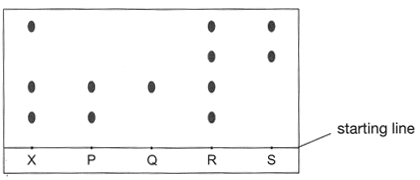
A student extracts the colour from some green smarties and uses paper chromatography to separate components colours. She finds blue has a Rf =0.38 and yellow Rf =0.75 this suggests
the yellow is more strongly adsorbed onto the stationary phase and is less solublein the mobile phase.
the yellow is more strongly adsorbed onto the stationary phase and is more soluble in the mobile phase.
the blue is more strongly adsorbed onto the stationary phase and is less solublein the mobile phase.
the blue is more strongly adsorbed onto the stationary phase and is less solublein the mobile phase.

