
 Worksheets
Y10 LC2 Physics Assessment 2020
Total questions: 60
Worksheet time: 15hrs 0mins

What type of energy decreased when you hit the brakes?
A 2 Kg mass is pushed along a horizontal, friction-less surface by a 3 N force that is parallel to the surface. How much gravitational potential energy would be gained by the mass if it is moved 2 meters horizontally?
0 J
6 J
40 J
4 J
Latent heat is
the heat absorbed or released at a boiling process during a change of phase
the heat absorbed or released at a constant temperature during a change of phase
the heat absorbed or released at a constant temperature during a change of phase of 1 kg object
the heat absorbed or released by an object to increase or decrease its temperature by 1 degree Celcius

The graph shows the cooling curve of a substance. At which stages the specific latent heat released?
AB and CD
BC and DE
AB and EF
BC and CD
How much heat energy is needed to raise the temperature of 2kg of water from 5 °C to 100 °C? The specific heat capacity of water is 4200 J/kg °C.
42000 J
840000 J
798000 J
199500 J

The cell in this circuit provides a voltage of 1.5 V. What is the current running through the circuit?
0.16 A
3 A
6 A
13.5 A
A phone charger has a power rating of 15 W and there is a resistance in the circuit of 4Ω. What is the current flowing through the charger?
1.9 A
3.8 A
14.0 A
60.0 A


Which of the following are not contact forces? Pick two.
Tension
Air resistance
Weight
Electrostatic
Ms Ashley goes on a rollercoaster and when it goes round a loop she feels a gravitational force 2 times the normal gravitational field strength. What would her weight be at this moment? Ms Ashley's mass is 70kg and normal gravitational field strength is 9.8 N/kg.
70 kg
140 N
686 N
1372 N
On which celestial body would you have the most mass?
Earth
Jupiter
Sun
Your mass isn't affected by where you are in the universe.

Santa has 4 reindeer pulling his sleigh. Each reindeer provides a forwards force of 150N. The resultant force on the sleigh is 500 N forwards. What is the value of the drag force acting on the sleigh?
350 N
100 N
50 N
There's no drag, he's flying through the air.
When Father Christmas goes down the chimney into Mr Wilson's house there is a downwards force due to his weight and an upwards force of 270N due to the friction with the chimney. Father Christmas has a mass of 130kg. Gravitational field strength is 9.8 N/kg. What is the size and direction of the resultant force on him?
1004 N downwards
1004 N upwards
140 N downwards
140 N upwards
What does it mean for an object to be in equilibrium? Select ALL correct answers.
It has no net force acting on it.
The forces acting on the object all cancel out.
The forces acting on an object balance out.
The sum of all the forces acting on an object is 0.
The object is ONLY at rest.
When an object is ....
A car's brakes do 300 kJ of work to make it stop. The car stopped in a distance of 25 m. Calculate the force that was needed to stop the car.
12000 N
12 N
7500 N
300 kN
A bus is moving and has 500 000 J of kinetic energy. The brakes are applied and the bus stops. How much work is needed to make the bus stop?
250 000 J
500 000 J
1 000 000 J
It's impossible to know.
A present with a mass of 0.5kg was lifted 2.3m high. Gravitational field strength = 9.8 N/kg. What was the work done in lifting the present 2.3m?
4.9 J
11.3 J
22.5 J
45.1 J
The elves are busy wrapping presents. When the presents are wrapped they must be lifted onto a conveyor belt. Each present has a mass of 0.7kg and they must be moved 40cm to the conveyor belt. If an elf wraps 50 presents, what is the total work done? Gravitational field strength is 9.8N/kg.
137 J
1400 J
13720 J
9 J
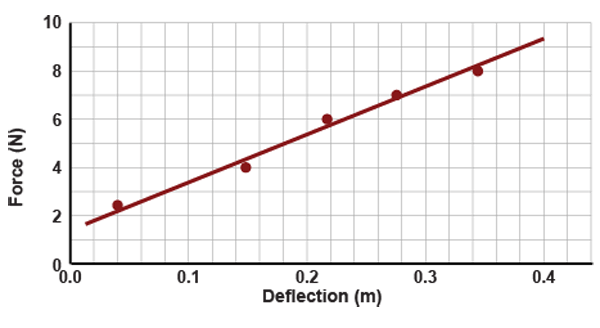

It is directly proportional
It shows the mass of the spring
The Limit of Proportionality is:
The point beyond which an object (eg. spring) will be permanently deformed.
When elastic deformation stops.
When inelastic deformation begins.
When elastic deformation begins

The spring has an unextended length of 2.5cm. When a weight of mass, m is added it extends by a length of 0.8 cm. When a mass of 3m is added, what is the spring's total length?
4.9 m
3.3 cm
4.1 cm
4.9 cm
When you do an experiment you should always repeat and calculate an average. Why is this?
To reduce the random error.
To remove any statistical errors.
To check your answer.
To make it a fair test.
A vector is a quantity that has:
Just magnitude
Magnitude and distance
Magnitude and direction
Magnitude and displacement
Which of the following statements is true? Pick one.
Velocity is a vector, which means it has a magnitude only
Velocity is a scalar, which means it has a magnitude only
Velocity is a vector, which means it has a magnitude and a direction
Velocity is a scalar, which means it has a magnitude and a direction
Jermaine runs exactly 2 laps around a 400 meter track. What is his displacement?
800
400
200
0
An elf chased after a rogue reindeer for 1hour and 20s at a speed of 3m/s. How far did she run?
10 860 m
12 960 m
240 m
4 m
Whilst practising for Christmas eve, Father Christmas travels the circumference of the Earth which is 40075 km in one night. He leaves the North pole at 9pm and gets back at 6am. Assuming he travels at a constant speed how fast must he have travelled?
1390 m/s
1240 m/s
742 m/s
1.236 m/s
Frosty the snowman moved 650 mm every 2s. How mast was he moving? Give your answer to 2 significant figures.
3300 m/s
320 m/s
32.5 m/s
0.33 m/s
Whilst out Christmas shopping, Ms Vernon travelled a distance of 12.3 km and she travelled at an average speed of 1.2 m/s. How long did it take Ms Vernon to do her Christmas shopping? Give your answer in minutes.
10250 s
171 min
10250 min
615 min
What is the average person's running speed?
1.5 m/s
3 m/s
4 m/s
6 m/s
Why does a car accelerate as it goes round a corner at a constant speed?
Its direction changes
It doesn't
It slows down
Its speeds up
Which of the following are true? Pick one.
Speed is a scalar so it is always the same number.
Velocity can change even when speed stays constant.
Velocity has different units to speed.
Acceleration requires a change in speed.


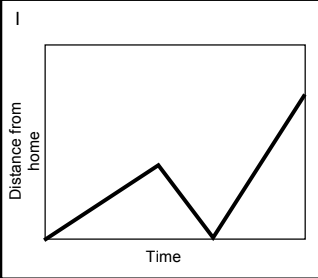
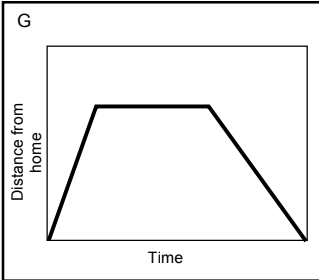
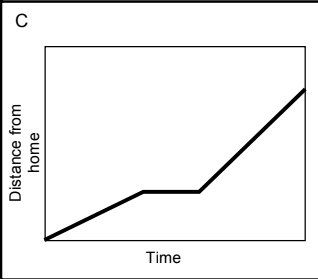
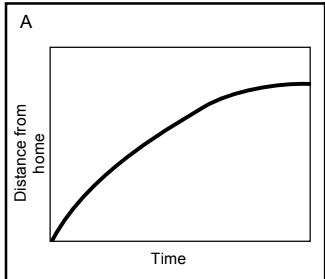

Which of the graphs shows that one of runners started 10 yards further ahead of the other?


Look at the distance time graph. Approximately how long was this person moving for?
70 s
60 s
35 s
25 s
Look at the distance time graph. How fast was this person travelling in section C?
1.14 m/s
0.83 m/s
0.3 m/s
0.5 m/s
The unit we use to measure acceleration is ___.
meters / second
meters
seconds
meters / second2
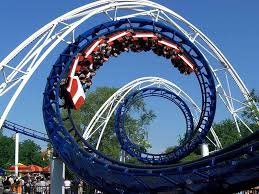
A roller coasters accelerates from an initial velocity of of 6.0 m/s to a final velocity of 70 m/s over 4 seconds. What's the acceleration?
24 m/s2
18 m/s2
16 m/s2
16 m/s

Santa falls down an elf hole with a constant acceleration due to gravity of 9.8m/s2. His initial velocity was 1.5 m/s and his final velocity before hitting the ground was 40 m/s. How far did he travel? Use the physics equation sheet.
82m
8m
81m
163m
A bauble falls off a Christmas tree. Just before it hits the ground it has reached a velocity of 7.2 m/s. How tall is the Christmas tree? Use the physics equation sheet.
2.6 m
0.4 m
10 m
3.4 m
Ms Kehoe accelerates her car from 5 m/s to 32 m/s. In this time she travelled a distance of 40m. What was her acceleration? Use the physics equation sheet.
12.5 m/s2
0.68 m/s2
0.34 m/s2
5.2 m/s2
Mr Wilson was jogging at a velocity of 2.8 m/s. He then began to accelerate at 2.5 m/s2. He travelled 50 m continuing at this acceleration. What was his final velocity? Use the physics equation sheet.
250 m/s
258 m/s
350 m/s
15 m/s

