wayground logo

Free Printable Worksheets

Font size

S
M
L
XL
Worksheets

Review units 1-5

Total questions: 115

Worksheet time: 4hrs 29mins

Name
Class
Date
1.
Who believed the government should protect a person's three natural rights: life, liberty, and property?
a)
Rousseau
b)
Beccaria
c)
Wollstonecraft
d)
Locke
2.
Who believed in a separation of powers as a way to provide checks and balances?
a)
Montesquieu
b)
Rousseau
c)
Hobbes
d)
Voltaire
3.
Which of these was greatly influenced by the Enlightenment?
a)
the Magna Carta
b)
the American Revolution
c)
the Scientific Revolution
d)
the divine right of kings
4.
If Baron de Montesquieu were to visit the United States today, he might be most pleased to see the
a)
our Declaration of Independents
b)
our Bill of Rights
c)
a government-run tax system
d)
the legislative, executive, and judiciary branches of our government
5.
The following ideas come from the Declaration of Independence and the U.S. Constitution’s Bill of Rights. Which most closely relates to the work of John Locke?
a)
innocent until proven guilty
b)
speedy and public trial
c)
life, liberty, and the pursuit of happiness
d)
freedom of speech and press
6.
This image is most closely related to which thinker?
a)
Montesquieu
b)
Locke
c)
Beccaria
d)
Hobbes
7.

Which of the documents was written first?

a)

Mayflower Compact

b)

English Bill of Rights

c)

Magna Carta

d)

Common Sense

8.

Which idea was written by John Locke?

a)

Social Contract

b)

Common Sense

c)

Magna Carta

d)

Mayflower Compact

9.

Which is the principle that there is an agreement between society and the government?

a)

Magna Carta

b)

Common Sense

c)

Mayflower Compact

d)

Social Contract

10.

Which document was written by Thomas Paine?

a)

Social Contract

b)

Common Sense

c)

Mayflower Compact

d)

Declaration of Independence

11.

Which one called the British king a tyrant and said he had abused his power?

a)

Mayflower Compact

b)

Common Sense

c)

English Bill of Rights

d)

The Enlightenment

12.

Who said it was absurd for an island to control a whole continent?

a)

John Locke

b)

King John

c)

Thomas Paine

d)

Thomas Jefferson

13.

Which one established self-government in the American colonies?

a)

Magna Carta

b)

English Bill of Rights

c)

Social Contract

d)

Mayflower Compact

14.

What was a movement in the 1700s that promoted freedom of thought and expression?

a)

Social Contract

b)

The Enlightenment

c)

Mayflower Compact

d)

Common Sense

15.

When this was published in early 1776, many American colonists became convinced that they should act to form a new kind of nation independent from the rule of Britain’s "cruel" courts.

a)

US Constitution

b)

Declaration of Independence

c)

Mayflower Compact

d)

Common Sense

16.

The Mayflower Compact was unique because it

a)

was the first example of colonial European self-government in northeastern North America.

b)

gave freedom to Black colonists

c)

provided a foundation for the Declaration of Independence

d)

allowed slavery

17.

Why was the Magna Carta important for the development of democracy?

a)

The Magna Carta limited the King's power and prevented absolutism from taking hold in England.

b)

Parliament became more powerful than the monarch.

c)

It guaranteed liberty to all.

d)

It outlawed slavery.

18.

In English history, the Magna Carta (1215) and the English Bill of Rights (1689) both reinforced the concept of

a)

universal suffrage (right to vote)

b)

religious freedom

c)

limited monarchy

d)

abolishing slavery

19.
Which statement describes an impact of the rule of law?
a)
state of nature
b)
checks and balances
c)
separation of powers
d)
transparency of institution
20.
Which characteristic serves as a long-term protection against tyranny and is a foundation of liberty in the United States?
a)
right to trial
b)
rule of law
c)
commerce clause
d)
elastic clause
21.

To refuse to buy items in order to show disapproval or force acceptance of one's terms.

a)

Boycott

b)

Repeal

c)

Petition

d)

Preamble

22.

To cancel an act or law.

a)

Boycott

b)

Repeal

c)

Petition

d)

Preamble

23.

Why did the British begin to tax the colonists?

a)

The British felt the colonists should pay more than those living in England

b)

The British did not like the colonists

c)

The British were greedy

d)

The British were in debt from supporting the colonists during the French and Indian War

24.

Why did the Stamp Act, and other taxes, upset the colonists?

a)

The colonists were too poor to pay taxes

b)

The colonists believed the British government should not tax them since they had no representation

c)

The colonists believed taxes by the British were illegal

d)

The colonists believed only the rich should pay taxes

25.

Which act made colonists give food & drinks to British soldiers and allowed them to live in their homes?

a)

Penny Act

b)

Quartering Act

c)

Food Act

d)

Tea Act

26.

What slogan did the colonists use as a protest?

a)

No taxation without representation

b)

No tea without the sea

c)

We make noise till you hear our voice

d)

No acts without the facts

27.

How did the colonists react to the Tea Act?

a)

They held a political party

b)

Dumping coffee into Boston Harbor

c)

Kicking British soldiers out of their homes

d)

Boston Tea Party

28.

Which pamphlet by Thomas Paine greatly influenced opinions of colonists about independence?

a)

Common Sense

b)

Declaration of Independence

c)

Common Time

d)

Federalist Papers

29.
Which branch of government existed when the Articles of Confederation was created?
a)
Legislative (congress)
b)
Judicial (Supreme court)
c)
Executive (President)
d)
Legislative, Executive, and Judicial
30.
Under the Articles of Confederation, which government had the MOST power?
a)
Legislative branch
b)
the president
c)
the state governments
d)
national government
31.
Which of the following is an example of a weakness in the Articles of Confederation?
a)
Congress couldn't collect taxes
b)
Weak national government
c)
Provided no common currency/money for all 13 states
d)
All of the  above
32.
Why was this first U.S. government so weak?
a)
King George III  was still in charge of USA
b)
Americans were afraid to give their new government too much power
c)
The American army did not win their independence from Great Britain and King George III
d)
ask; no
33.
The Articles of Confederation created a ________ national government.
a)
weak
b)
strong
c)
both strong and weak
d)
neither  strong nor  weak
34.
What is the name of the first written plan of government for the newly independent U.S.A.?
a)
Constitution
b)
Treaty of Paris
c)
Declaration of Independence
d)
Articles of Confederation
35.
Because of the Articles  of  Confederarion the government could NOT regulate(control) ______ among the states.
a)
food quality
b)
laws
c)
travel
d)
commerce (trade)
36.
What is one reason Americans wanted to change the Articles of Confederation?
a)
They opposed the Land Ordinance of 1785.
b)
They didn't want the government to have only 1 branch. 
c)
National government was weak, state government had too much power, states were not working together, and there was no leader.
d)
State government was weak and unsuccessful.
37.
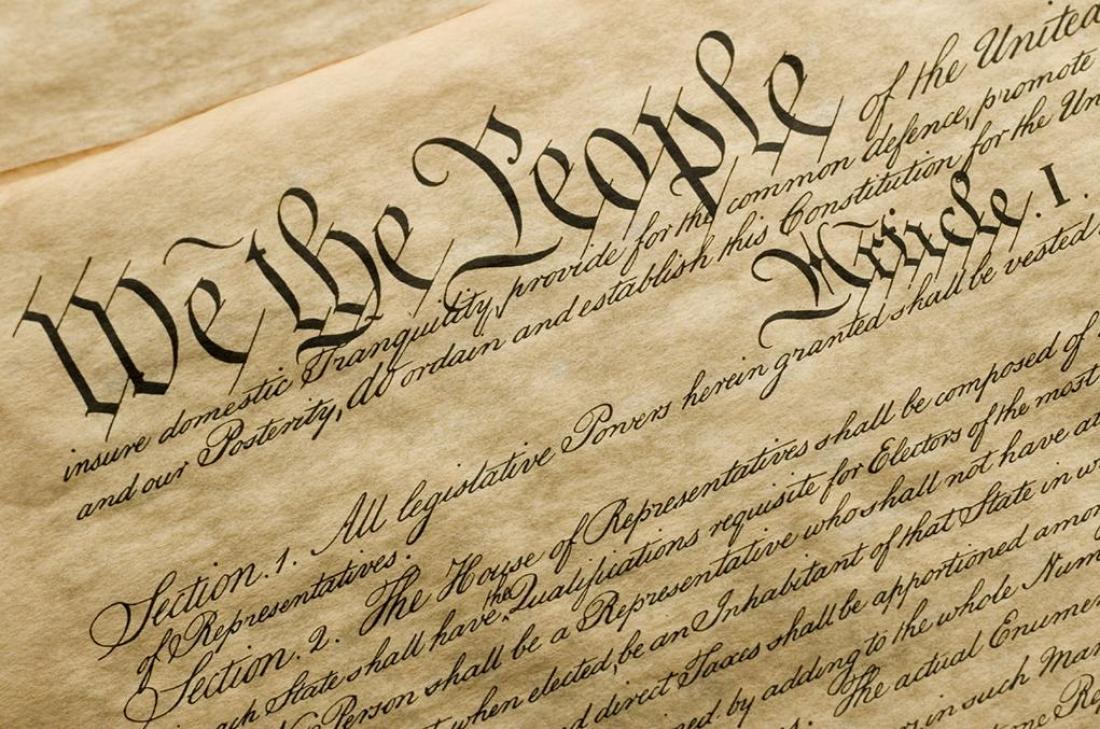
What Constitutional Principle says "We the People"?
a)
Popular Sovereignty
b)
Judicial Review
c)
Limited Government
d)
Separation of Powers
38.
What is federalism?
a)
The people vote for their leaders who then represent them. 
b)
The people have individual rights. 
c)
There are three branches of government. 
d)
The state and national government share power. 
39.
What is "checks and balances?"
a)
Each branch of power has the ability to limit the power of the other branches. 
b)
The people elect their leaders. 
c)
The people are in charge. 
d)
The people have rights. (Bill of Rights) 
40.
Which proves that the USA uses separation of powers?
a)
The people vote for their leaders. 
b)
The people are in charge. 
c)
There are three branches of government. 
d)
The people have individual rights. (bill of rights) 
41.
Name that principle.....
a)
Federalism
b)
Popular SOvereignty
c)
Rule of lAw
d)
Individual Rights
42.
Ability of each branch to oversee the activities of other branches-
a)
Federalism
b)
Separation of powers
c)
Jurisdiction
d)
Checks and balances
43.
Describes the directions for the Judicial Branch
a)
Article 1
b)
Article 2
c)
Article 3
44.
Describes the directions for the Legislative Branch
a)
Article 1
b)
Article 2
c)
Article 3
45.
Describes the directions for the Executive Branch
a)
Article 1
b)
Article 2
c)
Article 3
46.
Signature of those who agree to the Constitution and the date it took effect.
a)
Article 5
b)
Article 6
c)
Article 7
47.
Describes the Amendment Process to add/alter the Constitution
a)
Amendment 4
b)
Amendment 5
c)
Amendment 6
48.
Describes the powers of the states 
a)
Article 4
b)
Article 5
c)
Article 6
49.
The Federal Constitution is the Supreme Law of the land
a)
Article 4
b)
Article 5
c)
Article 6
50.
If government officials break the law, they can be arrested like anyone else.  This reflects:
a)
Federalism
b)
Republicanism
c)
Popular Sovereignty
d)
Limited Government
51.

How many "articles" make up the U.S. Constitution?

a)

3

b)

5

c)

7

d)

11

52.
What is the introduction to the Constitution called? 
a)
Articles of Confederation
b)
Declaration of Independence
c)
Bill of Rights
d)
Preamble
53.
According to the Preamble, where does the authority of the federal government come from? 
a)
Electoral College
b)
the states
c)
the people
d)
the President
54.
The Preamble lists the __________ of the United States Constitution. (p. 14)
a)
Grievances
b)
Unalienable Rights
c)
Purposes
d)
Weaknesses
55.
Which of the following phrases from the Preamble is best described by saying: "All citizens should have their basic needs of food, clothing, and shelter."
a)
perfect union
b)
common defense
c)
liberty
d)
general welfare
56.
What does the word tranquility mean?
a)
Calm
b)
Sleepy
c)
Crazy
d)
All of the above
57.
"For us and our future generations" would describe which part of the Preamble?
a)
We the People
b)
do ordain and establish
c)
to ourselves and our posterity
d)
in order to form a more perfect union
58.
1st Amendment
a)
Freedom of speech, religion, press petition and assembly
b)
No illegal searches and seizures
c)
The right to bear arms
d)
No quartering troops
59.

Which Amendments were passed as a result of the Civil War

a)

13-15

b)

1-10

c)

18-21

60.

The 13th Amendment ended which practice in the United States

a)

Slavery

b)

Women's Suffrage

c)

Poll Tax

d)

Government Tyranny

61.

Which Amendments are known as the Bill of Rights

a)

1-10

b)

13-15

c)

18-21

d)

11-19

62.

Which amendment guarantees citizenship to a person born in the United States?

a)

Amendment 13

b)

Amendment 19

c)

Amendment 14

d)

Amendment 1

63.

Which Amendment states voting cannot be discriminated against based on a person's race or background?

a)

Amendment 13

b)

Amendment 19

c)

Amendment 9

d)

Amendment 15

64.

Which Amendment granted women the right to vote?

a)

Amendment 19

b)

Amendment 1

c)

Amendment 9

d)

Amendment 21

65.

How many Amendments are there to the Constitution?

a)

26

b)

30

c)

27

d)

28

66.

The ___________ are for the ratification (approval) of the U.S Constitution.

a)

Federalists

b)

Anti-Federalists

c)

Whiggs

d)

Representatives

67.

The ___________ are NOT for the ratification (approval) of the U.S Constitution.

a)

Anti-Federalists.

b)

Federalists.

c)

Whiggs.

d)

Supreme Court Justices.

68.

Anti-Federalists were in favor of:

a)

States Rights and the protection of individual rights.

b)

A strong Central Government.

c)

A Monarchy (King & Queen) to rule over the country.

d)

a powerful National Government

69.

How did the Federalists and Anti-Federalists "compromise" to ratify (approve) the U.S Constitution?

a)

The added the Bill of Rights (First 10 Amendments)

b)

They outlawed cruel and unusual punishment.

c)

Ensured due process of the law.

d)

The Federalists threatened the Anti-Federalists to war.

70.
If what someone says directly leads to harm for someone else, it is inciting violence. This is a limit to:
a)
Freedom of Religion
b)
Freedom of Speech
c)
Freedom of the Press
71.
If a group becomes violent, or has a good chance of becoming violent is a limit to:
a)
Freedom of Petition
b)
Freedom of Assembly
c)
Right to bear arms
72.
Which of the following is a step in the naturalization process?
a)
applying for a driver's license
b)
getting a job
c)
registering to vote
d)
taking a citizenship test
73.
To become a citizen of the United States, an immigrant must have been a lawful, permanent resident for at least ________ years.
a)
1
b)
3
c)
7
d)
5
74.
Only people born in the U.S. are considered citizens.
a)
True
b)
False
75.
An important right and responsibility of all citizens is to
a)
obey traffic laws
b)
vote in elections
c)
pay taxes
d)
serve on a jury
76.
Which of these is an example of contributing to the common good?
a)
placing an ad in the newspaper to promote your business
b)
donating food to a homeless shelter
c)
spending a day working in your garden
d)
doing your homework
77.
Duties of citizens are ___________ but responsibilities are ____________.
a)
important/unimportant
b)
optional/required
c)
for males/for females
d)
required/optional
78.
Which practice is part of the obligation of a U.S. citizen to help defend the nation? 
a)
A. Serve on a jury
b)
B. Register for selective service
c)
C. Vote in all elections
d)
D. Keep informed about national issues 
79.
Which amendment defines citizenship?
a)
11th
b)
12th
c)
13th
d)
14th
80.
Which best describes a citizen?
a)
A person who lives in a country for more than 7 years.
b)
A person who lives in a country and is 18 years or older.
c)
A person who has completed an application to live in a country.
d)
A person who has specific rights and obligations within a country.
81.
How old must you be to go through the naturalization process?
a)
21
b)
18
c)
20
d)
any age
82.
The idea that your citizenship is based upon your parents no matter where you are born.
a)
Law of Blood
b)
Law of Soil
83.
It is the idea that citizenship is based upon where you are born. 
a)
Law of Blood
b)
Law of Soil
84.

Has conservative views

a)

D

b)

R

85.

Lower taxes and smaller government.

a)

D

b)

R

86.

Symbol is the donkey.

a)

D

b)

R

87.

Higher taxes and larger government.

a)

D

b)

R

88.

Where would you find a political party’s stance on issues?

a)

in their platform.

b)

in a televised debate.

c)

a campaign commercial.

d)

in the Constitution of the United States.

89.

Political parties serve an important role because they

a)

provide leadership in Congress

b)

select candidates.

c)

listen to citizen concerns

d)

all of the above

90.

Independent voters...

a)

Do not support a particular political party

b)

Vote for candidates of only one party

c)

Republicans

d)

Democrats

91.
A political party is a group of _______________________________________________.
a)
who share the similar beliefs about government.
b)
who share the similar beliefs about the president.
c)
who share the similar beliefs about congress.
d)
who share the similar beliefs about the judicial branch
92.
America has  a ___________ _______________ political system. 
a)
three party
b)
one party
c)
two party
d)
four party
93.

What is the media?

a)

Organization concerned with a particular issue. Gather people and resources to support public policies that help members.

b)

Political organization that promotes the cause of a particular interest group, usually through raising money

c)

the source of news and info about current events

94.
Which of the following is an example of the media exercising its "watchdog' role over government?
a)
A local radio talk show about uniforms in school
b)
A televised debate between presidential campaigns
c)
A newspaper story about the building if a new highway
d)
A local television news report about a city councilman taking bribes
95.
Who do lobbyists represent in their attempts to influence government?
a)
Military officers
b)
Elected officials
c)
Interest Groups
d)
Circuit Judges
96.

Who do lobbyists attempt to influence?

a)

interest groups

b)

the media

c)

lawmakers

d)

PACs

97.

What is a political action committee?

a)

a type of interest group that works to raise money for a

candidate who supports their issues

b)

a group that creates political ads for candidates

c)

a media group that acts as watchdog for opposing parties

98.

_________ are groups that form because of a common goal; they support a specific issue and work in large numbers to get their issue recognized by the government.

a)

Federalists

b)

political parties

c)

interest groups

d)

representatives

99.

Lobbying is when

a)

Interest groups work with elected legislators to get laws passed

b)

citizens petition the government

c)

candidates promote their platform

100.
Based on the government system in the U.S., which individual activity is used to directly influence legislative decisions?
a)
Watching political debates on TV
b)
Discussing political issues at work
c)
Collecting opinions for a yearbook
d)
Gathering signatures for a petition
101.

Propaganda is used to:

a)

inform

b)

entertain

c)

persuade

d)

worry

102.
To favor one side over another
a)
symbolism
b)
Bias
c)
Propaganda
d)
slogans
103.
the use of any of certain special figures or marks of identification to signify a message
a)
testimonials
b)
endorsements
c)
slogans
d)
symbolism
104.

The Legislative Branch is the _______________ branch of the federal government.

a)

Lawmaking

b)

Law enforcing

c)

Law ignoring

d)

Court

105.

A tax bill must start in which house?

a)

Senate

b)

House of Representatives

106.

Who is the President of the Senate?

a)

Majority Leader

b)

Minority Leader

c)

Vice President

d)

President

107.

Who is the leader of the House of Representatives?

a)

Vice President

b)

President

c)

Speaker of the House

d)

Majority Leader

108.

Congress can pass bills over a presidential veto with ______ vote.

a)

1/2

b)

2/3

c)

3/4

d)

5/6

109.

The powers that are listed in the Constitution that belong to Congress are called

a)

implied powers.

b)

enumerated powers.

c)

congressional powers.

d)

powerful powers.

110.

If the president ignores the bill and Congress is in session, how many days does it take for the bill to become a law?

a)

5

b)

10

c)

15

d)

20

111.

Who approves presidential appointments, like ambassadors, judges, and cabinet members?

a)

Senate

b)

House of Representatives

112.

True/False: Bills involving money originate in the Senate

a)

True

b)

False

113.

Which one of the following choices is an expressed/enumerated power of Congress?

a)

Establish Prisons

b)

Create Schools

c)

Create treaties

d)

Coin money

114.

Where does the trial of an impeached official/judge take place?

a)

Senate

b)

House of representatives

c)

Supreme Court

d)

Joint session of Congress

115.
A standing committee is a temporary committee of Congress.
a)
True
b)
False