
Font size
S
M
L
XL
 Worksheets
Pre-AP Chem Unit 2 Review
Total questions: 73
Worksheet time: 1hrs 14mins
Name
Class
Date
1.
What is the name given to the electrons in the highest occupied energy level of an atom?
a)
orbital electrons
b)
valence electrons
c)
anions
d)
cations
2.
How many electrons does oxygen gain in order to achieve a noble-gas electron configuration?
a)
1
b)
2
c)
3
d)
4
3.
The positive particles of an atom are
a)
electrons
b)
positrons
c)
neutrons
d)
protons
4.
all matter is made of what
a)
energy
b)
atoms
c)
electrons
d)
compounds
5.
the central region of an atom where its neutrons and protons are is its
a)
nucleus
b)
electron cloud
c)
core
d)
center
6.
an atom with atomic number 6 would have how many protons
a)
6
b)
12
c)
3
d)
cannot be determined
7.
the central region of an atom where its neutrons and protons are is its
a)
nucleus
b)
electron cloud
c)
core
d)
center
8.
Particles in an atom that are neutral and have no charge are
a)
negatrons
b)
electrons
c)
neutrons
d)
protons
9.
An atoms overall charge is
a)
positive
b)
depends on its mood
c)
neutral
d)
negative
10.
True or False? Neutrons have a negative charge
a)
True
b)
False
11.
What is the atomic number for an element with three protons?
a)
2
b)
1
c)
3
d)
6
12.
An atom's mass number equals the number of...
a)
protons plus the number of electrons
b)
protons plus the number of neutrons
c)
protons
d)
neutrons
13.
Which statement about the atomic nucleus is correct?
a)
The nucleus is made of protons and neutrons and has a negative charge
b)
The nucleus is made of protons and neutrons and has a positive charge
c)
The nucleus is made of electrons and has a positive charge
d)
The nucleus is made of electrons and has a negative charge
14.
A particle that moves around the nucleus is a(n)...
a)
Proton
b)
Neutron
c)
Electron
d)
Quark
15.
Atoms have no electric charge because they...
a)
have an equal number of charged and non charged particles
b)
have neutrons in their nuclei
c)
have an equal number of electrons and protons
d)
have an equal number of neutrons and protons
16.
Which statement best describes an electron?
a)
Smaller mass than a proton and a negative charge
b)
Smaller mass than a proton and a positive charge
c)
Greater mass than a proton and a negative charge
d)
Greater mass than a proton and a positive charge
17.
Most of the mass in an atom is concentrated in the...
a)
electrons
b)
nucleus
c)
protons
d)
empty space
18.
What does the nucleus consist of?
a)
Protons + Electrons
b)
Neutrons + Electrons
c)
Atoms
d)
Protons + Neutrons
19.
What is the smallest?
a)
worm
b)
molecule
c)
galaxy
d)
atom
20.
"Everything is composed of atoms" was stated by:
a)
Democritis
b)
Dalton
c)
Moseley
d)
Einstein
21.
John Dalton stated:
a)
elements are made of atoms
b)
atoms of a given element are identical
c)
atoms cannot be subdivided, created, nor destroyed
d)
all of the above
22.
The scientist responsible for "discovering" the nucleus is:
a)
Bohr
b)
Rutherford
c)
Schroedinger
d)
Einstein
23.
The nucleus of an atom can be described as:
a)
spacious and negatively charged
b)
dense and positively charged
c)
spacious and positively charged
d)
dense and negatively charged
24.
How did Rutherford discover the proton?
a)
Cathode tube ray experiment
b)
Gold Foil Experiment
c)
Planetary Model
d)
Plum Pudding Model
25.
Which scientist developed the atomic theory?
a)
JJ Thomson
b)
Ernest Rutherford
c)
John Dalton
d)
James Chadwick
26.
He developed the planetary model of the atom.
a)
Rutherford
b)
Bohr
c)
Chadwick
d)
Dalton
27.
James Chadwick discovered the ________.
a)
proton
b)
neutron
c)
electron
d)
nucleus
28.

The following element has _____________ electrons.
a)
114
b)
289
c)
175
d)
403
29.

The following element has _______________ neutrons.
a)
15
b)
16
c)
31
d)
46
30.

Who developed the wave theory?
a)
DeBrogile
b)
Heisenberg
c)
Thompson
d)
Dalton
31.

Who worked on the current model of the atom today a.k.a quantum mechanical?
a)
Heisenberg
b)
Dalton
c)
Rutherford
d)
DeBrogile
32.
Who determined that when electrons move energy levels their energy is given off in packets?
a)
Planck
b)
Bohr
c)
Heisenberg
d)
Einstein
33.
What did the uncertainty principle state was unknown?
a)
Position of electron
b)
Energy level of electron
c)
Speed of electron
d)
Charge of the electron
34.
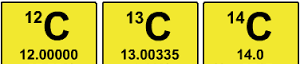
What do these isotopes of carbon all have in common?
a)
neutrons & mass number
b)
atomic number and neutrons
c)
atomic number and electrons
d)
protons, atomic number, and mass number
35.

How many neutrons does the isotope of lithium have?
a)
8
b)
3
c)
4
d)
5
36.
How many electrons are in an atom that has an atomic number of 34, an atomic mass of 74 and a charge of -2?
a)
34
b)
36
c)
2
d)
40
37.
If the number of electrons in an atom changes you make a(n) __________________.
a)
ion
b)
isotope
c)
new element
d)
isomer
38.
Two isotopes of carbon are carbon-12 and carbon-14. These isotopes differ from one another by two protons.
a)
true
b)
false
39.
Write the hyphen notation for the isotope that has 39 protons and 50 neutrons.
a)
Yttrium-11
b)
Tin-39
c)
Tin-89
d)
Yttrium-89
40.
24.1% of all the isotopes of a an element have a mass of 75.23 amu, 48.7% have a mass of 74.61 amu, and 27.2% have a mass of 75.20 amu.
What is the average mass of this element?
What is the average mass of this element?
a)
74.92 amu
b)
24.97 amu
c)
75.01 amu
d)
74.51 amu
41.
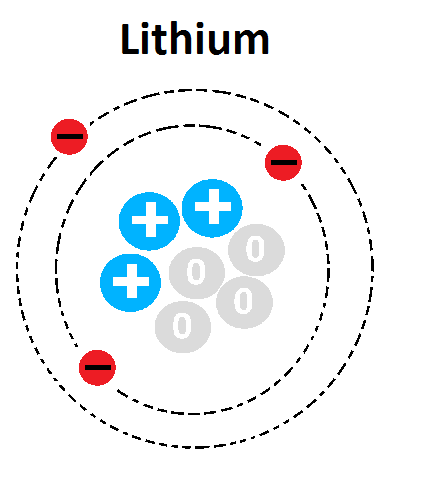
What is the mass number of this atom?
a)
1
b)
3
c)
4
d)
7
42.
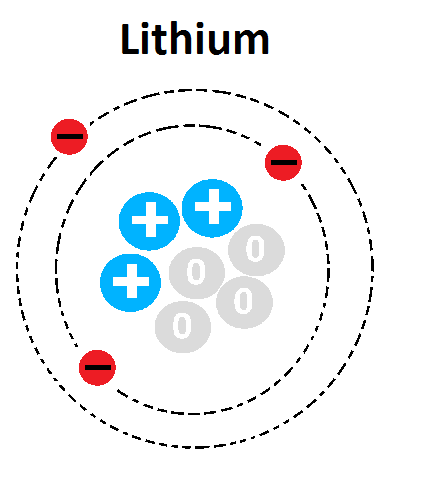
What is the atomic number of this atom?
a)
1
b)
3
c)
4
d)
7
43.
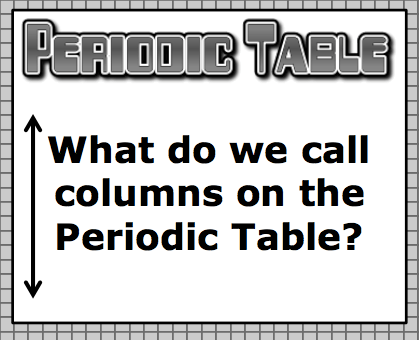
a)
Periods
b)
Groups
44.
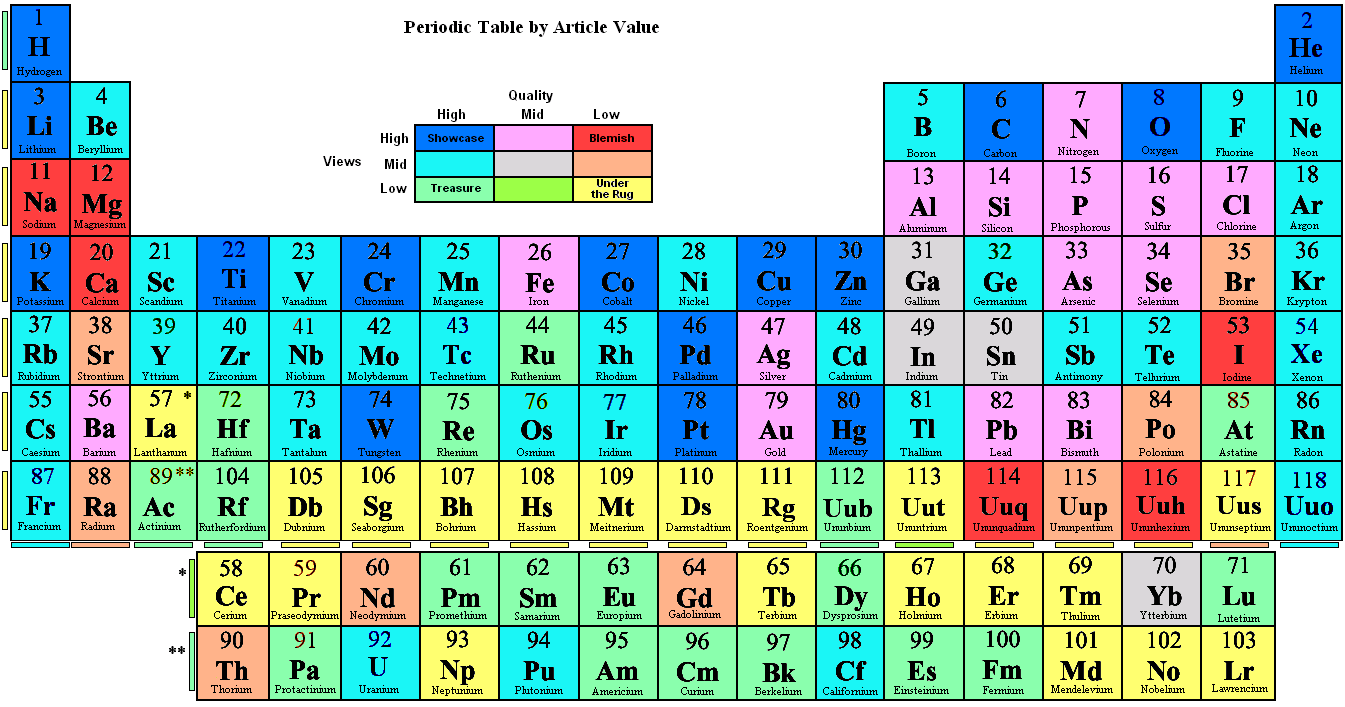
Sodium (Na) is found in period
a)
3
b)
2
c)
4
d)
1
45.
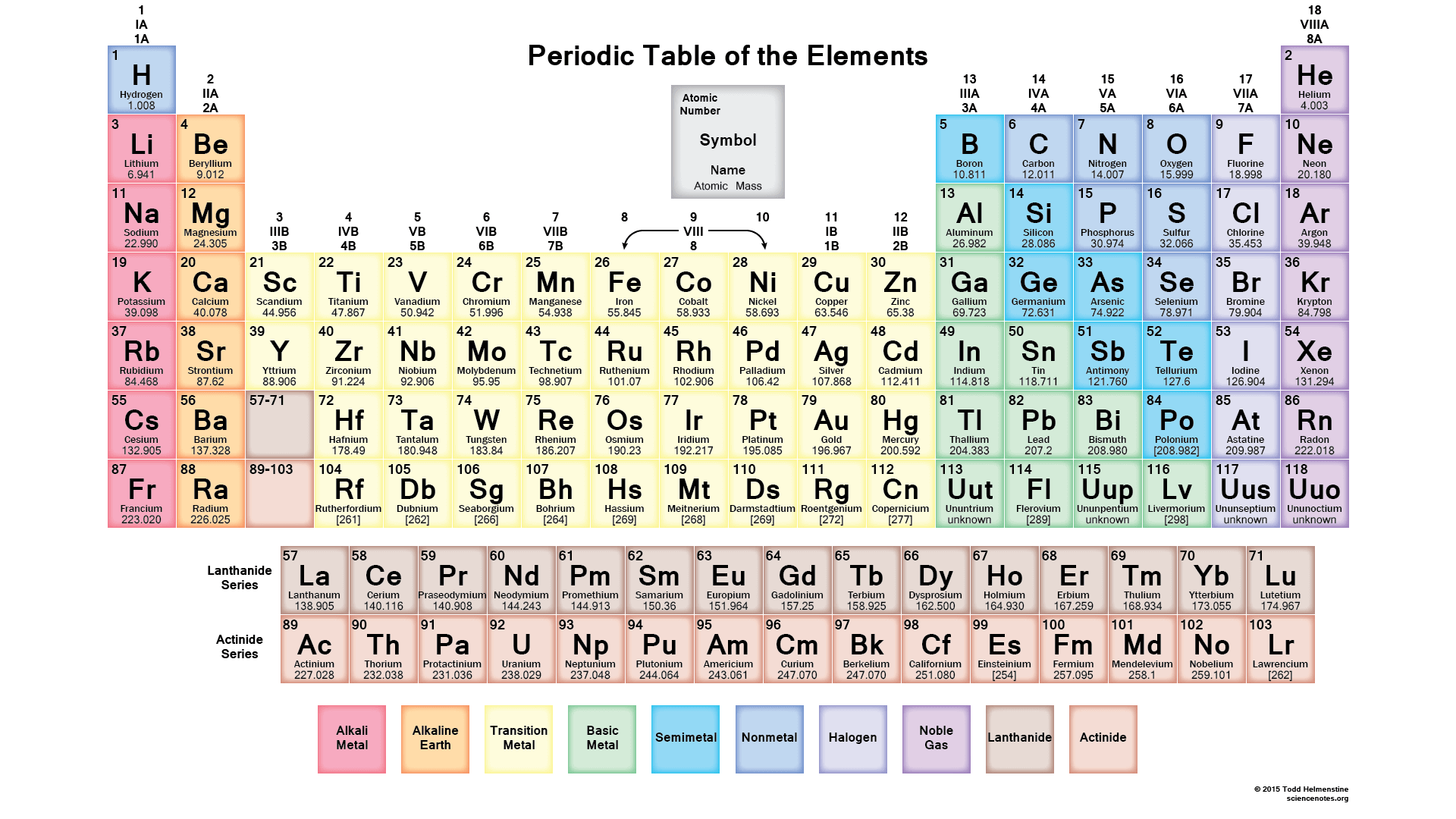
Sodium (Na) is found in group
a)
1
b)
2
c)
3
d)
4
46.
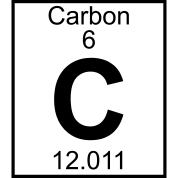
What does the 6 represent?
a)
atomic mass
b)
atomic number
c)
element name
d)
chemical symbol
47.
What does 12.011 represent?
a)
atomic mass
b)
atomic number
c)
element name
d)
chemical symbol
48.
Which group of the periodic table is composed of inert (not reactive) gases?
a)
alkali metals
b)
alkaline earth metals
c)
halogens
d)
noble gases
49.
Elements which are shiny, conduct electricity and heat are called
a)
metal
b)
nonmetal
c)
metalloid
d)
nonexistent
50.
Which element is not a metal?
a)
H
b)
Re
c)
Al
d)
B
51.

The atoms along the staircase are called
a)
metals
b)
nonmetals
c)
metalloids
d)
noble gases
52.
Which is a halogen?
a)
Helium
b)
Chlorine
c)
Oxygen
d)
Neptune
53.
Which is an alkali metal?
a)
Magnesium
b)
Iron
c)
Sodium
d)
Europium
54.
Which group has the greatest number of valence electrons?
a)
1
b)
14
c)
18
d)
16
55.
How many valence electrons are found in atoms of group 14?
a)
4
b)
3
c)
14
d)
16
56.
What are valence electrons?
a)
The total number of electrons in an atom
b)
The number of electrons in the outermost shell
c)
The number of electrons in the second shell
d)
The number of protons in the outermost shell
57.
Atomic Radius is...
a)
the relative size of the atom's nucleus
b)
the relative size of the atom's electron cloud
c)
the energy required to shield the outer electrons from the nucleus
d)
a measure of the ability of an atom to attract electrons
58.

As you move down the periodic table atoms get bigger. This is because ____________.
a)
The atoms have more mass.
b)
The atoms have more protons.
c)
The atoms have more energy levels
d)
The atoms have more nuetrons
59.
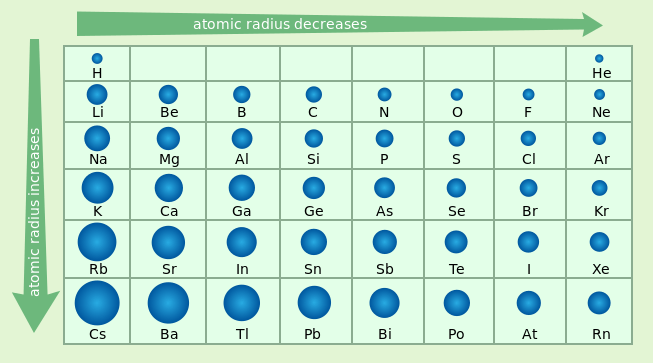
As you move across the periodic table atoms tend to get smaller because, ______________.
a)
the atoms have more mass.
b)
the atoms have less mass
c)
the atoms have more protons.
d)
the atoms have less electrons.
60.

Which atom has the largest atomic radius?
a)
potassium
b)
rubidium
c)
francium
d)
cesium
61.
Ionization energy is...
a)
the energy required to add an electron to a specific atom
b)
how much energy it takes to remove an electron from an atom
c)
the energy required to shield the outer electrons from the nucleus
d)
a measure of the ability of an atom to attract electrons
62.

Which of the following will have a lower ionization energy than Scandium (Sc)?
a)
Helium (He)
b)
Titanium (Ti)
c)
Calcium (Ca)
d)
Magnesium (Mg)
63.

Which of the following will have a higher ionization energy than arsenic (As)?
a)
Gallium (Ga)
b)
Neon (Ne)
c)
Antimony (Sb)
d)
Germanium (Ge)
64.
Electronegativity is...
a)
how good an atom is at attracting electrons
b)
the ability of an atom to lose electrons
c)
the energy required to remove an electron from a specific atom
d)
how easy it is to make friends.
65.
Atoms that have a high electronegativity, _______________.
a)
give up their electrons more easily.
b)
hold on to their electrons more tightly.
c)
have more electron shells.
66.

Which of the following will have a higher electronegativity than arsenic (As)?
a)
Carbon (C)
b)
Neon (Ne)
c)
Antimony (Sb)
d)
Germanium (Ge)
67.
The electronegativity of Cl is the highest in Period 2. Why?
a)
Cl is the largest and has the greatest effective nuclear charge
b)
Cl is the smallest and has the lowest effective nuclear charge
c)
Cl is the largest and has the lowest effective nuclear charge
d)
Cl is the smallest and has the greatest effective nuclear charge
68.
What atom matches this electron configuration?
1s22s22p63s23p64s23d10
1s22s22p63s23p64s23d10
a)
Zinc
b)
Copper
c)
Nickel
d)
Germanium
69.
What electron configuration matches an oxygen atom?
a)
1s22s22p63s2, 3p64s23d104p5
b)
1s22s22p4
c)
1s22s22p6
d)
1s22s22p63s23p64s23d1
70.
There are 4 different types of subshells s,p,d,f
a)
true
b)
false
71.

Which element is pictured?
a)
neon
b)
fluorine
c)
magnesium
d)
argon
72.
What does Pauli exclusion principle state ?
a)
states that each electron occupies the lowest energy orbital available
b)
states that a maximum of two electrons can occupy a single atomic orbital, but if only if the electros have opposite spins
c)
states that single electrons electrons with the same spin must occupy each-energy orbital before additional electrons with opposite spins can occupy the same orbitals
73.
What does Hund's rule states ?
a)
states that single electrons electrons with the same spin must occupy each-energy orbital before additional electrons with opposite spins can occupy the same orbitals
b)
states that each electron occupies the lowest energy orbital available
c)
states that a maximum of two electrons can occupy a single atomic orbital, but if only if the electros have opposite spins
Reset

