wayground logo

Free Printable Worksheets

NEW

Font size

S
M
L
XL
Worksheets

Unit 8 Review: Covalent Compounds

Total questions: 76

Worksheet time: 40mins

Name
Class
Date
1.

What is the formula for dihydrogen monoxide?

a)

HO

b)

HO2

c)

H2O

d)

OH

2.

When electrons are shared equally the compound is a what type of bond?

a)

Polar Covalent

b)

Polar Ionic

c)

Non-Polar Covalent

d)

None of the above

3.

When electrons are NOT shared equally it is a what type of bond?

a)

Polar Covalent

b)

Non-Polar Covalent

c)

Polar Ionic

d)

None of the above

4.

In the compound water, H2O, which element is the positive dipole?

a)

Hydrogen

b)

Oxygen

c)

Both

d)

Neither

5.

What makes up covalent compounds?

a)

Metal and a Non-Metal

b)

Two or more Non-Metals

c)

Two or more Metals

d)

Metals and Metalloids

6.

What is VSEPR?

a)

Electrons attract making bonds for compounds

b)

Electrons repel making the bonds easy to break

c)

Electrons attract giving compounds their shape

d)

Electrons repel each other which affects a compounds shape

7.

What is electronegativity?

a)

The ability to attract electrons

b)

The ability to attract protons

c)

The ability to react with other atoms

d)

The ability to bond

8.

What is the shape of water, H2O?

a)

Linear

b)

Bent

c)

Tetrahedral

d)

Trigonal Planar

9.

What is the shape of CF4?

a)

Linear

b)

Trigonal Planar

c)

Tetrahedral

d)

Trigonal Bipyramidal

10.

What is the shape of NF3?

a)

Bent

b)

Trigonal pyramidal

c)

Trigonal Planar

d)

Tetrahedral

11.

Is NF3 Polar or Non-Polar?

a)

Polar

b)

Non-Polar

c)

Both

d)

Neither

12.

What is the name of NF3?

a)

Mononitrogen Trifluoride

b)

Nitrogen Trifluoride

c)

Trinitrogen MonoFluoride

d)

Nitrogen Fluoride

13.

What is the formula for Decacarbon Hexafluoride?

a)

C6F10

b)

CF

c)

C10F7

d)

C10F6

14.

How many electrons make up a single bond?

a)

2

b)

4

c)

6

d)

1

15.

How many electrons make up a double bond?

a)

2

b)

4

c)

6

d)

1

16.

How many electrons make up a triple bond?

a)

2

b)

4

c)

6

d)

1

17.

All elements want 8 valence electrons EXCEPT who?

a)

Carbon only wants 2

b)

Oxygen only wants 2

c)

Hydrogen only wants 2

d)

Fluorine only wants 2

18.
Elements combine to form __________.
a)
compounds
b)
atoms
c)
positive ions
d)
negative ions
19.
What part of an atom is involved in chemical bonding?
a)
protons
b)
neutrons
c)
electrons
d)
nucleus
20.
How many valence electrons does nitrogen have?
a)
3
b)

2

c)
5
d)
1
21.
How many valence electrons does hydrogen have?
a)
3
b)
2
c)
5
d)
1
22.
Where are the non-metals located on the periodic table?
a)
All over
b)
On the left side of the "staircase"
c)
On the right side of the "staircase"
23.
A covalent bond involves a __________ of electrons.
a)
sharing
b)
borrowing
c)
exchanging
d)
switching
24.
A __________ is a number written to the right of a chemical symbol and slightly below it.
a)
subscript
b)
coefficient
c)
chemical formula
d)
compound
25.
The chemical formula shows one carbon atom bonded to __________ oxygen atoms.
a)
one
b)
two
c)
three
d)
four
26.
What is the prefix for 1?
a)
mono
b)
di
c)
tri
d)
tetra
27.
Name CCl4
a)
carbon carbon tetraiodide
b)
carbon tetrachloride
c)
monocarbon tetrachloride
d)
water
28.
Give the formula for oxygen dichloride
a)
OCl2
b)

O2Cl2

c)
OCl
d)
O2Cl
29.
Name CO2
a)
carbon dioxide
b)
carbon monoxide
c)
carbon oxide
d)
monocarbon dioxide
30.
How many valence electrons does carbon have?
a)
1
b)
2
c)
3
d)

4

31.
How many valence electrons does oxygen have?
a)
2
b)
3
c)
6
d)
4
32.
How many valence electrons does chlorine have?
a)
1
b)
7
c)
4
d)
2
33.
What is the proper name for S2O2?
a)
Sulfur oxide
b)
Sulfur dioxide
c)
sulfur (II) oxide
d)
disulfur dioxide
34.
Why do atoms share electrons?
a)
To attain the electron configuration of a noble gas.
b)
To become ions and take a charge
c)
to increase the mass
d)
it's a nice thing to do.
35.
How do covalent bonds form?
a)
Donating & receiving valence e- between atoms.
b)
Opposite slight charges attract each other between compounds.
c)
Scientists are still not sure how they form.
d)
Sharing valence e- between atoms.
36.

Which of the following is NOT covalently bonded?

a)

K2S

b)

H2O

c)

I2

d)

CO2

37.

Name the compound: NO

a)

Mononitrogen monoxide

b)

nitrogen oxide

c)

nitrogen monoxide

d)

mononitrogen oxide

38.

Give the formula: tetraphosphorus nonasulfide

a)

P4S9

b)

P9S4

c)

P2S3

d)

P4NS

39.

Give the formula:

dinitrogen tetraoxide

a)

N4O2

b)

N2O4

c)

N2O5

d)

N4O

40.

In the compound N2O, what does the subscript 2 indicate?

a)

There are 2 sodium atoms for each atom of oxygen

b)

There are 2 nitrogen atoms for each atom of oxygen

c)

There are 2 oxygen atoms for each atom of nitrogen

d)

Nitrogen atoms are twice a large as oxygen

41.

Which pair of atoms is most likely to form a covalent molecule?

a)

Hydrogen and lithium

b)

Phosphorus and sulfur

c)

Helium and neon

d)

Zinc and Boron

42.
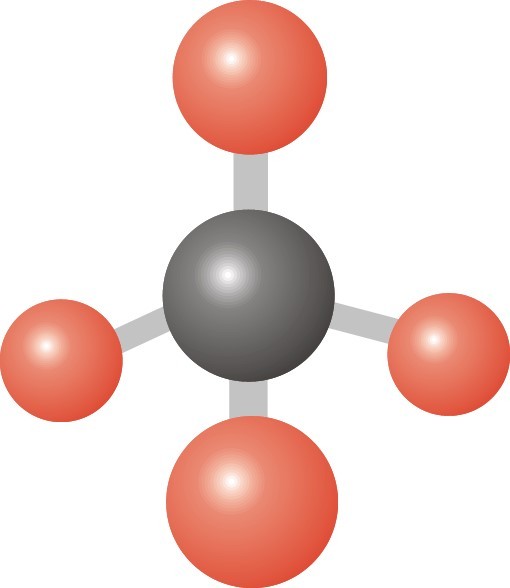
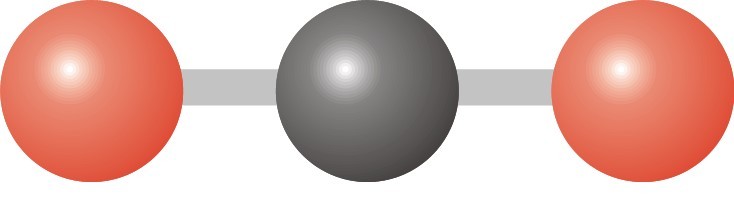
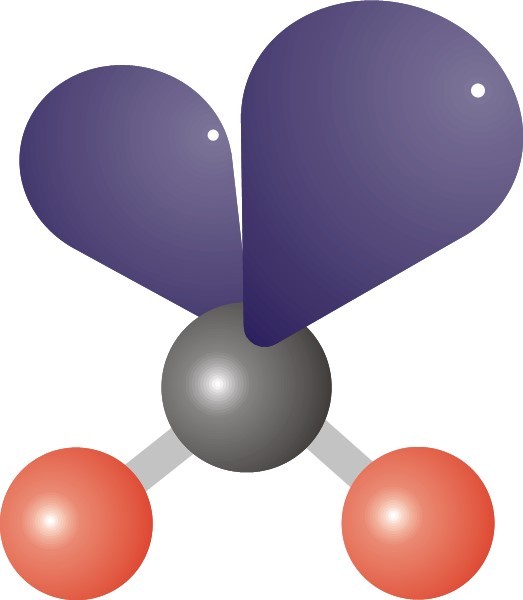
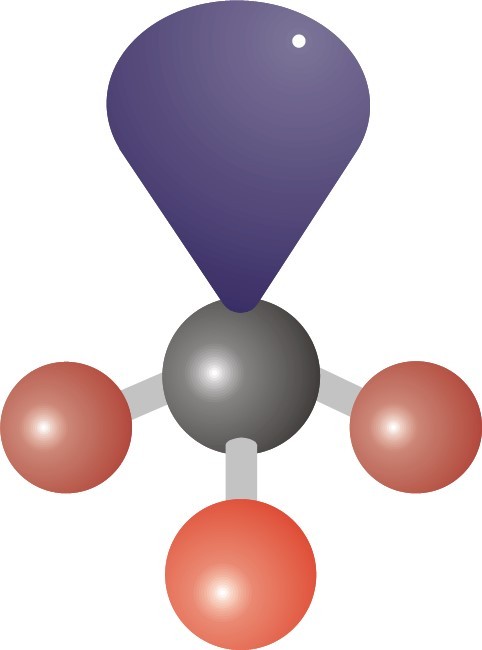
Who could this molecule be?
a)
CH4
b)
CO2
c)
PCl5
d)
BF3
43.
Which molecule would have this molecular geometry?
a)
BF3
b)
CH4
c)
PCl5
d)
CO2
44.
Who could this be? 
a)
CO2
b)
NH3
c)
H2S
d)
CH4
45.

Who could this be?

a)

H2O

b)

NH3

c)

CO2

d)

SO3

46.
According to VSEPR, molecules adjust their shapes to keep which of the following as far away as possible?
a)
Pairs of valence electrons
b)
Inner shell electrons
c)
Mobile Electrons
d)
Electrons closest to the nucleus
47.

How many unshared pairs of electrons will a bent molecule have?

a)

0

b)

2

c)

3

d)

4

48.
In a polar bond, the more electronegative element will assume a partial ________ charge.
a)
positive
b)
negative
49.
Br & Br
a)
Ionic 
b)
Polar Covalent 
c)
Nonpolar Covalent 
50.
In a polar covalent bond, electrons are shared ___________.
a)
equally
b)
unequally
c)
between non-metals with similar electronegativities
d)
between a metal and a non-metal
51.
This is an example of a __________ bond.
a)
non-polar covalent
b)
polar covalent
c)
ionic
d)
metallic
52.

When you have H-Cl, what is the polarity?

a)

nonpolar

b)

polar

c)

ionic

53.

When you have Si-O, what is the polarity?

a)

nonpolar

b)

polar

c)

ionic

54.

When you have F-F, what is the polarity?

a)

nonpolar

b)

polar

c)

ionic

55.

When you have C-H, what is the polarity?

a)

nonpolar

b)

polar

c)

ionic

56.
Which of the following is the correct Lewis structure for water?
a)
A
b)
B
c)
C
57.
The most electronegative atom in the periodic table is:
a)
Fluorine
b)
Helium
c)
Neon
d)
Francium
58.
A diatomic molecule like O2 is always_______ because electrons are shared ________.
a)
nonpolar; equally
b)
polar; equally
c)
nonpolar; unequally
d)
nonpolar; unequally
59.
If Bromine bonds with Hydrogen, a ____________ bond forms.
a)
polar covalent
b)
nonpolar covalent
c)
metallic
d)
ionic
60.

Is this molecule polar or non-polar?

a)

Polar

b)

Non-polar

61.

Is this molecule polar or non-polar?

a)

Non-polar

b)

Polar

62.
In this Lewis structure, the symbol above F means...
a)
electrons are being transferred to Fluorine
b)
electrons are less attracted to F than H
c)
electrons are more attracted to F than H
d)
Fluorine has formed a cation
63.
What geometry will this molecular structure have?: PH3
a)
bent
b)
tetrahedral
c)
linear
d)
trigonal pyramidal
64.
What geometry will this molecular structure have?: H2S
a)
bent
b)
tetrahedral
c)
linear
d)
trigonal pyramidal
65.
What geometry will this molecular structure have?: CCl4
a)
bent
b)
tetrahedral
c)
linear
d)
trigonal pyramidal
66.
Will this molecule be polar or nonpolar? H2S
a)
polar
b)
nonpolar
67.

What is the molecular geometry for this molecule?

a)

Bent

b)

Trigonal pyramidal

c)

Trigonal planar

d)

Linear

68.
Choose the correct shape for this molecule:
a)
Bent
b)
Linear
c)
Tetrahedral
d)
Trigonal pyramidal
69.

HCN is a linear molecular geometry. What is the polarity of HCN molecule?

a)

Polar molecule

b)

Non-polar molecule

70.
Choose the correct shape for this molecule:
a)
Trigonal planar
b)
Trigonal pyramidal
c)
Tetrahedral
d)
Linear
71.

Choose the correct shape for this molecule:

a)

Trigonal planar

b)

Linear

c)

Bent

d)

Tetrahedral

72.
Choose the correct shape for this molecule:
a)
linear
b)
Trigonal pyramidal
c)
Bent
d)
Tetrahedral
73.
Choose the correct shape for this molecule:
a)
linear
b)
Trigonal pyramidal
c)
Bent
d)
Tetrahedral
74.
Choose the correct shape for this molecule:
a)
Bent
b)
Trigonal pyramidal
c)
Tetrahedral
d)
Trigonal planar
75.

Choose the correct shape for this molecule:

a)

Bent

b)

Linear

c)

Tetrahedral

d)

Trigonal pyramidal

76.

Which Lewis Dot Model drawing correctly shows an O2 molecule?

a)
b)
c)
d)