
 Worksheets
End of Semester 1 Review Challenge
Total questions: 37
Worksheet time: 14mins

When studying the Earth scientists today take this approach:
They study the Earth as a collection of separate parts.
They study Earth as a system of interacting parts and processes.
They study one specific area of the Earth
They look at all the living and non living parts of the Earth.

Look at the scenarios below, which one describes how the biosphere interacts with the geosphere:
A tree breaking a rock.
Clouds forming in the sky.
A volcano erupts ash into the air.
An elephant drinks some water.

All of the following are characteristics of a mineral EXCEPT:
They are solids.
They are inorganic.
They are shiny.
They have a crystal structure.

Check the boxes below that are the three types of SEDIMENTARY rocks.
Organic
Intrusive
Chemical
Clastic
Foliated

The locations of EARTHQUAKES and VOLCANOES are explained by the
Theory of Kinetic Energy
Theory of Plate Tectonics
Cell Theory
Big Bang Theory

Along which type of plate boundary will you find the DEEPEST earthquakes?
Divergent
Convergent
Strike - Slip
Transform

Check the boxes that are the key words for how IGNEOUS rocks are formed.
Melting
Weathering
Cooling
Pressure
Erosion

Which sentence below BEST describes the Earth System:
It is a stable system that does not change much over time.
It is an isolated system that does not gain or lose energy .
It is a simple system that does not follow laws of nature.
It is a dynamic system with parts that interact with each other over long or short periods of time.

This layer of the earth is in the middle of the mantle, it is plastic like, and can flow slowly over time.
Asthenosphere
Lithosphere
Core
Crust

Look at the picture above, what type of volcano is it that has long broad sides and quiet eruptions?
Caldera
Sheild
Cinder Cone
Composite or Strato

A stationary plume of magma, which creates volcanoes as the plate moves over it, is called a
hotspot
subduction zone
contact metamorphism
caldera

Click on the processes below that form a SEDIMENTARY rock.
heat
weathering
melting
erosion
compaction and/or cementation

How light reflects off of a mineral is called:
hardness
streak
luster
cleavage

Click on the boxes that are the THREE types of PLATE BOUNDARIES that we studied.
Hotspot
Transform
Divergent
Strike Slip
Convergent

A person swimming in a lake is an example of what two spheres interacting?
atmosphere and biosphere
biosphere and hydrosphere
atmosphere and geosphere
geosphere and biosphere

Which type of rock is formed by heat and pressure?
Igneous Rock
Metamorphic Rock
Sedimentary Rock

Sedimentary rocks are formed by which processes? Click all that apply.
heat and pressure
weathering and erosion
compaction and cementation
melting and cooling

The crust and the upper mantle make up which layer?
asthenosphere
core
lithosphere
moho

molten rock below Earth surface is called _________ and molten rock on the Earth's surface is called ________.
hot, cold
lava, magma
magma, lava
aa, block lava

The amount of energy released by an earthquake is called its
intensity
focus
epicenter
magnitude

An example of a transform plate boundary is
Himalaya Mountains
Mid Atlantic Ridge
San Andreas Fault
Mariana Trench

A gap in a rock sequence due to erosion is called a
unconformity
cross cutting
superposition
inclusion

According the principle of cross cutting relationships, an intrusion is ___________ the the rock it cuts through.
younger
older
the same age as

Resources that can be replaced naturally as fast as they are used are called?
non-renewable
recycled
reduced
renewable

Which statement below describes Earth as a Dynamic System.
Systems that explode and due to reactions with each other systems.
Earth has systems that interact in complex ways and changes over long and short periods of time.
Shielded system that does not affect any other systems in the solar system.
Earth does not have systems it is made up of parts that do not interact in any way.

What process causes the tectonic plates to move as magma rises and sinks?
conduction
radiation
convection
albedo effect

The age of oceanic crust gets younger as you move
closer to the mid-ocean ridge
farther from the mid-ocean ridge
behind the mid-ocean ridge
along side the mid-ocean ridge

The Hawaiian Islands are located on a hot spot in the middle of the pacific ocean.
Click on the statement explains the plate movement over the hot spot.
The hot spot is moving underneath the islands.
The Pacific plate is moving southeast over the hotspot.
The hot spot is moving west underneath the islands
The Pacific plate is moving northwest over the hotspot.
Through which of Earth systems or spheres does carbon naturally move as part of the carbon cycle?
Only the atmosphere
Only the hydrosphere and biosphere
Atmosphere, geosphere, biosphere, and hydrosphere
Only the mantle and outer core
How do plants play a key role in the carbon cycle?
They release large amounts of carbon dioxide during photosynthesis.
They absorb carbon dioxide and produce oxygen.
They increase Earth’s temperature by trapping heat.
They reflect most sunlight back into space.
Climate change has the potential to impact which of the following?
Patterns of human settlement and farming
The strength of Earth’s magnetic field
Only the chemistry of deep-ocean vents
The distance between Earth and the Sun
Which human activity directly adds carbon dioxide to the atmosphere?
Planting forests to increase biomass
Burning coal, oil, and natural gas
Reducing the use of automobiles
Increasing carbon storage in wetlands
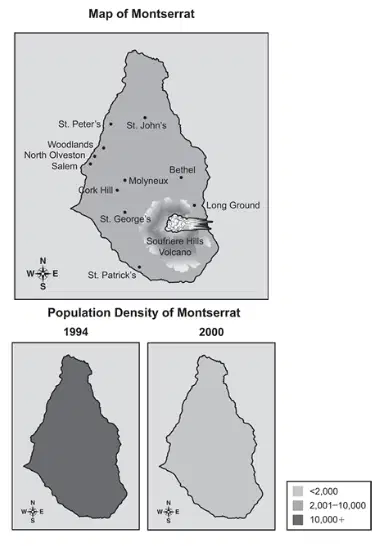
A map of Montserrat shows a major change in population between 1994 and 2000 along with volcanic features. What conclusion is most supported by this evidence?
A severe drought occurred, causing crops to fail and people to leave.
A long-term cooling trend encouraged migration to warmer regions.
A significant volcanic eruption forced residents to relocate.
A widespread disease outbreak sharply reduced the population.
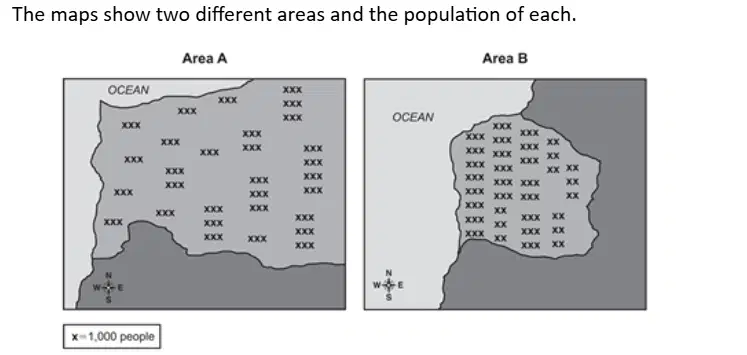
Two regions are shown with different population densities. If a tsunami of equal magnitude strikes both areas, where would more casualties be expected?
Region A, because its population is widely distributed over a large area
Region B, because its population is concentrated closer to the shoreline
Region A, because it has more land for the tsunami to travel across
Region B, because it has fewer people spread out over the land
Which process is responsible for the formation of sedimentary rocks?
Compaction and cementation of sediments
Evaporation of seawater
Melting and cooling of magma
Extreme heat and pressure
What is the main cause of tectonic plate movement?
Wind erosion
Convection currents in the mantle
Solar radiation
Magnetic field changes
Which sphere of the Earth includes all living organisms?
Atmosphere
Geosphere
Hydrosphere
Biosphere

