
Font size
 Worksheets
Meteorology Unit Review
Total questions: 40
Worksheet time: 31mins

The stage of the water cycle when water vapor turns from a gas to a liquid.
Evaporation
Transpiration
Precipitation
Condensation

What drives the water cycle to continue?
Salt in the Ocean
The Sun
Clouds
Gravity

The sun is warming up the water on the surface of this lake and changing the liquid to water vapor. This is an example of -
condensation
evaporation
run-off
accumulation

what is the meaning of conduction?
when heat transfers through space
circulation of heat caused by density differences

warm and High pressure
warm and Low pressure


When isobars are closer together, what does that signify?
stronger, faster winds
an area of no wind
clear skies
slow, weak winds

A large balloon that carries sensors to gather temperature, air pressure, and humidity is high in the atmosphere is ____.


Because unequal heating of Earth’s surface generates pressure differences, ____ is the ultimate energy source for most wind.
convergence
convective lifting
dew point
solar radiation
orographic lifting

Which of the following is NOT a characteristic of a tornado?
Tornadoes last for days
Tornadoes can form quickly
Tornadoes are made up of Low Pressure systems
Tornadoes generally start as a Mesocyclone.

Tornadoes are detected and measured using
Enhanced Fujita Scale
Doppler Radar
Saffir-Simpson Wind Scale
Satellite Imagery

Warm air rises and the cool air sinks demonstrates this type of heat transfer.
conduction
convection
radiation
Insolation

The Coriolis Effect is caused by
Earth rotating around the sun
Earth rotating on its axis
Earth's revolution
Gravity

What is the temperature?
67
65
20
34

This instrument measures air pressure in millibars:
thermometer
rain gauge
anemometer
barometer


The gradual increase in the temperature of the atmosphere is known as ________________.


Which weather instrument is most useful in measuring relative humidity?
barometer
anenometer
psychrometer
wind vane

The temperature at which air reaches 100% saturation, can hold no more water, and condensation occurs:
Boiling point
Condensation
Dew Point
Evaporation point

Which of the gases is NOT a greenhouse gas?
Ozone
Nitrogen
Carbon Dioxide
Methane

Which of the following natural events is NOT a source of carbon dioxide?
Wildfires from lightning
Animal respiration
Volcanic eruption
Earthquake

Melting of glaciers and polar ice caps....
will result in cooler temperatures in the Arctic
will result in sea-levels rising
Will have no effect on ecosystems
will result in decreasing sea levels

Cutting down large forests (deforestation) can result in:
little to no changes
more homes for animals
less plants to absorb carbon dioxide, a greenhouse gas
An increase of Oxygen
Gasoline, diesel, natural gas, and coal are all _________. Burning them releases CO2 into the atmosphere.
fossil fuels
renewable resources
clean fuels
Biomass

What is storm forms over warm oceans, contains storm surges, and has wind speeds of 74 mph - 200 mph?
thunderstorms
severe thunderstorms
tornadoes
hurricanes


Where is the pressure the lowest in a hurricane?
The eye walls
The eye
In the bands of rain
Near the ocean surface
What are the contributing factors that may cause an area to flood? Choose all correct choices.
Near the coast
High elevations
Along river valleys
Rapid snow melts
Increased vegetation (trees)

A strong low-pressure weather system forms off the coast and moves toward a land area. Which weather conditions will likely result from the low-pressure system?
clear, sunny skies and calm winds
mostly sunny skies with little to no precipitation
partly cloudy skies with little precipitation and light winds
mostly cloudy skies with moderate to heavy precipitation and strong winds
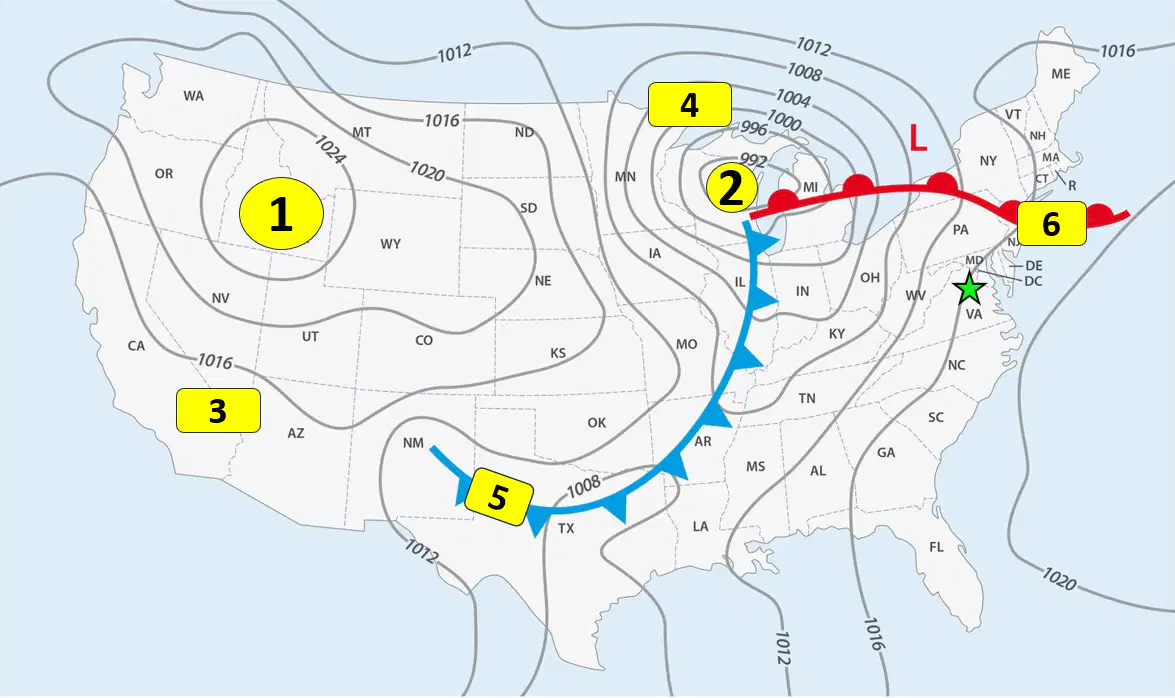
Which number on the weather map should be labeled with an "H" for high pressure?
1
2
4
6
Which number on the weather map should be labeled with an "L" for Low pressure?
1
2
5
4
Which number on the weather map has the fastest/strongest winds?
5
6
3
4
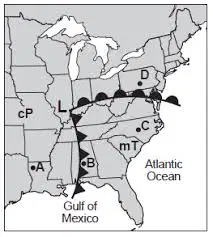
Which location is forecasted to have warmer temperatures in the near future?
A
B
C
D
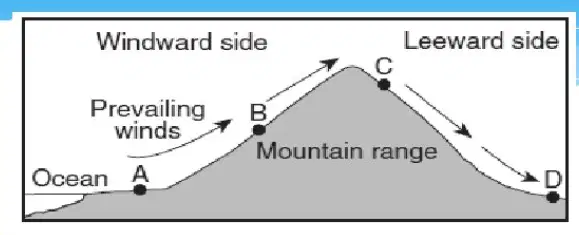
Which area will experience the most precipitation due to the Orographic Effect?
A
B
C
D

