wayground logo

Free Printable Worksheets

Font size

S
M
L
XL
Worksheets

Semester Exam Review PS

Total questions: 71

Worksheet time: 1hrs 15mins

Name
Class
Date
1.

What does the subscript in a chemical formula tell you?

a)

How many molecules are present

b)

How many atoms are present

c)

How many elements are present

d)

How many neutrons are present

2.

How many elements are in this chemical formula?

HCl

a)

1

b)

2

c)

3

d)

4

3.

How many atoms of Carbon are in this formula? C6 H12O6C_{6\ }H_{12}O_6  

a)

6

b)

1

c)

12

4.

What elements are represented in this chemical formula?  Fe2O3Fe_2O_3  

a)

Iron, Oxygen

b)

Francium, Europium, Oxygen

c)

Ferrium, Oxygen

d)

Berylium, Oxygen

5.

What is the total number of atoms in this formula? H2O2H_2O_2  

a)

2

b)

4

c)

3

6.

Which of the following elements is least likely to form a compound?

a)

Hydrogen

b)

Sodium

c)

Argon

d)

Potassium

7.

What is the total number of atoms in this chemical formula? C8H3NaBr12C_8H_3NaBr_{12}  

a)

18

b)

12

c)

25

d)

24

8.

Which element has the greatest number of atoms?  AgNO3AgNO_3  

a)

Silver

b)

Gold

c)

Nitrogen

d)

Oxygen

9.

How many CARBONs are in this formula?

a)

1

b)

4

c)

8

d)

12

10.

How many total POTASSIUM atoms are in this formula?

a)

8

b)

2

c)

4

d)

12

11.

How many CARBON are in this formula?

a)

5

b)

2

c)

10

d)

20

12.

What determines the reactivity of an element?

a)

protons

b)

neutrons

c)

electrons

d)

valence electrons

13.

What determines the identity of an element?

a)

protons

b)

neutrons

c)

electrons

d)

valence electrons

14.

How many NEUTRONS does this atom have?

a)

18

b)

39

c)

40

d)

22

15.

PROTONS are different from to ELECTRONS because they....

a)

electrons have more mass

b)

protons have more mass

c)

electrons are negatively charged

d)

different locations

16.

Which atoms have similar reactivity

a)
b)
c)
d)
17.

What is the Law of Conservation of Mass?

a)

It states that matter cannot be created or destroyed.

b)

It states that energy cannot be created or destroyed.

c)

It states that matter can be created or destroyed.

d)

It states that sound can be created or destroyed.

18.
What is a coefficient?
a)
The small number on the right of the chemical symbol.
b)
The large number in front of a chemical formula.
c)
The number in between the chemical symbols.
d)
The number behind a chemical formula.
19.
What is the part of the chemical equation in green called? 
Fe + S --> FeS
a)
products
b)
reactants
c)
yield
d)
chemical formula
20.
What is the little number after an element in a chemical equation called.
Example: H2
a)
Coefficient 
b)
Subscript
c)
Atom
d)
Equation
21.
What coefficient should be used to make the following equation balanced?
N2+O2--> _NO 
a)
1
b)
2
c)
3
d)
4
22.
Which problem is balanced?
(Check ALL answers)
a)
PbO2 + 2H2
b)
SO2 + H20 --> H2SO4
c)
2Na + 2H2O --> 2NaOH + H2
23.
How many HCl molecules do you need to balance this equation? 
Mg +  __HCl --->  MgCl2 + H2
a)
1
b)
2
c)
3
d)
4
24.
Is this balanced?
Al + O2 → 2Al2O3
a)
Yes
b)
No
25.

Is the equation balanced?: 2H2O + O2 --> 4MgO + 3Fe

a)

yes

b)

no

26.

Balance this equation

_Al +_HCl --> _H2 +_AlCl3

a)

2,6,3,2

b)

it's already balanced

c)

4,12,3,4

d)

2,1,4,5

27.
What is the right part of a chemical equation called...
2H2 + O2 --> 2H2O
a)
Reactants
b)
Products 
c)
Yields 
d)
Chemical Equation 
28.
What is the total number of atoms present in 5Na3PO4
a)
5
b)
40
c)
55
d)
8
29.

Chemical Reaction

a)

a substance formed as a result of a chemical reaction

b)

a change in matter that produces one or more new substances

c)

the process in which substances undergo chemical changes that result in the formation of new substances

d)

a substance that enters into a chemical reaction

30.

Balance the following equation:

___ SeCl6+ ___ O2→___ SeO2+____Cl2

a)

1, 1, 1, 3

b)

2, 1, 2, 1

c)

1, 2, 1, 2

d)

2, 2, 2, 4

31.
AB + CD →AD + CB
a)
Double Replacement
b)
Single Replacement
c)
Synthesis
d)
Decomposition
32.
Identify this type of reaction,
Cl2 + 2KI -->  I2 + 2KCl
a)
Synthesis
b)
Single displacement
c)
Double displacement
d)
Decomposition
33.
2 C5H5 + Fe --> Fe(C5H5)2 
a)
single displacement
b)
double displacement
c)
decomposition
d)
synthesis
34.
2 RbNO3 + BeF2 --> Be(NO3)2 + 2 RbF
a)
single displacement
b)
double displacment
c)
decomposition
d)
synthesis
35.
Which chemical reaction breaks down into 2 substances?
a)
Double displacement
b)
Single displacement
c)
Synthesis
d)
Decomposition
36.
Which of the following is an example of synthesis?
a)
Na + Br--> NaBr
b)
KClO--> KCl + O2
c)
HgO + Cl2-->HgCl + O2
d)
Cl2 + NaBr --> NaCl + Br2
37.
Which of the following is the general formula for a decomposition reaction?
a)
A + B  → AB
b)
AB → A + B
c)
AB + C → AC + B
d)
AB + CD → AC + BD
38.
2 AgNO3 + Cu --> Cu(NO3)2 + 2 Ag 
a)
single displacement
b)
double displacement
c)
decomposition
d)
synthesis
39.
A + BC →B + AC
a)
Single Replacement
b)
Decomposition
c)
Double Replacement
d)
Synthesis
40.
NO2 →N2 + O2
a)
Synthesis (combination)
b)
Decomposition
c)
Single replacement
d)
Combustion
41.
Mg + N2 →Mg3N2
a)
Synthesis (combination)
b)
Decomposition
c)
Single replacement
d)
Combustion
42.
2NaCl →2Na +Cl2
a)
Synthesis Reaction
b)
Decomposition Reaction
c)
Single Displacement Reaction
d)
Double Displacement Reaction
43.
The force that holds 2 atoms together is called a ________________.
a)
Chemical Reaction
b)
Chemical Bond
c)
Diatomic Chemical
d)
Glue
44.

Ionic Bonds

a)

metal with nonmetal

b)

nonmetal with nonmetal

45.

Covalent Bonds

a)

metal with nonmetal

b)

nonmetal with nonmetal

46.

NH3

a)

Ionic Bond

b)

Covalent Bond

47.

NaO

a)

Ionic Bond

b)

Covalent Bond

48.
How are covalent bonds formed?
a)
Sharing of electrons
b)
Transfer of electrons
49.
How are ionic bonds formed?
a)
Transfer of electrons
b)
Sharing of electrons
50.
Is hydrogen considered a metal or a non-metal?
a)
A metal
b)
Nonmetal
c)
Metalloid
51.
What is a valence electron?
a)
The sum of neutrons and protons.
b)
The # of electrons in the last shell.
c)
A type of bond.
d)
A popular compound.
52.
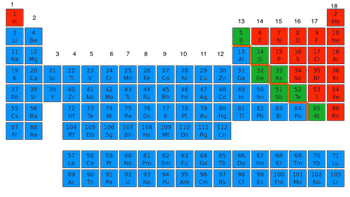
Where are metals located on the periodic table?
a)
Blue
b)
Green
c)
Red
53.
Where are the nonmetals located on the periodic table? 
a)
Blue
b)
Red
c)
Green
54.
Where are the metalloids located on the periodic table?
a)
Blue
b)
Red
c)
Green
55.
Two or more atoms held together by a chemical bond is called what?
a)
A molecule
b)
A molecure
56.
Which of these is not a real bond in chemistry?
a)
James
b)
Ionic
c)
Covalent
57.
all matter is made of what 
a)
energy 
b)
atoms 
c)
electrons 
d)
compounds 
58.
The positive particles of an atom are 
a)
electrons 
b)
positrons 
c)
neutrons 
d)
protons 
59.
Particles in an atom that are neutral and have no charge are 
a)
negatrons 
b)
electrons 
c)
neutrons 
d)
protons 
60.
Neutrons are _______________ particles.
a)
negative
b)
positive
c)
neutral
d)
cows
61.
The positive particles of an atom are called ___________.
a)
electrons 
b)
atoms
c)
neutrons 
d)
protons 
62.
The central region of an atom where its neutrons and protons are is called the
a)
nucleus 
b)
electron cloud
c)
core 
d)
center 
63.
electrons have this type of charge?
a)
negative
b)
positive
c)
neutral
64.
Where are neutrons located in the atom?
a)
shells/orbitals
b)
rings
c)
center
d)
nucleus
65.
What is the atomic mass of "F"
a)
9
b)
18
c)
17
d)
19
66.

What does the 1.00794 stand for?

a)

Hydrogen

b)

atomic number

c)

atomic mass

d)

atomic explosion

67.
Beryllium has how many protons?
a)
4
b)
9.0122
c)
2
d)
13.0122
68.
How many protons does P-30 have?
a)
30
b)
16
c)
12
d)
15
69.
What element has 42 protons?
a)
Ca
b)
Mo
c)
Zr
d)
Po
70.
How many neutrons would Fe-56 have?
a)
56
b)
26
c)
30
d)
33
71.
How many protons does P-30 have?
a)
30
b)
16
c)
12
d)
15