wayground logo

Free Printable Worksheets

NEW

Font size

S
M
L
XL
Worksheets

Semester 1 Test 2020

Total questions: 42

Worksheet time: 1hrs 24mins
Name
Class
Date
1.
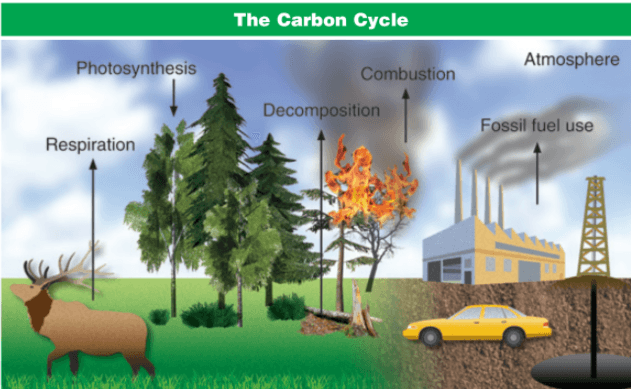
Burning fossil fuel has which effect in the carbon cycle?
a)
It removes carbon dioxide from the atmosphere.
b)
It puts carbon dioxide under the ground.
c)
It adds carbon dioxide to the atmosphere.
d)
It has no effect in the carbon cycle.
2.
Carbon enters the living world through the process of _____.
a)
photosynthesis
b)
respiration
c)
combustion
d)
decomposition
3.

Subduction and Volcanic eruptions are part of which carbon cycle?

a)

Geological

b)

Biological

4.

Decomposition and Photosynthesis and part of which carbon cycle?

a)

Geological

b)

Biological

5.
An example of a connection between ATMOsphere and HYDROsphere is:
a)
rain
b)
rivers
c)
lakes
d)
rocks
6.

Carbon enters the soil through dead plant or animal matter.

a)

Decomposition

b)

Respiration

c)

Photosynthesis

d)

Diffusion

7.
This picture best describes which connection?
a)
Atmosphere-Biosphere
b)
Hydrosphere-Atmosphere
c)
Hydrosphere-Geosphere
d)
Geosphere-Biosphere
8.
Bio = 
a)
Earth
b)
Sphere
c)
Life
d)
Water
9.

Geo =

a)

Rock

b)

Sphere

c)

Life

d)

Water

10.
Hydro = 
a)
Sphere
b)
Earth
c)
Life
d)
Water
11.

Atmo =

a)

Air

b)

Earth

c)

Life

d)

Water

12.
What is the correct order (starting from the surface) of Earth's layers?
a)
crust, mantle, inner core, outer core
b)
mantle, outer core, inner core, crust
c)
inner core, outer core, mantle, crust
d)
crust, mantle, outer core, inner core
13.
How does temperature change as you move from the crust to the core?
a)
it gets cooler
b)
it gets hotter
c)
it stays the same
d)
the core is frozen
14.

Why are many plants green?

a)

plant cells are green

b)

plants absorb green light

c)

chlorophyll reflects green light

d)

rigid cell walls are green

15.
Chloroplasts are...
a)
A type of pigment used for photosynthesis
b)
The location inside a plant cell where photosynthesis happens
c)
The location where cellular respiration happens
d)
Green beans
16.
The products of photosynthesis are
a)
water and carbon dioxide
b)
oxygen and water
c)
sugar and cabon dioxide
d)
oxygen and sugar (glucose)
17.
Which of the following formulas represents photosynthesis?
a)
6 H2O + 6 O2 = C6H12O6 + 6 CO2
b)
6 H2O + 6 CO2 = C6H12O6 + 6 O2
c)
 C6H12O6 + + 6 O2 = 6 H2O + 6 CO2
18.
What is the purpose of cellular respiration?
a)
to break down food
b)
to create energy in the body
c)
to release energy from food
d)
there is none; it's a waste of time
19.
What is the correct equation for cellular respiration?
a)
6O2 + C6H12O6 -> 6CO2 + 6H2O + Energy
b)
6O2 + C6H12O6 + Energy -> 6CO2 + 6H2O
c)
6CO2 + 6H2O -> 6O2 + C6H12O6 + Energy
d)
6CO2 + 6H2O + Energy -> 6O2 + C6H12O6
20.
ATP is...
a)
A form of energy the cell can use that is produced by cellular respiration
b)
A kind of sugar produced in photosynthesis
c)
A battery
21.

You put a plant on a table near a window and notice that when you come home at the end of the day the plant has bent towards the window. What is this an example of?

a)

Geotropism

b)

Sonotropism

c)

Phototropism

d)

Thigmotropism

22.
All ____________ are made up of two or more atoms bonded together.
a)
atoms
b)
molecules
c)
electrons
d)
elements
23.
Bonds between atoms in a molecule form as a result of the sharing  of?
a)
formulas
b)
electrons
c)
atoms
d)
chemicals
24.
What are the basic building blocks for all matter?
a)
atoms
b)
elements
c)
compounds
d)
chemicals
25.
How are covalent bonds formed?
a)
Sharing of electrons
b)
Transfer of electrons
26.
The four organic compounds found in living things are?
a)
Carbohydrates, Lipids, Nucleic Acids, and Oxygen
b)
Carbohydrates, Lipids, Proteins, and Carbon
c)
Carbohydrates, Lipids, Proteins, Nucleic Acids
d)
Carbon, Lipids, Proteins, Nucleic Acids
27.
How many atoms of carbon (C) are in C6H12O6?
a)
3
b)
6
c)
12
d)
24
28.
Element or compound?
H2O
a)
element
b)
compound
29.
What does biotic mean?
a)
Living
b)
Non living
c)
Man made
30.

Which of these organisms is the producer?

a)

Owl

b)

Mouse

c)

Grasshopper

d)

Grass

31.
Two or more members of a particular species living and interacting in the same area
a)
Community
b)
Population
c)
Organisms
d)
Biosphere
32.
Different populations living and interacting with each other in the same area
a)
Biome
b)
Ecosystem
c)
Community
d)
Niche
33.
What does every food chain start with? (Even if it's not drawn or written there!)
a)
producers
b)
sun
c)
consumer
d)
decomposers
34.
What does a food web represent?
a)
All connections of energy flow throughout all organisms in a habitat.
b)
The specific ways that mutualism is carried out.
c)
A single pathway or energy flow between organisms. 
d)
How carnivores get their food. 
35.
As you move upward, from level to level, in an energy pyramid, energy _____.
a)
increases
b)
decreases
c)
stays the same
d)
increases exponentially
36.

1. What are renewable resources?

a)

. Resources that are used faster than they form

b)

resources that can replenish themselves over time

c)

resources that formed over millions of years

d)

resources that exist only in rural areas

37.

1. Which of the following is not a renewable resource?

a)

coal

b)

wind energy

c)

solar energy

d)

water

38.
An area of land where all the water flows to one location, like a funnel. 
a)
Superfund Site
b)
Watershed
c)
Succession
d)
River
39.

When human-made chemicals and garbage find their way into nature and harm the air, soil, and water it is called

a)

pollution

b)

habitat destruction

c)

overexploitation

d)

climate change

40.
An example of a non-point solution is 
a)
waste water from leaking pipe
b)
fertilizer runoff from lawns
41.
Which of the following are indicators of healthy water systems?
a)
high nitrates, high pH, and low temperatures
b)
low temperatures, high dissolved oxygen, and neutral pH
42.
What is the possible effect of high nitrate level in water systems?
a)
algal bloom
b)
fewer algae