
NEW
Font size
 Worksheets
Pre Calculus S2 Final Exam
Total questions: 37
Worksheet time: 1hrs 25mins
Choose the end behavior for this polynomial function.
f(x)=2x5−3x2+4x−10
x→−∞limf(x)=+∞; x→+∞limf(x)=+∞
x→−∞limf(x)=+∞; x→+∞limf(x)=−∞
x→−∞limf(x)=−∞; x→+∞limf(x)=+∞
x→−∞limf(x)=−∞; x→+∞limf(x)=−∞

What are the zeros and their multiplicities of the polynomial graphed?
-6 (multiplicity of 1)
-5 (multiplicity of 2)
-2 (multiplicity of 2)
1 (multiplicity of 1)
-6 (multiplicity of 2)
-5 (multiplicity of 1)
-2 (multiplicity of 1)
1 (multiplicity of 2)
6 (multiplicity of 1)
5 (multiplicity of 2)
2 (multiplicity of 2)
-1 (multiplicity of 1)
6 (multiplicity of 2)
5 (multiplicity of 1)
2 (multiplicity of 1)
-1 (multiplicity of 2)
Using the Rational Zeros Theorem, which is the complete list of the possible rational zeros for the polynomial function?
f(x)=5x4+8x2−7x+15
±1, ±3, ±5, ±15
±51, ±1, ±53, ±3, ±5, ±15
±151±51±31±1, ±35, ±3±5
±151±51±31±1, ±35±5, ±15
Find all zeros for the polynomial function given one of the factors of the function is (x+3).
f(x)=2x3+5x2−6x−9
x=−3,−1
x=−3, −1, 23
x=1, 3
x= 2−3, 1, 3,

Which statement is NOT true regarding the graphed polynomial function?
The factors are (x+1)(x−1)2(x−2)
The factors are (x−1)(x+1)2(x+2)
The solutions are -1, 1, 2
The intercepts are
(-1, 0), (0, 1), (1, 0), (2, 0)
Solve the polynomial function. You may use a graphing utility to help you.
f(x)=x4+4x3−17x2−20x+60
zeros: 2, −6, 5, −5
zeros: −2, 6, 5, −5
zeros: 2, −6, 5, −5
zeros: 2, −6, 5i, −5i
State all of the intercepts for the graph of the rational function.
f(x)=x−5x2+x−6
(−3, 0), (2, 0), (0, 56)
(0, −3), (0, 2), (56, 0 )
(0, −3), (0, 2), No y intercept.
(−3, 0), ( 2, 0), No y intercept.
State all of the the asymptotes and holes (if any) for the graph of the rational function.
f(x)=x2−1x2+5x−6
x=3, x=2, y=±1, no hole
x=3, x=2, y=±1, hole@ x=1
x=−1, y=1, hole@ x=1
x=−1, y=1, no hole

Match the picture of the graph to its corresponding rational equation below.
f(x)=x2+xx2
f(x)=x2+x−124x2
f(x)=2x2+x−124x2
f(x)=2x2−x+128x2
State all of the the asymptotes and holes (if any) for the corresponding graph of the rational function.
f(x)=x+12x2+x+1
x=−1, y=2, no hole
x=−1, y=2x, hole@ x=0
x=−1, y=2x−1, no hole
x=−1, y=2x−1, hole@ x=0

State the domain in interval notation for the corresponding graph of the rational function.
f(x)=x−5x2+x−6
Domain: x=±5
Domain: (−∞, −3)∪(5, +∞)
Domain: (−∞, −5)∪(3, +∞)
Domain: (−∞, 5)∪(5, +∞)

State all of the the asymptotes for the corresponding graph of the rational function.
x=5, y=6
x=5, y=x+6
x=5, y=−x+6
x=5, y=21x+6
In set notation, state the domain of the simplified composite.
f(x)=x−34, g(x) = x10
f(g(x))
{x∥ x=0,310}
{x∥ x=0, 3}
{x∥x=0}
{x∥ x=310}
{x∥ x=3}
Which of the following equations is the exponential function that contains the following two points?
(−5, 96) & (2, 43)
y=2(31)x
y=3(21)x
y=2(41)x
y=4(21)x
Which statement below is the inverse of f(x)=x−12x+1
f−1(x)=x−21x, x=21
f−1(x)=x+1x−21, x=−1
f−1(x)=x−2x−1, x=2
f−1(x)=x−2x+1, x=2
Solve the logarithmic equation.
log5x=3
x = __________
15
1
25
125
Use the properties of logarithms to find the exact value of each expression.
log82+log84=
1
2
4
.86
Choose the correctly condensed logarithm
2log3u−log3z
2log3(zu)
log3(zu2)
log3(u2−z)
2log3(u−z)
Choose the correct expanded common logarithm:
log(xy2)
logx+2logy
logx+logy2
logx−2logy
logx+logy+log2
Solve for x in the logarithmic equation.
log6(x+4)+log6(x+3)=1
-1
4
-3
6
Solve for x in the exponential equation.
7x=12
Round your answer to the nearest hundreth.
1.28
1.39
0.92
1.71
Solve for x in the exponential equation.
8x+1=3
Round your answer to the nearest hundreth.
-0.47
-0.52
-0.63
-0.71
Solve for the exact value of x in the exponential equation.
2x−1=3x+1
Then approximate your answer to the nearest hundreth.
x=log(32)log(6), Therefore x=−4.42
x=log2−log3log3−log2, Therefore x=−1
x=(log2−log3)log6, Therefore x=4.26
x=(log2−log3)2log3, Therefore x=−5.42
Find the amount that results from the investment.
Invested: $700
Time: 2 years
Interest rate: 6%
Compounding: daily
Type your answer WITHOUT dollar signs and commas, rounded to the nearest penny.
$789.24
$742.56
$722.38
$704.44
How many years will it take for an initial investment of $25,000 to grow to $80,000 at a rate of 7% compounded continuously?
Type your answer rounded to the nearest hundredth. No label needed.
16.62
16.21
16.87
17.34
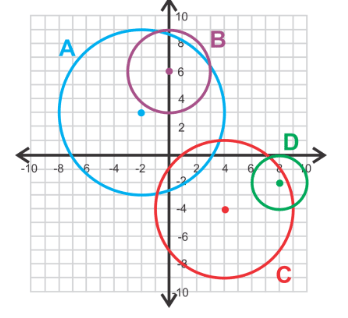
Which graph corresponds to
(x+2)2+ (y-3)2=36
A
B
C
D
Where is the vertex of y=3(x−26)2+14 ?
(26, 14)
(14, 26)
(-26, 14)
(3, 14)
(3, 26)
Which transformations are involved in the equation y=21x+1−1 ?
V Stretch by 2, H shift left 1, V Shift down 1
V Stretch by 2, H shift right 1, V Shift down 1
V Shrink by 1/2, H shift left 1, V Shift down 1
V Shrink by 1/2, H shift right 1, V Shift down 1


Describe the intervals over which the given function is decreasing.
(-∞, 0) U (2, ∞)
(5, -4) U (2, -3)
(-3, 0) U (2, 3)
(5, -4) U (0, -3)
What is the domain of this function?
f(x) = √(x-2)
[2,∞)
(-∞,2]
(-2, ∞)
(-∞,2) U (2, ∞)

What is f(3)?
3
14
6
√6

What is the value of f(0)?
-2
2
4
-2 and 2


Use the graph to find the values of x where f(x)≥g(x) in interval notation.
[−1,3]
(−1,3)
(−∞,−1)U(3,∞)
(−∞,−1]U[3,∞)
The price p (in dollars) and the quantity x items of a certain product sold follow the demand equation p=−31x+400 . Express the revenue R as a function of x. (Remember R=xp). Find the revenue after 447 units are sold.
R(x)=−31x2+400x, Revenue of 447 units; $112,197
R(x)=−31x2+400x, Revenue of 447 units; $251
R(x)=−31x2+400x, Revenue of 447 units; $120,000
R(x)=−3p2+400p, Revenue of 447 units; $115,340

