Wayground logo

Free Printable Worksheets

Font size

S
M
L
XL
Worksheets

Practice Chapter 7 Quadrilaterals and other Polygons

Total questions: 70

Worksheet time: 59mins

Name
Class
Date
1.
What is the measure of the missing angle?
a)
100 degrees
b)
105 degrees
c)
110 degrees
d)
112 degrees
2.

How should this polygon be classified?

a)

Regular Octagon

b)

Irregular Octagon

c)

Regular Hexagon

d)

Irregular Hexagon

3.

How should this polygon be classified?

a)

Irregular Hexagon

b)

Irregular Pentagon

c)

Regular Hexagon

d)

Regular Pentagon

4.

Regular or irregular polygon?

a)

Regular Polygon

b)

Irregular Polygon

5.
Solve for x.
a)
7
b)
9
c)
-11
d)
-6
6.
What is the SUM of the angle measures in a nonagon (9 sides)?
a)
1440°
b)
900°
c)
1080°
d)
1260°
7.

The sum of the exterior angles for any type of polygon should be equal to

a)

90 degrees

b)

180 degrees

c)

360 degrees

d)

It depends on the polygon

8.

What is the measure of ONE interior angle in a regular pentagon (5-sides)?

a)

90°

b)

108°

c)

120°

d)

180°

9.
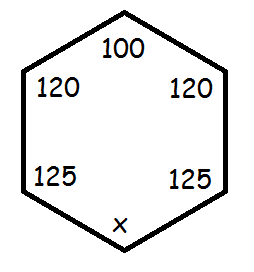
Find the value of X.
a)
100
b)
120
c)
125
d)
130
10.
Find the value of x
a)
141
b)
150
c)
135
d)
163
11.

What is the sum of the exterior angles of a decagon?

a)

1440

b)

360

c)

540

d)

720

12.

If ABCD is a parallelogram, what is the length of BD?

a)

10

b)

11

c)

7

d)

5

13.

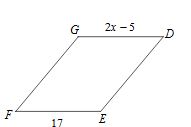
The figure is a parallelogram.

Solve for x.

a)

11

b)

10

c)

6

d)

2

14.

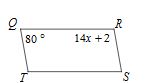
The figure is a parallelogram.

Solve for x.

a)

1

b)

11

c)

7

d)

6

15.

The figure is a parallelogram.

Solve for x.

a)

7

b)

2

c)

0

d)

4

16.
The opposite sides of a parallelogram are...
a)
congruent
b)
perpendicular
c)
skew
d)
supplementary
17.
The opposite angles of a parallelogram are ...
a)
complementary
b)
congruent
c)
supplementary
d)
perpendicular
18.
What is the best definition of a parallelogram?
a)
quadrilateral with one pair of parallel sides 
b)
quadrilateral with two pairs of parallel sides
c)
any four sided figure with opposite sides congruent 
d)
a quadrilateral with two pairs of congruent sides
19.
Diagonals of a parallelogram bisect each other
a)
always true
b)
sometimes true
c)
never true
20.
What do we know about the diagonals of ALL parallelogram?
a)
They are congruent
b)
They bisect each other
c)
They are perpendicular to each other
d)
They are parallel to each other
21.

Parallelograms are ...

a)

triangles

b)

quadrilaterals

c)

pentagons

d)

hexagons

22.
State which method we can use to show that the quadrilateral is a parallelogram. 
a)
Both pairs of opposite angles are congruent.
b)
Both pairs of opposite sides are congruent.
c)
Both pairs of diagonals bisect each other.
d)
Both pairs of opposite sides are parallel. 
23.

Is there enough information to determine that this quadrilateral is a parallelogram?

a)

yes, all opposite sides are congruent

b)

yes, opposite angles are congruent

c)

yes, opposite sides are parallel

d)

yes, consecutive interior angles are supplementary

24.
The figure is a parallelogram.  
Solve for x.  
a)
1
b)
8
c)
2
d)
6
25.
In a parallelogram, consecutive angles are __________.
a)
congruent
b)
supplementary
c)
corresponding
d)
parallel
26.
The figure is a parallelogram.  
Solve for x.  
a)
7
b)
2
c)
0
d)
4
27.
State which method we can use to show that the quadrilateral is a parallelogram. 
a)
Both pairs of opposite angles are congruent.
b)
Both pairs of opposite sides are congruent.
c)
Both pairs of diagonals bisect each other.
d)
Both pairs of opposite sides are parallel. 
28.
How do you find the length of the side of a parallelogram?
a)
Use the distance formula
b)
Use the slope formula
c)
Use the midpoint formula
29.
How do you prove two lines are parallel?
a)
Use the distance formula
b)
Use the midpoint formula
c)
Use the slope formula and show the slopes are the same
d)
Use the slope formula and show the slopes are opposite reciprocals
30.

Is the quadrilateral a parallelogram?

a)

Yes; one pair of opposite sides are parallel

b)

Yes; one pair of opposite sides are congruent

c)

Yes; opposite sides are parallel and congruent

d)

No; only one pair of sides are parallel

e)

No; only one pair of sides are congruent

31.

Diagonals of a rectangle are congruent.

a)

True

b)

False

32.

All sides of a rhombus are congruent.

a)

True

b)

False

33.

All sides of a rhombus are congruent.

a)

True

b)

False

34.

Diagonals of a rectangle are perpendicular.

a)

True

b)

False

35.

A rhombus has four right angles.

a)

True

b)

False

36.

Diagonals of a rectangle bisect the angles.

a)

True

b)

False

37.

Diagonals of a rhombus bisect the angles.

a)

True

b)

False

38.
Which quadrilateral has opposite sides parallel?
a)
Rectangle
b)
Rhombus
c)
Square
d)
All of these do
39.
Which quadrilateral always has four right angles?
a)
Parallelogram
b)
Rectangle
c)
Rhombus
d)
Trapezoid
40.
A rectangle is a parallelogram.
a)
always
b)
sometimes
c)
never
41.
A parallelogram is a rectangle.
a)
always
b)
sometimes
c)
never
42.
  ABCD is a rectangle.    AB = 14, BC = 9, AC = 22.  Find DC.
a)
14
b)
9
c)
11
d)
22
43.
ABCD is a rectangle.  AB = 14, BC = 9, AC = 22.  Find ED.
a)
11
b)
22
c)
14
d)
9
44.
If the figure is a rectangle, the value of x is...
a)
2
b)
12
c)
13
d)
28
45.
Name the following shape: 
a)
Rhombus
b)
Rectangle
c)
Square
46.
Which quadrilateral does not have diagonals that are perpendicular?
a)
Rectangle
b)
Rhombus
c)
Square
47.
A square is a rectangle.
a)
Sometimes
b)
Always
c)
Never
48.

A square is a parallelogram.

a)

True

b)

False

49.

A square is a rhombus.

a)

True

b)

False

50.
A square has all the properties of a
a)
parallelogram
b)
rectangle
c)
rhombus
d)
parallelogram, rectangle, and rhombus
51.

Which of the following statements is false?

a)

a kite has no parallel sides

b)

a kite has one pair of congruent angles

c)

the diagonals of a kite are perpendicular

d)

the diagonals of a kite are congruent

52.
The sum of all four angles in a quadrilateral is ____________.
a)
360 degrees
b)
180 degrees
c)
90 degrees
d)
supplementary
53.
Find the measure of ∠1:
a)
79°
b)
101°
c)
72°
d)
180°
54.
Which of the following statements is true?
a)
a kite has congruent opposite sides
b)
a kite has two pairs of congruent angles
c)
the diagonals of a kite are perpendicular
d)
the diagonals of a kite form 4 congruent triangles
55.
The diagonals in a kite  __________.
a)
are perpendicular
b)
are congruent
c)
bisect each other
56.
Solve for Angle 1 and Angle 2.
a)
1= 92, 2 = 46 degrees
b)
1 = 118, 2 = 118 degrees
c)
1 = 92, 2 = 92 
d)
1 = 136, 2 = 100 
57.
Base angles of an isosceles trapezoid are _____.
a)
neither
b)
supplementary
c)
congruent
58.
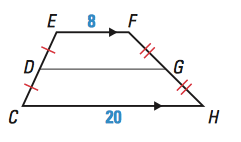
Find the measure of DG.
a)
14
b)
28
c)
12
d)
16
59.
Find the value of x.
a)
23
b)
28
c)
30
d)
Cannot be determined
60.
The legs of an isosceles trapezoid are _____.
a)
parallel
b)
perpendicular
c)
congruent
d)
skew
61.
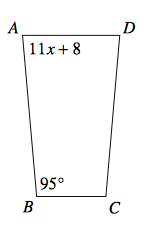
Find the value of x.
a)
35
b)
3
c)
33
d)
None of these
62.
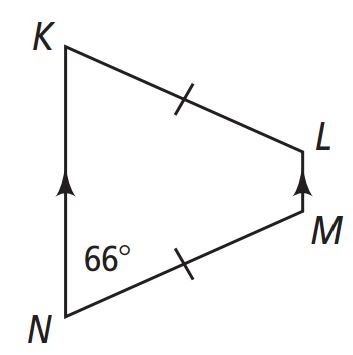
Find the measure of ∠K:
a)
114°
b)
124°
c)
77°
d)
66°
63.
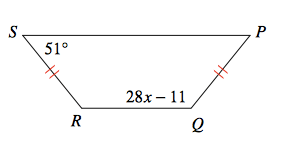
Find the value of x.
a)
4
b)
6
c)
5
d)
129
64.
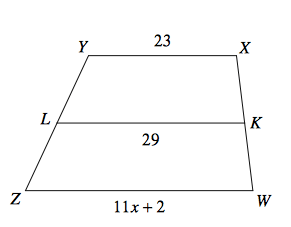
What is x?
a)
35
b)
45
c)
55
d)
90
65.
Find the value of x.
a)
7
b)
8
c)
85
d)
None of these
66.
What is the correct name for the shape?
a)
Rectangle
b)
Trapezoid
c)
Kite
d)
Pentagon
67.

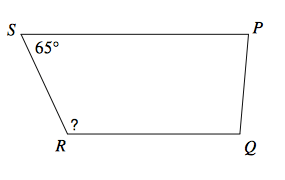
Find the missing angle of the trapezoid.

a)

65

b)

115

c)

180

d)

None of these

68.
Kite LMNO is shown.
Solve for x.
a)
90
b)
180
c)
60
d)
75
69.
A trapezoid is a quadrilateral with exactly one pair of _____ sides.
a)
parallel
b)
congruent
c)
perpendicular
d)
skew
70.

The diagonals of a rhombus (select two )

a)

are perpendicular

b)

are congruent

c)

bisect opposite angles

d)

are parallel