

wayground logo

Free Printable Worksheets

NEW

Font size

S
M
L
XL
Worksheets

1st 9 Weeks REVIEW

Total questions: 45

Worksheet time: 38mins

Name
Class
Date
1.
What is atomic number?
a)
Number of protons in an atoms 
b)
Number of neutrons in an atom
c)
Mass of an atom
d)
Charge on an atom
2.
Which subatomic particles are found in the nucleus of an atom?
a)
Protons and Electrons
b)
Protons and Neutrons
c)
Neutrons and Electrons
d)
Protons, Neutrons and Electrons
3.
What electrical charge does a proton have?
a)
+1
b)
0
c)
-1
d)
+2
4.
The total number of protons and neutrons in an atom is called the...
a)
Atomic number
b)
Proton number
c)
Mass number
d)
Weight number
5.
Complete the missing label on the diagram.
a)
Neutron
b)
Centre
c)
Nucleus
d)
Sub atomic particle
6.
Atoms of the same element must always have the same number of _________
a)
electrons
b)
neutrons
c)
isotopes
d)
protons
7.

The mass number of an element that has 18 protons, 18 electrons, and 19 neutrons is _____.

a)

12.5

b)

13

c)

25

d)

37

8.
What element is represented in this Bohr Model? 
a)
Carbon
b)
Hydrogen
c)
Aluminum
d)
Lithium
9.
Which particle is negatively charged?
a)
proton
b)
atom
c)
neutron
d)
electron
10.

What is the correct number of subatomic particles of a phosphorous atom with a mass of 31?

a)

p# - 15, n# = 15, e# = 15

b)

p# - 15, n# = 16, e# = 15

c)

p# - 15, n# = 15, e# = 16

d)

p# - 16, n# = 15, e# = 15

11.

The vertical (up and down) columns in the Periodic Table are called

a)

groups

b)

towers

c)

periods

d)

atomic numbers

12.
Which group of the periodic table is composed of inert (not reactive)  gases?
a)
alkali metals
b)
alkaline earth metals
c)
halogens
d)
noble gases
13.
The atoms along the staircase are called 
a)
metals
b)
nonmetals
c)
metalloids
d)
noble gases
14.
Elements in a ..................have similar chemical properties.  
a)
period
b)
group
c)
row
15.
Elements in the same column of the periodic table always have the same # of _______ as one another.
a)
Protons
b)
Neutrons
c)
Electrons
d)
Valence Electrons
16.
How many valence electrons are in an atom of K?
a)
3
b)
8
c)
4
d)
1
17.
Sodium (Na) and potassium (K) are in the same group on the periodic table. Based on their locations, which statement about sodium and potassium is true?
a)
Sodium is less electronegative than potassium. 
b)
Sodium has fewer energy levels than potassium. 
c)
Sodium has a larger ionic radius than potassium. 
d)
Sodium has lower ionization energy than potassium. 
18.
Which of these elements has an electron structure most similar to that of element X?
a)
1
b)
2
c)
3
d)
4
19.

Which elements have the same number of energy levels?

a)

Hydrogen, Sodium, Potassium

b)

Lithium, Carbon, Nitrogen

c)

Neon, Helium, Carbon

d)

Calcium, Magnesium, Borin

20.
Is this a metal, nonmetal or metalloid?
a)
Metal
b)
Nonmetal
c)
Metalloid
21.
How many atoms of carbon (C) are in C6H12O6?
a)
3
b)
6
c)
12
d)
24
22.
How many Hydrogen are in 4H2O?
a)
6
b)
8
c)
2
d)
4
23.
Which of the following reactions is balanced?
a)
2CH4 + O2 -> CO2 + H2O
b)
CH4 + 2O2 -> CO2 + H2O
c)
CH4 + 2O2 -> CO2 + 2H2O
d)
None of the chemical equations are balanced.
24.
The substances listed on the left side of a chemical equation are the
a)
Products
b)
Coefficients
c)
Precipitates
d)
Reactants
25.
The substances listed on the right side of a chemical equation are the
a)
Yields
b)
Reactants
c)
Products
d)
Precipitates
26.

Which is the Law of Conservation of Matter?

a)

matter cannot be created or destroyed, it only rearranges

b)

matter can be created but it cannot be destroyed, it never rearranges

c)

matter can be destroyed but it cannot be created, it usually just rearranges

d)

matter is an unproven theory created by Hans Geiger
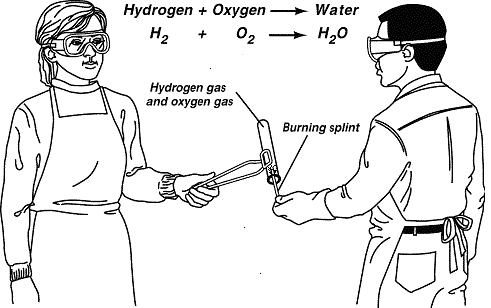
27.
Identify the reactant(s) and product(s) of the reaction.
a)
All three are reactants and none are products.
b)
Hydrogen and water are the reactants, and oxygen is the product.
c)
Water and oxygen are the reactants, and hydrogen is the product.
d)
Hydrogen and oxygen are the reactants, and water is the product.
28.
Which one is a compound?
a)
Co
b)
Br
c)
Fe
d)
CO
29.
Which one is an element?
a)
Co
b)
CO
c)
CO2
d)
CO3-2
30.
How many elements are found in the following molecule? Mg(ClO3)2
a)
1
b)
4
c)
3
d)
5
31.
Which of the following is a chemical change rather than a physical change 
a)
boiling water at 100 C
b)
chopping up a piece of wood. 
c)
cooking a cake 
d)
ice carbon dioxide sublimating to gas 
32.
An gel ice pack getting cold after you put it in the freezer for an hour.
a)
Chemical Change
b)
Physical Change
33.
Which of the following IS a physical change?
a)
Getting a haircut
b)
Rusty metal
c)
sour milk
d)
A compound
34.
Which of the following IS a chemical change
a)
using chalk
b)
water freezing
c)
slicing cheese
d)
digestion
35.
How do chemical reactions turn substances into new substances?
a)
with burning acid
b)
the molecules mix together and create new substances
c)
the atoms break apart and combine back together in new ways
d)
the ionic compounds mix in water to form solutions
36.
Your mother used pancake mix, eggs, and milk to make pancakes.  Which of these is the product?
a)
the pancake mix
b)
the eggs
c)
the milk
d)
the pancakes
37.
Which of the following is an example of a physical change?
a)
wood burning
b)
ice melting
c)
food digesting
d)
iron rusting
38.
Which of the following is an example of a chemical change?
a)
rusting of a bicycle
b)
painting a house
c)
washing a dog
d)
tearing up a newspaper
39.
a)
2
b)
8
c)
3
d)
13
40.
Valence electrons are the...
a)
Innermost electrons
b)
Middle electrons
c)
Outermost electrons
d)
Any electrons
41.

What groups are the most reactive metals?

a)

2 and 3

b)

1 and 18

c)

1 and 2

d)

16 and 17

42.

What groups are the most reactive non metals?

a)

1 and 2

b)

16 and 17

c)

2 and 17

d)

1 and 16

43.
How many valence electrons are elements trying to reach in their outer shells?
a)
1
b)
2
c)
5
d)
8
44.
What determines the reactivity of an element?
a)
Size of its nucleus
b)
Number of total electrons
c)
Number of valence electrons
d)
Number of shells
45.
How do you determine the number of valence electrons an element has?
a)
Look at its period
b)
Look at its group
c)
Look at its atomic number
d)
Look at its atomic mass

