
 Worksheets
Symbiosis, Succession, Levels of Org. Fall Final Review
Total questions: 15
Worksheet time: 11mins
Foraging honey bees collect pollen from plants and transport it to the beehive, where it's stored and used as food for the colony. Bees help flowers by transferring pollen between flowering plants. Which best describes this relationship?
Parasitism
Mutualism
Predation
Commensalism
Cuckoo birds lay their eggs in the nests of other birds. The cuckoo chicks then compete for food with the host's own babies. The cuckoo birds are bigger and often get more food than the smaller birds, so the smaller birds often starve. Which best describes this relationship?
Parasitism
Mutualism
Predation
Commensalism
Bacteria in the nodules of legume plants convert nitrogen into a form that the plants can use through a process called nitrogen fixation. In return for giving useful nitrogen to the plant, the bacteria receive shelter, carbon, and energy from the plant. Which best describes this relationship?
Predator-prey
Parasite-host
Commensalistic
Mutualistic
Birds live in the hollows of trees. Their presence does no harm to the tree, but the tree provides the bird with shelter and protection.
Parasitism
Mutualism
Competition
Commensalism
If a new island is created and it is bare rock, which of the following is likely to be the first organism to live there?
Lichen
Grass
Weeds
Birds
If a volcano erupts and creates a new island in the middle of the ocean, which of the following gives some examples of life on the new island in the correct order of ecological succession?
Barren rock, mosses and lichens, grasses and small plants, dwarf trees
Dwarf trees, barren rock, mosses and lichens, and grasses and small plants
Mosses and lichens, dwarf trees, barren rock, and grasses and small plants
Barren rock, grasses, mosses and lichen, dwarf trees
Which of the following correctly gives the levels of organization from smallest to largest?
Population, community, ecosystem, biosphere, biome
Organelle, cell, tissue, organ, organ system, organism
Population, community, ecosystem, organism, organ system
Cell, tissue, organ, organelle, organ system, organism, population
A lichen is composed of two organisms, a fungus and a cyanobacterium. The fungus provides a growing surface, moisture, and nutrients to the cyanobacterium. The cyanobacterium provides food to the fungus. This relationship is considered to be an example of which of the following
neutralism
commensalism
parasitism
mutualism
A remora is a fish that has an adhesive disk on the back of its head that it uses to attach itself to a large shark. When food floats away from the shark's mouth as it feeds, the remora collects the scraps. The relationship between the remora and the shark is an example of ---
predation
parasitism
commensalism
competition

Which table correctly identifies each type of interaction described?


Parrotfish are herbivores that are found in coral reefs. To escape predation, a parrotfish will graze with a rabbitfish, which has venomous spines at the end of its pelvic fins. The rabbitfish does not benefit from this relationship. Which type of relationship do the parrotfish and the rabbitfish have in the coral-reef environment?
predator-prey
parasitic
mutualistic
commensal
Primary succession occurs in an area that has:
Has Soil
Has No Soil
Has Some Soil
none of these
What is the main difference between primary and secondary ecological succession?
Primary begins WITHOUT soil; Secondary begins WITH soil
Primary is the first state and secondary is the second stage
Primary builds plant community; secondary builds animal community.
Primary begins WITH soil; Secondary begins WITHOUT soil
Which of the following is the correct order of ecological succession?
grass - shrubs - lichens - trees
lichens - shrubs - grasses - trees
lichens - grasses - shrubs - trees
grasses - lichens - shrubs - trees
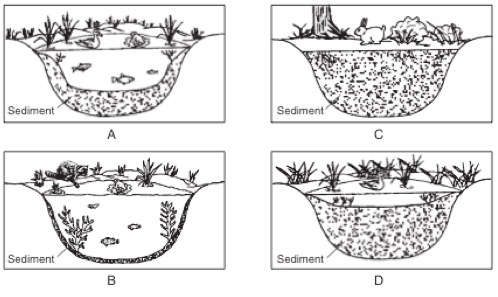
What changes happen during pond succession?
Trees are replaced by grass as the pond gradually develops and gets deeper and deeper due to erosion.
Fish and aquatic plants are replaced by terrestrial organisms as silt and sediment fills the pond.
All organisms die off as the habitat changes

