wayground logo

Free Printable Worksheets

NEW

Font size

S
M
L
XL
Worksheets

Test (Mendel and more)

Total questions: 59

Worksheet time: 1hrs 17mins

Name
Class
Date
1.

Which of the following is heterozygous?

a)

MM

b)

Mm

c)

mm

2.

Which of the following is homozygous dominant?

a)

RR

b)

Rr

c)

rr

3.

What term denotes the physical expression of a gene?

a)

genotype

b)

phenotype

c)

appearance

d)

homologous

4.

Which term denotes the combination of alleles an organism has?

a)

genotpye

b)

phenotype

c)

heterozygous

d)

homozygous

5.

Which term refers to the allele that shows up in the phenotype of a heterozygous genotpye?

a)

invasive

b)

recessive

c)

dominant

d)

passive

6.

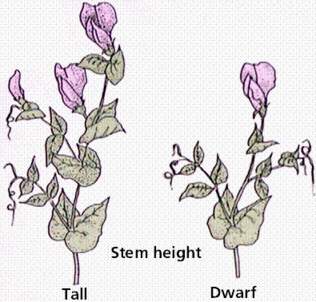
Which of these genotypes would most likely be used to represent the dominant for pea plant height?

a)

TT

b)

tt

c)

PP

d)

pp

7.

Which of the following would produce a recessive phenotype?

a)

hh

b)

Rr

c)

Ww

d)

BB

8.

Which of the following would produce a recessive phenotype?

a)

hh

b)

Rr

c)

Ww

d)

BB

9.

Which of the these is homozygous?

a)

gg

b)

Yy

c)

Nn

d)

Ee

10.

What organism did Mendel study?

a)

pea plants

b)

onions

c)

mice

d)

cats

11.

Gregor Mendel did experimented on what kind of plants?

a)

Lilacs

b)

Peas

c)

Apples

d)

Sunflowers

12.

What is the scientific study of heredity?

a)

Genetics

b)

Epistemology

c)

Pathology

d)

Podiatry

13.

In a heterozygous genotype, the ___________ allele takes over in the phenotype.

a)

recessive

b)

dominant

c)

both

14.

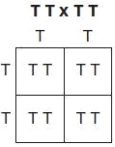
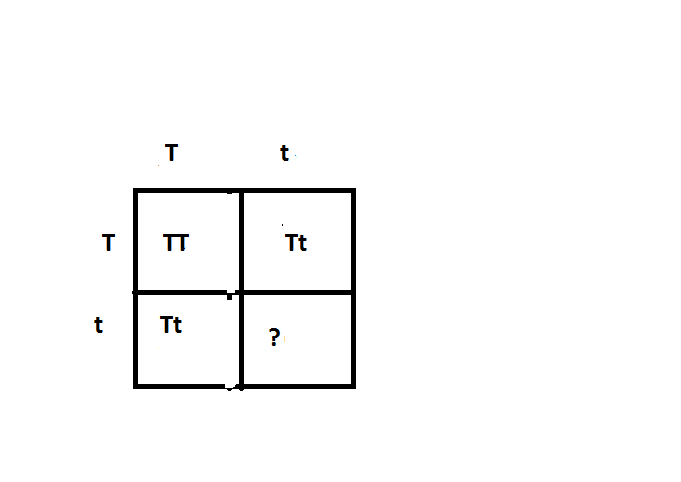
T - tall and t = short

In the Punnett square, what belongs in the missing square?

a)

tt

b)

Tt

c)

TT

15.

G = green, g = yellow

The genotype for a yellow plant is...

a)

GG

b)

Gg

c)

gg

d)

all of the choices result in yellow

16.

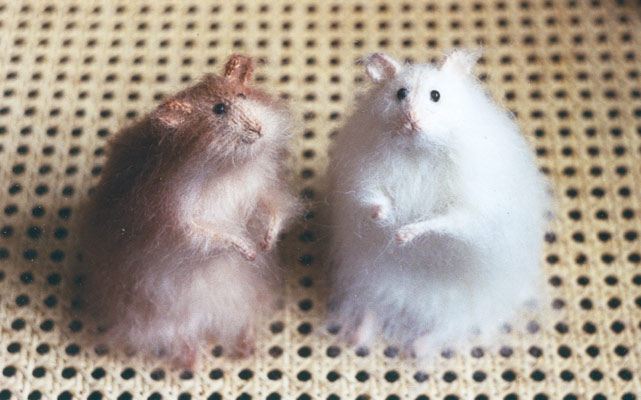
B = brown fur b = white fur

In the punnett square, what is the probability for white fur?

a)

0%

b)

25%

c)

50%

d)

75%

17.

In plants, tall (T) is dominant to short (t). Perform the following cross: Tt x Tt. What is the probability of producing a short plant?

a)

0%

b)

25%

c)

50%

d)

75%

18.

Which of the following alleles is purebred recessive?

a)

Tt

b)

tt

c)

TT

19.

Two brown eyed parents (Bb) have a baby. What is the chance their baby is blue eyed?

a)

0 %

b)

25%

c)

50%

d)

75%

20.

Each one of the boxes on the Punnett square represents what probability of an offspring's genotype?

a)

25%

b)

1%

c)

10%

d)

0%

21.

Aa, DD, Ba, and yy are all examples of ---

a)

genotypes

b)

phenotypes

22.

AA and Aa always show up as ---

a)

dominant.

b)

recessive.

23.

What is ratio of the offspring from the cross shown will be homozygous recessive for the trait of tallness? T = tall t = short

a)

0 in 4

b)

1 in 4

c)

2 in 4

d)

4 in 4

24.
If T=Tall & t=short, what is the genotypic ratio?
a)
1:3
b)
3:1
c)
1:2:1
d)
2:2
25.
B = brown fur  b = white fur
In the Punnett square, what is the probability for white fur
a)
0%
b)
25%
c)
50%
d)
75%
26.
A heterozygous yellow pea plant's genotype would be:
a)
YY
b)
yy
c)
Yy
d)
Yg
27.
What are the possible genotypes for this cross?
(Click the picture to see it without the text)
a)
TT = 25% Tt= 50% tt=25%
b)
all tall
c)
TT= 75% tt = 25%
d)
Tt = 100%
28.
In the Punnett square shown, what must the genotype of the missing parent be?
a)
BB
b)
Bb
c)
bb
d)
Tt
29.
Heterozygous is when...
a)
the alleles are the same
b)
the alleles are different
c)
the alleles are absent
d)
the alleles are present
30.
In a heterozygous genotype, the ___________ allele takes over in the phenotype.
a)
recessive
b)
dominant
c)
lower case letter
d)
both 
31.
G = green, g = yellow
The genotype for a yellow plant is...
a)
GG
b)
Gg
c)
gg
d)
all of the choices result in yellow
32.
B = brown fur  b = white fur
In the punnett square, what is the probability for white fur? 
a)
0%
b)
25%
c)
50%
d)
75%
33.
T - tall and t = short
In the punnett square below, what belongs in the missing square
a)
tt
b)
Tt
c)
Bb
d)
TT
34.
B = brown fur  b = white fur
In the punnett square, what is the probability for white fur? 
a)
0%
b)
25%
c)
50%
d)
75%
35.
What is the probability of heterozygous offspring?
a)
25%
b)
50%
c)
0%
d)
100%
36.
What allele combination should go in the missing box?
a)
AA
b)
Aa
c)
aa
d)
none of these
37.
In a flowering plant species, red flower color (R) is dominant over white flower color (r). What is the genotype of any red-flowering plant resulting from this species?
a)
rr
b)
R
c)
RR
d)
RR or Rr
38.

If a heterozygous parent and a homozygous recessive parent mate, what percentage of their offspring will be dominant?

a)

25%

b)

50%

c)

75%

d)

100%

39.
If you have a parent who has GgBb as their genotype, what are the possible alleles they could donate to their gametes?
a)
GB, Gb, gB, gb
b)
GB, GB, gb, gb
c)
Gb, Gb, Gb, GB
d)
GG, BB, gg, bb
40.
How many offspring will you have in a dihybrid cross? 
a)
4
b)
8
c)
16
d)
5
41.
T4 - Black fur in mice (B) is dominant to brown fur (b). Short tails (T) are dominant to long tails (t). What percentage of the offspring of the cross BbTt x BBtt will have black fur and long tails?
a)
0%
b)
25%
c)
50%
d)
100%
42.
T4 - What genotype is missing from this Punnett Square?
a)
RrYy
b)
RRYY
c)
rryy
d)
RrYY
43.
T4 - Based off this Punnett Square, what fraction of the offspring will have wrinkled, yellow seeds?
a)
9/16
b)
3/16
c)
1/16
d)
16/16
44.
T4 - What fraction of offspring from the cross AaBB x Aabb will be heterozygous for both traits (ex. AaBb) ?
a)
1/16
b)
1/4
c)
1/2
d)
3/16
45.
T4 - Based off this Punnett Square, what fraction of the offspring will have wrinkled, yellow seeds?
a)
9/16
b)
3/16
c)
1/16
d)
16/16
46.
Assume mom's gametes are on the left, what is her genotype?
a)
TTZz
b)
TtZz
c)
ttZZ
d)
TtZZ
47.
Assume dad's gametes are on top, what is his genotype?
a)
AAPP
b)
AaPp
c)
aaPP
d)
Aapp
48.
In watermelons, green rinds (G) are dominant to striped rinds (g).  What is the genotype of a heterozygous green watermelon?
a)
GG
b)
Gg
c)
gg
d)
green
49.
In cacti, long arms (A) are dominant to short arms (a).  Suppose 2 heterozygous cacti are crossed.  What percentage of their offspring are expected to have short arms?
a)
0%
b)
25%
c)
75%
d)
100%
50.
Long tongues (T) are dominant to short tongues in green tree frogs.  What is the probability that two frogs that are heterozygous for long tongues could produce offspring with short tongues?
a)
100%
b)
75%
c)
50%
d)
25%
51.
One of the two forms of a gene is called a(n)
a)
genotype
b)
allele
c)
hybrid
d)
trait
52.
Black fur is dominant (B) over white fur (b).  Find the probability of heterozygous offspring using the following genotype of these parents.
Bb + bb
a)
0%
b)
25%
c)
50%
d)
100%
53.
Gregor Mendel is often called ....
a)
The father of heredity.
b)
The father of genetics.
c)
The king of peas
d)
The father of punnett squares.
54.
What are genes?
a)
Something you wear.
b)
Segments of DNA that carry traits for offspring.
c)
The powerhouse of cells.
d)
None of the above.
55.
What would be the results of a genetic cross between the following parents?  TT + Tt
a)
Tt, tt, tt, tt
b)
TT, TT, TT, Tt
c)
Tt, Tt, Tt, TT
d)
TT, TT, Tt, Tt
56.
It is NOT possible for two purebred black rabbits (both BB) to produce white offspring.
a)
True
b)
False
57.
Each one of the boxes on the Punnett Square represents what probability of an offsprings' genotype?
a)
25%
b)
1%
c)
10%
d)
0%
58.
T - tall and t = short
In the punnett square below, what belongs in the missing square

a)
tt
b)
Tt
c)
Bb
d)
TT
59.
A green pea plant (GG) is being crossed with a green pea plant (Gg). What is the phenotype?
a)
100 % rainbow 
b)
50% yellow and 50% green 
c)
100% green
d)
100% yellow