wayground logo

Free Printable Worksheets

NEW

Font size

S
M
L
XL
Worksheets

Ocean Floor Features

Total questions: 40

Worksheet time: 40mins
Name
Class
Date
1.
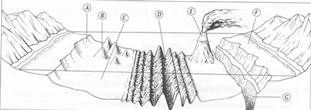
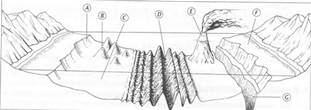
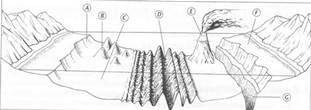
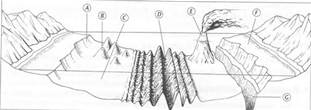
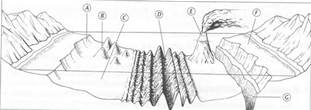
What is letter A?
a)
Cont. Shelf
b)
Cont. Slope
c)
Seamount
d)
Abyssal Plain
2.
What letter is B?
a)
Cont. Shelf
b)
Cont. Slope
c)
Mid-Ocean Ridge
d)
Seamount
3.
What is letter C?
a)
Mid-Ocean Ridge
b)
Cont. Shelf
c)
Cont. Slope
d)
Abyssal Plain
4.
What is letter D?
a)
Cont. Shelf
b)
Mid-Ocean Ridge
c)
Volcanic Island
d)
Seamount
5.
What is letter E?
a)
Volcanic Island
b)
Seamount
c)
Mid-Ocean Ridge
d)
Abyssal Plain
6.
What is letter G?
a)
Mid-Ocean Ridge
b)
Rift
c)
Trench
d)
Cont. Shelf
7.
The gradually sloping part of a continent that extends under the ocean is the...
a)
continental slope
b)
continental shelf
c)
abyssal plain
d)
trench
8.
Seamount is similiar to...
a)
a volcanic island
b)
a small mountain or volcano
c)
The Great Plains
d)
The Grand Canyon
9.
The continental slope is located at the end of the...
a)
shoreline
b)
continental shelf
c)
mid ocean ridge
d)
abyssal plain
10.
The place where new ocean floor forms is called the...
a)
mid ocean ridge
b)
abyssal plain
c)
trench
d)
continental shelf
11.
The shallowest(least deep) part of the ocean is the ____________________
a)
trench
b)
abyssal plain
c)
continental shelf
d)
continental slope
12.
the deepest part of the ocean
a)
trenches
b)
abyssal plain
c)
ocean basin
d)
rift
13.
Which process adds more crust to the ocean floor?
a)
earthquakes
b)
sea floor spreading 
c)
subduction
d)
convection
14.
What is the difference between a volcanic island & a seamount?
a)
A volcanic island rises above the water & a seamount does not
b)
A seamount rises above the water & a volcanic island does not
c)
Both the seamount & volcanic island are underwater
d)
Both the seamount & the volcanic island rise above the water
15.
The Maraina __________ is the deepest known place on Earth
a)
Volcanoe
b)
Seamount
c)
Ridge
d)
Trench
16.
Which is the largest ocean?
a)
Pacific
b)
Atlantic
c)
Arctic
d)
Indian
17.
How many oceans are there?
a)
1
b)
10
c)
5
d)
2
18.
What are underwater mountain ranges called?
a)
continental shelf
b)
mid-ocean ridges
c)
abyssal plains
d)
continental slopes
19.
What are valleys between the mountain ridges?
a)
rift zones
b)
trenches
c)
abyssal plains
d)
continental slope
20.
Which pair represents wide, flat areas of land? 
a)
Mountains- Mid-Ocean Ridge
b)
Trench- Canyon
c)
Plains- Abyssal Plains
d)
Volcano-Seamount 
21.
The ocean makes up about ________ % of the Earth's surface. 
a)
100%
b)
53%
c)
70 %
d)
90%
22.
When you are building a sand castle on the beach, what feature are you standing on? 
a)
abyssal plain
b)
continental shelf
c)
seamount
d)
continental rise
23.
Which of the following describes a trench
a)
it rises above the water
b)
flat, low lying area of the ocean floor
c)
a stretch of underwater mountains
d)
deep cuts in the ocean floor, canyon-like 
24.
The abyssal plain makes up most of the ocean _____________. 
a)
mountain ranges
b)
islands
c)
floor
d)
features
25.
Label F
a)
continental slope
b)
continental shelf
c)
abyssal plain
d)
sea mount
26.
_____________ is the measure of how salty the ocean's water is. 
a)
salinity
b)
solution 
c)
coral 
d)
plankton 
27.

As the depth of the ocean water increases, the temperature...

a)

increases (warmer)

b)

decreases (colder)

28.

Where are you walking when you are wading in the ocean?

a)

Ocean Trench

b)

Abyssal Plain

c)

Continental Slope

d)

Continental Shelf

29.

Which of the following is the best order from beach to middle of the ocean?

a)

continental shelf, continental slope, abyssal plane

b)

continental slope, continental shelf, abyssal plane

c)

continental shelf, abyssal plane, continental slope

d)

continental slope, abyssal plane, continental shelf

30.
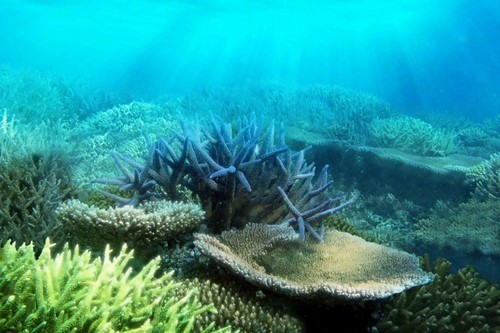
Which ocean feature is pictured?
a)
Trench
b)
Mid-Ocean Ridge
c)
Seamount
d)
Volcanic Island
31.
Scientists use ______ to determine the oceans depth.
a)
Submarine
b)
Sonar
c)
Helicopter
d)
Light
32.
This image shows
a)
sea floor is spreading
b)
continental shelf
c)
continental slope
d)
sea mount
33.
Which structure extends from the outer edge of the continental shelf to the ocean floor?
a)
continental slope
b)
abyssal plain
c)
oceanic trench
d)
sea mount
34.
Refer to the photo. The plate boundary at point "G" is:
a)
Transform
b)
Divergent
c)
Convergent
d)
Subduction zone
35.
Refer to the photo. The plate boundary at point "D" is:
a)
Transform
b)
Divergent
c)
Convergent
d)
Subduction zone
36.

What is the difference between a guyot and a seamount?

a)

Guyots are rounded, seamounts are not.

b)

Seamounts are rounded, guyots are not.

c)

Seamounts have been weathered by wave and becomes a guyot, a cone shaped volcano.

d)

Seamounts are cone shaped volcanoes, and biologically, that would scientifically confirm that there is no difference.

37.

Converging ocean crustal plates which pushes one back into Earth's mantle causes this feature

a)

deep-ocean trench

b)

turbidity currents

c)

continental rise

d)

submarine canyon

38.
A guyot has a flat top due to
a)
Swift ocean currents
b)
Weathering and erosion when it was an island
c)
Bioerosion over time
d)
The density of the rock it's made out of
39.
This boundary moves away from another boundary.
a)
divergent
b)
convergent
c)
transform
40.
This boundary is also called a colliding boundary.
a)
transform
b)
convergent
c)
divergent