
 Worksheets
Dilations and Multiple Transformations
Total questions: 50
Worksheet time: 2hrs 54mins
A(3,3) B(6,6) C(9,3)

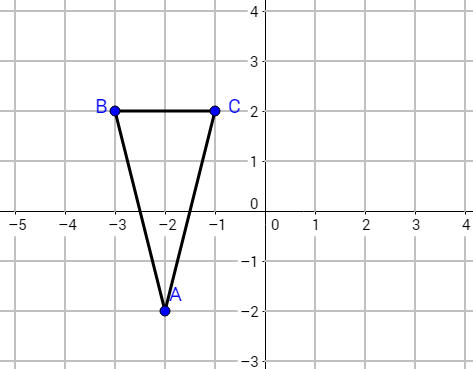
TRUE or FALSE:
A dilation produces an image that is similar to the pre-image.
True
False
TRUE OR FALSE:
When a dilation has a scale factor greater than one, the dilation is an enlargement.
True
False


TRUE OR FALSE:
The image A'B'C' is a rotation of ABC.
True
False

Which of the following describes the sequence of transformations shown?
Reflect across the x-axis and then rotate -90 degrees cw around the origin
Rotate 90 degrees cw around the origin and then translate down.
Reflect across the x-axis and then reflect across the y-axis.
Translate up and then rotate 90 degrees ccw about the origin.


Pre-Image: (2, 6)
Translate up 3, left 1 and rotate 180°
Image:
(-1,-9)
(1, -9)
(5,5)
(-5,5)
Pre-Image: (-3, -1)
Reflect across the line y = x and translate down 1
Image:
(-1, -4)
(-1, -2)
(3, 0)
(-2, -3)

Choose the correct transformations
rotate 90 degrees counter-clockwise around the origin, and then reflect over the x-axis
right 1, down 4, and then reflection over the y-axis
right 6, and then reflection over the x-axis
reflection over the line y=x, and then translate up 4, right 2

Identify the transformations:
rotation
reflection
translation
dilation
Point A is rotated 180 degrees and then flipped over the y-axis. What is A" if A is (2,7)
(2,7)
(-2, -7)
(-2, 7)
(2, -7)
Find Q''' if Q(-3, 1) is:
reflected over the x-axis
rotated 90 degrees ccw
translated right 3 and up 4
(-3, 1)
(4, 1)
(4, -1)
(-3,-1)
Triangle ABC is rotated 90 degrees ccw ,and then translated up 4 and left 5. What is point A if point A''' is (1,2)?
(2, -4)
(2,6)
(4, -2)
(-2 -6)
Given the triangle A(2,3) B(5,3) C(5,0) under a dilation with a scale factor of 34 . What are the coordinated for the image?
A(38,4) B(320,4)C(320,0)
A(2.6,4)B(4,6.7) C(4,0)
A(32,1) B(35,1) C(35,0)
A figure is dilated so that point C(2, 9) becomes C'(8, 36). what is the rule for this transformation?
(x, y) --> (1/4x, 1/4y)
(x, y) --> (4x, 4y)
(x, y) --> (x + 6, y + 27)
Not here
(x, y) --> (x - 6, y - 27)
A figure is dilated so that point C(8, 36) becomes C'(2, 9). what is the rule for this transformation?
(x, y) --> (1/4x, 1/4y)
(x, y) --> (4x, 4y)
(x, y) --> (x - 6, y - 27)
Not here
(x, y) --> (x + 6, y + 27)

What is the rule for this transformation?
(x, y) --> (2x, 2y)
(x, y) --> (1/2x, 1/2y)
(x, y) --> (-2x, -2y)
Not here
Which transformation(s) preserve congruency?
(Choose all that apply)
rotations
reflections
translations
dilations
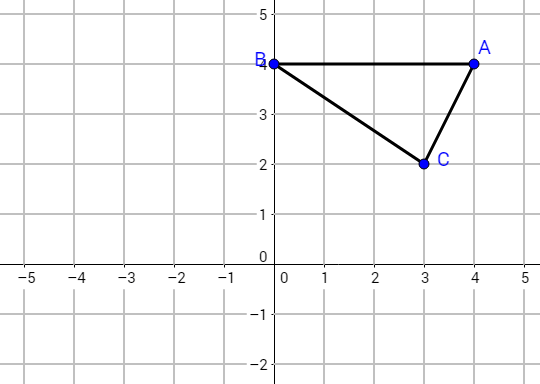

Choose the correct scale factor:
2.5
1.5
3.5
4


Which algebraic expression could be the rule for a reduction?
(x, y)→(2x, 2y)
(x, y)→(5/2x, 5/2y)
(x, y) →(0.5x, 0.5y)
(x, y)→(5x, 5y)
(x, y)→(0.8x, 0.8y)

Polygon ABCDE will be dilated by a scale factor of 2. Select the true statement(s).
The corresponding angles of the two polygons will be equal.
The dilation will be an enlargement.
The pre-image and the image will be congruent.
Polygon A'B'C'D'E' will be proportional to polygon ABCDE.


Under what composition of transformations does triangle ABC map onto triangle A''B''C''
Reflection over x-axis, then Rotation of 90 Degrees
Rotation of 90 Degrees, then Reflection over y-axis
Reflection over y-axis, then Rotation of 90 Degrees
Rotation of 90 Degrees, then Reflection over x-axis

If the red triangle is rotated 180 degrees, then reflected over y=2 what is the final image?
Green Triangle
Blue Triangle
Orange Triangle
Red Triangle

What is the transformation from Triangle ABC to Triangle A''B''C''?
Reflection x-axis, then rotation of 180 Degrees
Reflection over y-axis, then rotation of 90 Degrees
Rotation of 90 Degrees, then reflection over x-axis
Rotation of 180 Degrees, then reflection over y-axis
A reflection over the x-axis followed by a reflection over the y-axis is the same as a ...
Rotation of 180 Degrees
Rotation of 90 Degrees ccw
Reflection over the x-axis
Reflection over the y-axis
Rotation of 90 Degrees cw

Describe the transformations that map ABC onto A"B"C"
translate 5 up and 1 left, then reflect over y-axis
translate 5 down and 1 left, then reflect over y-axis
reflect over y = x, then translate left 8
reflect over x-axis, then rotate 90 degrees clockwise

Name the series of transformations that maps ABC (the pre-image) onto DEF (the image).
The dotted triangle is the transformation between ABC and DEF.
reflect over x-axis, then translate left 6 up 1
reflect over y-axis, then translate down 6 left 1
translate right 6 down 1, then reflect over x-axis
rotate 90 clockwise, then reflect over y-axis

Segment AB is the pre-image. Which segments could be the image if translations, rotations, or reflections were applied?
Select all that apply.
CD
GH
JK
LM
NP
Find the image of A( -3, 5) after:
1. (x,y) --> (x , y - 4)
2. reflect across the y-axis
(3,1)
(3, -1)
(-1, 5)
(-1, 3)
What is the ordered pair for the final location of P( -7, 3) after this series of transformations? (x,y)→(x, y+3) then rotated 90° clockwise about the origin.
P′(−7, 6)
P′(−7, −6)
P′(6, −7)
P′(6, 7)

Which sequence of transformations is used to transform the original image to the final image?
Pre-Image: ABCD
Image: A" B" C"D"
Reflect over the x-axis, then rotate clockwise 90 around the origin.
Rotate counterclockwise 90 around the origin, then translate 8 units left.
Reflect over the y-axis, then rotate counterclockwise 90 around the origin.
Rotate clockwise 90 around the origin, then translate 8 units left.
Quadrilateral QRST is rotated 360 counterclockwise around a center at one of its vertices. Which statements must be true? Select all that apply.
Q'R'S'T' appears as a translation of QRST .
Q'R'S'T' appears as a reflection of QRST .
The coordinate x- and y-values of Q'R'S'T' are the same as QRST coordinate x- and y-values
Image Q'R'S'T' is mapped exactly on top of QRST .
The coordinate x- and y-values of Q'R'S'T' are the reverse of QRST coordinate x- and y-values

Which transformations could be used to transform from the original image to the final image?
Translate 7 units down, then reflect across the y-axis.
Translate 8 units right, then rotate 180.
Rotate 90 counterclockwise, then translate 8 units right.
Rotate 180 around the origin, then translate 7 units up.

What are the series of rigid motions that would map ∆ABC onto ∆A''B''C''?
a reflection followed by a rotation
a reflection followed by a translation
a translation followed by a rotation
a translation followed by a reflection

