
 Worksheets
Charged Particles
Total questions: 10
Worksheet time: 10mins
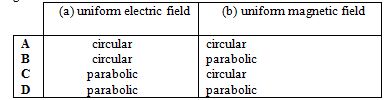
Which line, A to D, correctly describes the trajectory of charged particles which enter, at right angles, (a) a uniform electric field, and (b) a uniform magnetic field?
A
B
C
D
Protons, each of mass m and charge e, follow a circular path when travelling perpendicular to a magnetic field of uniform flux density B. What is the time taken for one complete orbit?
2πeB/m
m/2πeB
eB/2πm
2πm/eB

3.7
7.5
60
112.5
Particles of mass m carrying a charge Q travel in a circular path of radius r in a magnetic field of flux density B with a speed v. How many of the following quantities, if changed one at a time, would change the radius of the path?
m, Q, B, v
one
two
three
four
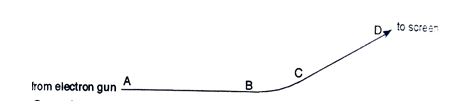
The path of electrons in a CRO follows the path shown above. Part of the path crosses a magnetic field.
In which one or more sections of the path does a magnetic field act on the electron?
AB
BC
CD
no part of the path
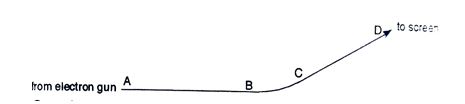
The shape of the path followed by electrons between B and C is best described by:
a circular arc
a parabolic path
a hyperbolic path
none of the option A, B and C
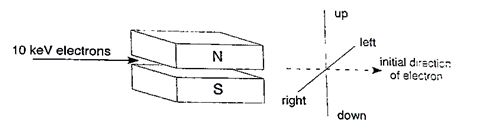
Which of the following best describes the path of an electron as it passes through the magnetic field?
It is deflected to the left.
It is deflected to the right.
It is deflected up.
It is deflected down.
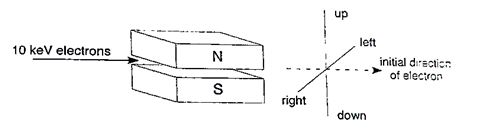
Which of the following is closest to the speed of 10 keV electrons?
6*107 ms-1
7*107 ms-1
8*107 ms-1
9*107 ms-1
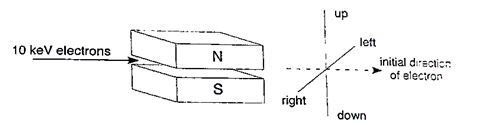
Which of the following is closest to the radius of curvature of 10keV electrons as they travel through a uniform magnetic field of strength 2.0 T?
2*10-3 m
2*10-4 m
2*10-5 m
2*10-7 m
As high-energy electrons pass through one of the bending magnets in a synchrotron, they are bent through an arc of radius 7.0 m. The magnetic field strength is 1.7 T. Which of the following is closest to the momentum of the electrons?
1*10-18 Ns
2*10-18 Ns
3*10-18 Ns
4*10-18 Ns

