wayground logo

Free Printable Worksheets

Font size

S
M
L
XL
Worksheets

Alg2ACP - Intro and Quads Spiral Review

Total questions: 81

Worksheet time: 20hrs 15mins

Name
Class
Date
1.
What is x if
f(x) = -2?
a)
4
b)
0
c)
3
d)
8
2.
Given h(x) = 5 - 9x, find h(8). 
a)
h(8) = -360
b)
h(8) = -67
3.
If f(x) = x - 5, what is the value of x when f(x) = 15?
a)
20
b)
10
c)
5
d)
0
4.
Which ordered pair below would prevent this table from being a function?
a)
(10, 10)
b)
(2, 4)
c)
(6, 1)
d)
(-2, 0)
5.
Which graph is not a function?
a)
Graph 1
b)
Graph 2
c)
Graph 3
d)
Graph 4
6.

Find f(-1)

a)

-3

b)

15

c)

19

d)

17

7.

Find f(-3)

a)

-3

b)

15

c)

19

d)

17

8.

If f(x) = 19, Find the value for x.

a)

0

b)

1

c)

2

d)

3

9.

If f(x) = 4, Find the value for x.

a)

0

b)

1

c)

2

d)

3

10.

Find f(1)

a)

1

b)

2

c)

-1

d)

3

11.

Find f(0)

a)

1

b)

2

c)

-1

d)

3

12.

If f(x) = 3 Find the value of x.

a)

2

b)

4

c)

6

d)

0

13.

If  f(x)=2xf\left(x\right)=2x   and  g(x)=2x21g\left(x\right)=2x^2-1   find  f(g(3))f\left(g\left(3\right)\right)  

a)

34

b)

71

c)

35

d)

142

14.

If  f(x)=2xf\left(x\right)=2x   and  g(x)=2x21g\left(x\right)=2x^2-1   find  g(f(1))g\left(f\left(-1\right)\right)  

a)

2

b)

15

c)

7

d)

-9

15.

If  f(x)=2xf\left(x\right)=2x   and  g(x)=2x21g\left(x\right)=2x^2-1   find  f(g(x))f\left(g\left(x\right)\right)  

a)

 4x214x^2-1  

b)

 4x224x^2-2  

c)

 8x218x^2-1  

d)

 16x2116x^2-1  

16.

If  f(x)=1xf\left(x\right)=\frac{1}{x}   and  g(x)=3x+2g\left(x\right)=3x+2   find  f(g(x))f\left(g\left(x\right)\right)  

a)

 13x+2\frac{1}{3x}+2 

b)

 3x+23x+2  

c)

 3x+2\frac{3}{x}+2  

d)

 13x+2\frac{1}{3x+2}  

17.

Given f and g in the graph,

what is f(f(3)) ?

a)

3

b)

2

c)

4

d)

1

18.

find h(f(-1))

a)

-5

b)

4

c)

-4

d)

12

19.

Find g(f(-2))

a)

-18

b)

-2

c)

1

d)

9

20.

Find h(f(-2))

a)

0

b)

2

c)

-2

d)

26

21.

The line with the equation

y + 1 = -3(x - 5),

contains the point (5, -1)

and has a slope of _______.

a)

-1

b)

1

c)

-3

d)

5

22.

Write the equation in point-slope form

of the line that passes through the point

(4, -7) and has a slope of -1/4.

a)

y + 7 = -1/4(x - 4)

b)

y - 4 = -1/4(x + 7)

c)

y + 7 = 4(x - 4)

d)

y - 7 = -1/4(x - 4)

23.

For the equation

y = 2(x + 4) + 3,

the line has a slope of 2 and contains what point?

a)

(-4, 3)

b)

(3, -4)

c)

(-3, -4)

d)

(-4, -3)

24.

Write the equation of the line in Point-Slope Form.

a)

y=-3/4(x-2)

b)

y=3/5(x-5)+2

c)

y=3/5x-1

d)

y=3/5(x-2)+5

25.

Given the table, what is the equation of the line in point slope form?

a)

y = ½(x - 6) + 12

b)

y = ½(x - 8) + 4

c)

y = ½(x + 4) - 2

d)

y = ½(x +12) - 6

26.

Which is NOT a correct point-slope equation for the line?

a)

y = 1/2(x + 2) + 0

b)

y = 1/2(x - 0) + 1

c)

y = 1/2(x + 2) - 2

d)

y = 1/2(x - 2) + 2

27.

f(x) = -4x - 12

What is f-1(x)?

a)

f-1(x) = 4x - 3

b)

f-1(x) = -1/4x - 3

c)

f-1(x) = 1/4x + 3

d)

f-1(x) = -4x - 3

28.

Which is f -1(x)?

a)

f -1(x) = 5x + 3

b)

f -1(x) = 5x - 3

c)

f -1(x) = 5x - 15

d)

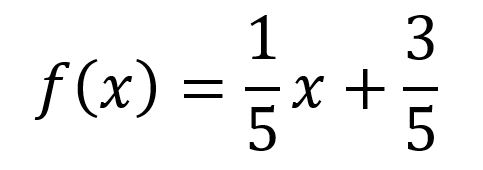
f -1(x) = 1/5(x) + 3/5

29.
Are the following inverses of each other?
a)
True
b)
False
30.
Was the inverse function found correctly?
a)
no,
b)
yes
31.
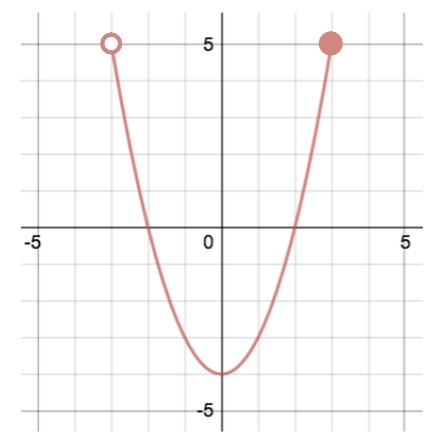
What is the RANGE?
a)
{-3, 3]
b)
all real numbers
c)
[-4, 5]
d)
[-4, ∞)
32.
What is the DOMAIN?
a)
(4, ∞)
b)
(-4, ∞)
c)
[-3, 3)
d)
(-3, 3]
33.
What is the RANGE?
a)
(-∞, 0)
b)
(0, ∞)
c)
All real numbers
d)
{0, 1, 2, 3, 4,...}
34.
What is the DOMAIN?
a)
[0, ∞)
b)
(-∞, 0)
c)
All real numbers
d)
{0, 1, 2, 3, 4,...}
35.
In the above graph complete the following end behavior:
As x --> -∞, f(x) --> ____
As x --> +∞, f(x) --> ____
a)
-∞
-∞
b)
+∞
-∞
c)
-∞
+∞
d)
+∞
+∞
36.

Describe the end behavior of the graph.

a)

x → -∞, f(x) → ∞ and x→∞, f(x) →⁻∞

b)

x → -∞, f(x) → ∞ and x→∞, f(x) →∞

c)

x → -∞, f(x) → ∞ and x→∞, f(x) → 0

d)

x → -∞,f(x) → -∞and x→ ∞, f(x) → ∞

37.
Describe the end behavior of the graph.
a)
x →∞, y→⁻∞ and x →⁻∞,y→⁻∞
b)
x →∞, y→∞ and x→⁻∞, y→∞
c)
x →∞, y→∞ and x→⁻∞, y→0
d)
x →∞,y→∞ and x→⁻∞, y→⁻∞
38.

What is the increasing interval for the function below?

a)

(,)\left(-\infty,\infty\right)

b)

(,2]\left(-\infty,2\right]

c)

(,6]\left(-\infty,6\right]

d)

(6,6)\left(-6,6\right)

39.

What is/are the increasing interval(s) for the function shown?

a)

(3, 1)\left(-3,\ 1\right)

b)

(4, 8)\left(4,\ 8\right)

c)

(,1) and (3, 1)\left(-\infty,1\right)\ and\ \left(-3,\ 1\right)

40.

What is/are the decreasing interval(s) for the function shown?

a)

 (2, 4) and (8, )\left(2,\ 4\right)\ and\ \left(8,\ \infty\right) 

b)

 (, 1) and (8, )\left(-\infty,\ 1\right)\ and\ \left(8,\ \infty\right) 

c)

 (,1), (3, 1) and (8, )\left(-\infty,1\right),\ \left(-3,\ 1\right)\ and\ \left(8,\ \infty\right) 

d)

 (, 1), (2, 4) and (8, )\left(-\infty,\ 1\right),\ \left(2,\ 4\right)\ and\ \left(8,\ \infty\right) 

41.

What is the decreasing interval(s) on the function shown?

a)

(7, 6) and (2, 4)\left(-7,\ -6\right)\ and\ \left(-2,\ 4\right)

b)

(7, 0) and (2, 4)\left(-7,\ 0\right)\ and\ \left(-2,\ 4\right)

c)

(7, 6) and (2, 0)\left(-7,\ -6\right)\ and\ \left(-2,\ 0\right)

d)

(7, 0) and (4, 5)\left(-7,\ 0\right)\ and\ \left(4,\ 5\right)

42.
Using the pictured graph, what is f(-3)? 
a)
-3
b)
-1
c)
1
d)
3
43.
On the graph, which portion of the piecewise function is represented in red?
a)
x
b)
0.5x + 2.5       
c)
-1
d)
0.5x + 2
44.

Match the graph with the correct equation.

a)
b)
c)
d)
45.

Find f(2)

a)

f(2) = 0

b)

f(2) = 1

c)

f(2) = 3

d)

f(2) = 4

46.
a)
A
b)
B
c)
C
d)
D
47.

Describe the transformation that occurred

p(x) = f(x + 3)

a)

Right 3 units

b)

Vertical Stretch

c)

Up 3 units

d)

Left 3 units

48.

Describe the transformation that occurred.

h(x) = f(x) + 2

a)

up 2 units

b)

left 2 units

c)

Vertical Strech

d)

right 2 units

49.

Describe the transformation that occurred

g(x) =2f(x)

a)

Up 2 units

b)

vertical compression

c)

vertical stretch

d)

Right 2 Units

50.
What are the transformations?
y=(x-2)3+4
a)
Horz shift right 2      Vert shift up 4
b)
Horz shift left 2    Vert shift up 4
c)
Horz shift right 2      Vert shift down 4
d)
Horz shift left 2      Vert shift up 4
51.
Describe the transformation of y = g(x) for the function
y = 3g(x - 3) + 5
a)
Shifted up 5 units
Shifted right 3 units
Stretched vertically by a factor of 3
b)
Shifted up 5 units
Shifted left 3 units
Stretched vertically by a factor of 3
c)
Shifted down 5 units
Shifted left 3 units
Stretched vertically by a factor of 3
d)
Shifted down 5 units
Shifted left 3 units
Stretched vertically by a factor of 1/3
52.
Which equation describes the transformation of shifting f(x)=x3 two units right?
a)
x3 + 2
b)
x3 - 2
c)
(x + 2)3
d)
(x - 2)3
53.

Which equation represents the parent quadratic function being vertically stretched by a factor of 2, translated 5 units to the right and translated 3 units down?

a)

y=2(x5)23y=2\left(x-5\right)^2-3

b)

y=2(x+5)23y=2\left(x+5\right)^2-3

c)

y=12(x+5)23y=\frac{1}{2}\left(x+5\right)^2-3

d)

y=12(x5)23y=\frac{1}{2}\left(x-5\right)^2-3

54.
Which function is graphed?
a)
f(x) = 2|x + 2| -4
b)
f(x) = 2|x - 4| + 2
c)
f(x) = |x + 2| - 4
d)
f(x) = -2|x - 4|
55.
Which function is graphed?
a)
f(x) = 2|x - 5|
b)
f(x) = |x - 5|
c)
f(x) = |x - 5| + 5
d)
f(x) = |x| + 5
56.
What is the equation of the absolute value function?
a)
f(x)= 4|x+3|
b)
f(x)= 1/4 |x+3|
c)
f(x)= 1/4 |x - 3|
d)
f(x)= 4|x - 3|
57.
Which graph matches the function:
y = -2|x - 3| + 5
a)
A
b)
B
c)
C
d)
D
58.

What is the vertex of this function?

 f(x)=(x+2)2+4f\left(x\right)=\left(x+2\right)^2+4  

a)

(2, 4)

b)

(-2, 4)

c)

(-4, 2)

d)

(4, 2)

59.

Which of the following describes the extrema of g(x)?

 g(x)=(x4)2+6g\left(x\right)=-\left(x-4\right)^2+6  

a)

Absolute max of 6 at x = 4

b)

Absolute min of 6 at x = 4

c)

Absolute max of 4 at x = 6

d)

Absolute min of 4 at x = 6

60.

What are the x-intercepts of

 f(x)=x27x+12f\left(x\right)=x^2-7x+12  ?

a)

(3, 0) and (4, 0)

b)

(-3, 0) and (4, 0)

c)

(3, 0) and (-4, 0)

d)

(-3, 0 and (-4,0)

61.

What is the y-intercept of

 f(x)=2(x+4)217f\left(x\right)=2\left(x+4\right)^2-17  

a)

(0, -17)

b)

(-17, 0)

c)

(0, 15)

d)

(15, 0)

62.

What is the equation of a quadratic function that goes through (3, -7)?

a)

f(x)=2(x+3)27f\left(x\right)=2\left(x+3\right)^2-7

b)

f(x) = 12(x3)2+7f\left(x\right)\ =\ \frac{1}{2}\left(x-3\right)^2+7

c)

f(x)=3(x3)27f\left(x\right)=3\left(x-3\right)^2-7

d)

f(x)=(x+7)23f\left(x\right)=\left(x+7\right)^2-3

63.

What is the axis of symmetry of

 f(x)=3x2+12x1f\left(x\right)=3x^2+12x-1  ?

a)

2

b)

-2

c)

6

d)

-6

64.

Which of these are quadratic?

(select all that apply)

a)

(x2)(3x+1)\left(x-2\right)\left(3x+1\right)

b)

4x(x2+7)4x\left(x^2+7\right)

c)

(2x3)2+4\left(2x-3\right)^2+4

d)

4x3+5y4x^3+5y

65.

What is the axis of symmetry?

 f(x)=3(x1)(x+7)f\left(x\right)=3\left(x-1\right)\left(x+7\right)  

a)

x = -1

b)

x = 3

c)

x = -3

d)

x = 7

66.

Select all the x-intercepts

 f(x)=2(x+4)(x12)f\left(x\right)=-2\left(x+4\right)\left(x-12\right)  

a)

(-2, 0)

b)

(-4, 0)

c)

(4, 0)

d)

(-12, 0)

e)

(12, 0)

67.

What is the y-intercept?

 f(x)=(x1)(x+5)f\left(x\right)=\left(x-1\right)\left(x+5\right)  

a)

1

b)

-1

c)

5

d)

-5

68.

What is the y-intercept?

 g(x)=x2+4x7g\left(x\right)=-x^2+4x-7  

a)

(0, -7)

b)

(0, 4)

c)

(0, -1)

d)

(0, 2)

69.

What is the vertex?

 h(x)=x2+2x+3h\left(x\right)=x^2+2x+3  

a)

(1, 6)

b)

(-1, 2)

c)

(1, 2)

d)

(-1, 6)

70.
The discriminant is
a)
aX2  + bX  +  c
b)
b - 4ac
c)
b2 - 4ac
d)
b2 + 4ac
71.

What is the discriminant of 6x2 − 2x − 3 = 0

a)

76

b)

29

c)

68

d)

none of these

72.

Solve by factoring: x2 + 3x - 18 = 0

a)

x = -3 and x = 6

b)

x = 3 and x = -6

c)

x = -9 and x = 2

d)

x = 9 and x = -2

73.
Solve by taking square roots:
5b2 - 4 = 41
a)
b = 9, b = -9
b)
b = 3, b = -3
c)
b = 8, b = -8
d)
no solutionb
74.
Use the quadratic formula to find the solutions for
y = 3x3 + 8x - 1
a)
0.1167 and -2.7833
b)
.7 and -16.7
c)
.35 and -8.35
d)
0.2358 and -1.236
75.
Simplify √-81
a)
-√81
b)
-9i
c)
9i
d)
81i
76.
Find the sum.
(5-2i) + (-7+8i)
a)
-2+6i
b)
12+6i
c)
-35-16i2
d)
-35 -16i
77.
(1-3i)(2+5i)
a)
22-i
b)
16-i
c)
17-i
78.

 i31i^{31} 

a)

1

b)

-1

c)

 ii  

d)

 i-i  

79.

Solve the equation x2+8x+20=0x^2+8x+20=0  

a)

 4±2i-4\pm2i  

b)

 2i±42i\pm4  

c)

 2±4i-2\pm4i  

d)

 3±2i3\pm2i  

80.
The profit from selling local ballet tickets depends on the ticket price.  Using past receipts, we find that the profit can be modeled by the function p= -15x2 +600x +60 , where x is the price of each ticket.  What is the maximum profit you can make from selling tickets?
a)
$6060
b)
$20
c)
$600
d)
$10,250
81.

A ball is thrown into the air from the edge of a 48-foot-high cliff so that it eventually lands on the ground. The graph below shows the height, y, of the ball from the ground after x seconds.


How much time does it take for the ball to reach its maximum height?

a)

150s

b)

5.5s

c)

2.5s

d)

0s