
 Worksheets
practical molecular biology
Total questions: 26
Worksheet time: 22mins
Which dye is used for viewing the DNA under UV light?
Ethidium bromide
proflavin
acridine orange
methylene blue
Once DNA has been extracted from the nucleus of a cell, it is exposed to ______ ______ that act like biochemical scissors to cut the DNA.
restriction enzymes
gel agarose
clotting factors
electric shock

How are buffers used in Electrophoresis?
Conduct electricity
Remove salts
Add extension energy
Dissolve excess DNA
Made up of fragments of the same length
Band
Lane
Well
Tank
Marker / DNA Ladder
A chamber that the gel is place inside
Band
Lane
Well
Tank
Marker / DNA Ladder

In gel electrophoresis, the largest DNA fragment will appear
closest to the starting wells
farthest from the starting wells
three quarters away from the starting wells
it depends on how many fragments there are
The uptake of naked DNA by bacteria is called :
Conjugation
Transformation
Transfection
Transduction
Most commonly used matrix in gel electrophoresis is
(a) (b) (c) (d)
ethidium bromide
agarose
polyacrylamide
sulphate bromide.
Which of the following is common in sticky ends and molecular probes?
They both are parts of RNA molecules.
They both involve complementary pairing.
They both are important aspects of bacterial sex.
They both are used as gene vectors in genetic engineering.
For a DNA to function as a cloning vector the most essential requirement is -
multiple restriction sites
several selectable markers
circular nature
'ori' sequence
Who discovered Restriction Enzymes?
a).Watson and Crick
b).Arber ,Natha, Linn
c).Jacob and Monod
d).Beadle and Tatum
How do we name restriction Enzymes ?
a).First letter in Cap for Genus, next two letter in small for species, next one letter for strain and roman numeral for order of discovery
b). First two letter in Cap for Genus, next one letter in small for species, next one letter for strain and English numeral for order of discovery
c). First two letter in Cap for Genus, next one letter in capital for species, next one letter for strain and roman numeral for order of discovery
d). First two letter in Cap for Genus, next one letter in small for species, next one letter for strain and roman numeral for order of discovery
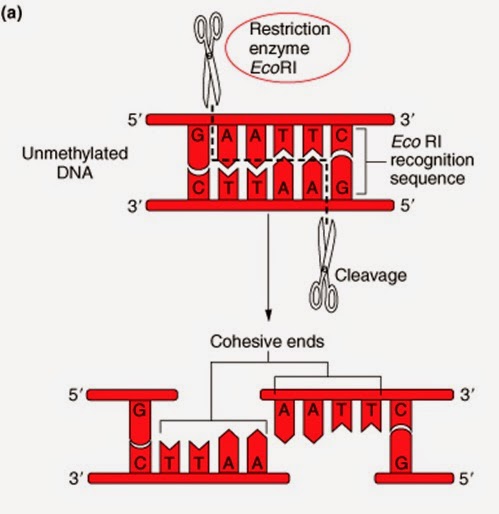
The recognition sites for restriction enzymes are :
a).Tautomer
b). Pallindrome
c).Metamere
d).Acronym
Restriction Enzymes were primarily used as :
a).Defence by Protozoa against antibiotics
b).Tool by Virus to cleave Bacterial genome
c)Defence by Bacteria against bacteriophages viruses
d).All of the above
Restriction enzymes belong to class of enzymes:
a).Peptidase
b).Amylases
c).Lipases
d).Nucleases

What is the term given to symmetrical ends of DNA after being cut by a restriction enzyme?
Blunt Ends
Sticky Ends
Ligated Ends
Restrictive Ends


Type of cut?
sticky
blunt

What type of cut?
sticky
blunt

What are the fragment legenths?
8 , 24, 10
8, 15, 19
7, 37, 7
7, 17, 14, 11

