wayground logo

Free Printable Worksheets

Font size

S
M
L
XL
Worksheets

HGEO Ch. 5 Test Review

Total questions: 100

Worksheet time: 3hrs 3mins

Name
Class
Date
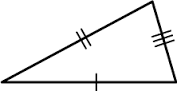
1.

What is the name of this kind of triangle?

a)

Right

b)

Isosceles

c)

Scalene

d)

Equilateral

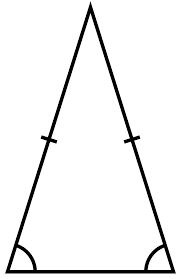
2.

What is the name of this kind of triangle?

a)

Right

b)

Scalene

c)

Isosceles

d)

Equilateral

3.

What kind of triangle is this if two of the sides are perpendicular?

a)

Acute

b)

Right

c)

Obtuse

d)

Robot

4.

What is the name of this kind of triangle?

a)

Right

b)

Scalene

c)

Isosceles

d)

Equilateral

5.
How many acute angles must an acute triangle have?
a)
2
b)
1
c)
4
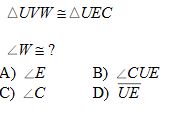
d)
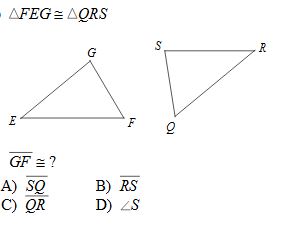
3
6.

Find the measure of the indicated angle.

a)

95 degrees

b)

85 degrees

c)

35 degrees

d)

45 degrees

7.

Find the measure of the indicated angle.

a)

26 degrees

b)

36 degrees

c)

85 degrees

d)

144 degrees

8.
Find the measure of angle D.
a)
140 degrees
b)
16 degrees
c)
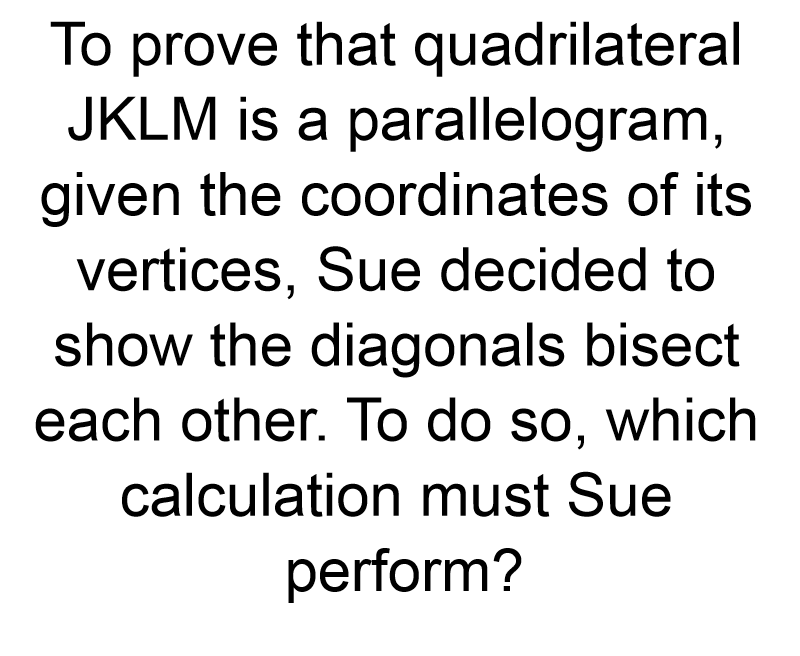
40 degrees
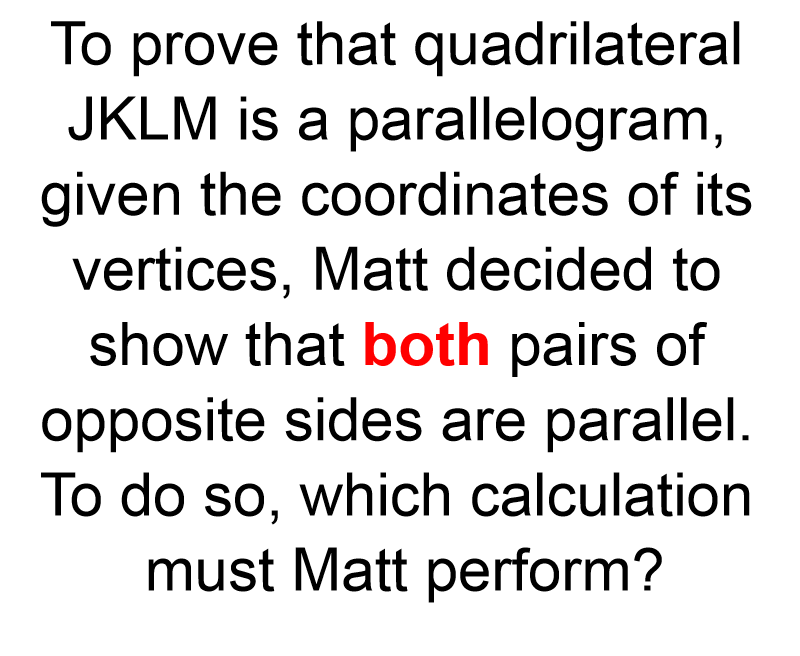
d)
90 degrees
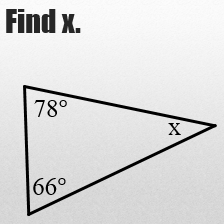
9.
Find the missing angle.
a)
29° 
b)
39° 
c)
49° 
d)
59° 
10.
A triangle has angle measurements of 26°, 59°, and 95°. What kind of triangle is it?
a)
acute triangle
b)
right triangle
c)
obtuse triangle
d)
none of the above
11.
A triangle has angle measurements of 54°, 52°, and 74°. What kind of triangle is it?

a)
acute triangle
b)
right triangle
c)
obtuse triangle
d)
none of the above
12.
A triangle has angle measurements of 163°, 2°, and 15°. What kind of triangle is it?

a)
acute triangle
b)
right triangle
c)
obtuse triangle
d)
none of the above
13.
A triangle has angle measurements of 74°, 90°, and 16°. What kind of triangle is it?

a)
acute triangle
b)
right triangle
c)
obtuse triangle
d)
none of the above
14.
A triangle has angle measurements of 27°, 72°, and 81°. What kind of triangle is it?

a)
acute triangle
b)
right triangle
c)
obtuse triangle
d)
none of the above
15.

A triangle has side lengths of 19 centimeters, 19 centimeters, and 20 centimeters. Is this triangle equilateral?

a)

equilateral triangle

b)

isosceles triangle

c)

scalene triangle

d)

none of the above

16.
A triangle has two 71° angles and one 38° angle. Is this triangle isosceles?

a)
yes 
b)
no
17.
a)
yes
b)
no
18.

An acute triangle has __________ angles that each measure less than 90°.

a)

one

b)

two

c)

three

d)

four

19.

An isosceles triangle has at least _________ equal sides.

a)

one

b)

two

c)

three

d)

four

20.

An ____________ triangle has three equal sides.

a)

isosceles

b)

equilateral

c)

scalene

21.

An obtuse triangle has one angle that measures _____________ 90°.

a)

less than

b)

exactly

c)

more than

22.

A _________ triangle has no equal sides.

a)

scalene

b)

isosceles

c)

equilateral

23.
If a triangle has all angles less than 90° and two equal sides, what type of triangle is it?
a)
Acute Isosceles
b)
Acute Scalene
c)
Obtuse Scalene
d)
Obtuse Isosceles
24.
If a triangle has one angle greater than 90° and no equal sides, what type of triangle is it?
a)
Acute Isosceles
b)
Acute Scalene
c)
Obtuse Scalene
d)
Obtuse Isosceles
25.
If a triangle has one angle exactly 90° and two equal sides, what type of triangle is it?
a)
Right Isosceles
b)
Acute Scalene
c)
Obtuse Scalene
d)
Obtuse Isosceles
26.
If a triangle has all three angles equivalent and all three sides equivalent, what type of triangle is it?
a)
Acute Isosceles
b)
Equilateral
c)
Obtuse Scalene
d)
Obtuse Isosceles
27.

Triangles can be classified by what two things?

a)

Number of sides

b)

Number of Vertices

c)

Angles

d)

Congruent Sides

28.

Identify the triangle by its sides and angles.

a)

Obtuse Equilateral

b)

Obtuse Isosceles

c)

Isosceles

d)

Acute Scalene

29.

Identify the triangle by its sides and angles.

a)

Right Isosceles

b)

Right Scalene

c)

Right Equilateral

30.

Identify the triangle by its sides and angles.

a)

Equilateral

b)

Obtuse Equilateral

c)

Acute Equilateral

d)

Acute Isosceles

31.

Identify the triangle by its sides and angles.

a)

Right Isosceles

b)

Right Scalene

c)

Obtuse Isosceles

d)

Obtuse Scalene

32.

Identify the triangle by its sides and angles.

a)

Obtuse Isosceles

b)

Obtuse Equilateral

c)

Obtuse Scalene

33.

Identify the triangle by its sides and angles.

a)

Acute Equilateral

b)

Right Equilateral

c)

Acute Isosceles

d)

Obtuse Isosceles

34.

Identify the triangle by its sides and angles.

a)

Obtuse

b)

Acute Isosceles

c)

Obtuse Scalene

d)

Obtuse Isosceles

35.

All acute triangle are equilateral.

a)

True

b)

False

36.

A right triangle cannot be equilateral.

a)

True

b)

False

37.

∆ABC≅∆XYZ

which is true?

a)

segment AB ≅ segment XY

b)

segment AB ≅ segment YX

c)

segment AB ≅ segment XZ

d)

segment BC ≅ segment CB

38.
∆PRQ≅∆SRT
a)
TRUE
b)
FALSE
39.
Solve for x.
a)
x = 5 
b)
x = 20
c)
x = 3
d)
x = 9
40.

Use the picture to answer the question.

a)

30 degrees

b)

60 degrees

c)

15 degrees

d)

120 degrees

41.
Which of these is a valid congruency statement for these 2 triangles?
a)
∆PTW ≅ ∆HGD
b)
∆PWT ≅ ∆GDH
c)
 ∠G ≅ ∠P
d)
∠D ≅ ∠H
42.
Which of these is a valid congruency statement for these 2 triangles?
a)
∆PTW ≅ ∆HGD
b)
∆PWT ≅ ∆GDH
c)
 ∠G ≅ ∠P
d)
∠D ≅ ∠H
43.
Which of these is a valid congruency statement for these 2 triangles?
a)
 ∠A ≅ ∠N
b)
∠B ≅ ∠M
c)
 ∠E ≅ ∠P
d)
∠T ≅ ∠G
44.

Which of these is a valid congruency statement for these 2 triangles?

a)

segment BE ≅ segment PN

b)

segment AB ≅ segment MP

c)

segment AE ≅ segment MN

d)

segment BA ≅ segment PM

45.
Which of these is a valid congruency statement for these 2 triangles?
a)
 ∠R ≅ ∠S
b)
∠J ≅ ∠Y
c)
 ∠Q ≅ ∠J
d)
∠T ≅ ∠G
46.

Which of these is a valid congruency statement for these 2 triangles?

a)

segment LK ≅ segment TS

b)

segment KS ≅ segment MU

c)

∠T ≅ ∠K

d)

∠M ≅ ∠L

47.
Which of these is a valid congruency statement for these 2 triangles?
a)
∆UST ≅ ∆LKM
b)
∆UST ≅ ∆MKL
c)
∆UST ≅ ∆KML
d)
∆UST ≅ ∆KLM
48.
What is the length of segment CM?
a)
8m
b)
15m
c)
11m
d)
32°
49.
What is the length of segment BM?
a)
8m
b)
15m
c)
11m
d)
32°
50.
What is the measure of angle Y?
a)
45°
b)
103°
c)
11m
d)
32°
51.
What is the length of segment PC?
a)
13cm
b)
21cm
c)
29cm
d)
15m
52.
What is the measure of angle X?
a)
112°
b)
132°
c)
122°
d)
29°
53.

What is the value of y?

a)

y = 3

b)

y = 8

c)

y = 15

d)

y = 12

54.

What is the value of y?

a)

y = 3

b)

y = 8

c)

y = 15

d)

y = 12

55.

What is the value of x?

a)

x = 7

b)

x = 11

c)

x = 12

d)

x = 23

56.

What is the value of z?

a)

z = 7

b)

z = 11

c)

z = 12

d)

z = 23

57.

What are the values of x and y?

a)

x = 7, y = 23

b)

x = 6, y = 10

c)

x = 5, y = 14

d)

x = 9, y = 14

58.

What are the values of x and y?

a)

x = 7, y = 23

b)

x = 6, y = 10

c)

x = 5, y = 14

d)

x = 9, y = 14

59.

What are the values of x and y?

a)

x = 7, y = 23

b)

x = 6, y = 10

c)

x = 5, y = 14

d)

x = 9, y = 14

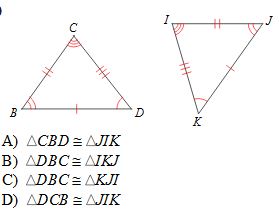
60.
Which is a correct congruence statement.
a)
A
b)
B
c)
C
d)
D
61.
Which is a correct congruence statement.
a)
A
b)
B
c)
C
d)
D
62.
Name the corresponding angle or side.
a)
A
b)
B
c)
C
d)
D
63.
Name the corresponding angle or side.
a)
A
b)
B
c)
C
d)
D
64.
Name the corresponding angle or side.
a)
A
b)
B
c)
C
d)
D
65.
State if the two triangles are congruent.  If they are, state how you know.
a)
A
b)
B
c)
C
d)
D
66.
State if the two triangles are congruent.  If they are, state how you know.
a)
A
b)
B
c)
C
d)
D
67.
State if the two triangles are congruent.  If they are, state how you know.
a)
A
b)
B
c)
C
d)
D
68.
State if the two triangles are congruent.  If they are, state how you know.
a)
A
b)
B
c)
C
d)
D
69.
State if the two triangles are congruent.  If they are, state how you know.
a)
A
b)
B
c)
C
d)
D
70.
State if the two triangles are congruent.  If they are, state how you know.
a)
A
b)
B
c)
C
d)
D
71.
State if the two triangles are congruent.  If they are, state how you know.
a)
A
b)
B
c)
C
d)
D
72.
State if the two triangles are congruent.  If they are, state how you know.
a)
A
b)
B
c)
C
d)
D
73.
State if the two triangles are congruent.  If they are, state how you know.
a)
A
b)
B
c)
C
d)
D
74.
State if the two triangles are congruent.  If they are, state how you know.
a)
A
b)
B
c)
C
d)
D
75.
What additional information is required for the 2 triangles to be congruent by ASA?
a)
A
b)
B
c)
C
d)
D
76.
What additional information is required for the 2 triangles to be congruent by SSS?
a)
A
b)
B
c)
C
d)
D
77.
What additional information is required for the 2 triangles to be congruent by SAS?
a)
A
b)
B
c)
C
d)
D
78.
What additional information is required for the 2 triangles to be congruent by AAS?
a)
A
b)
B
c)
C
d)
D
79.

Which of the following is a correct statement and reason for the proof shown?

a)

JKJK\overline{JK}\cong\overline{JK} ; Reflexive POC

b)

ML\angle M\cong\angle L ; Reflexive POC

c)

MJLK\overline{MJ}\cong\overline{LK} ; Def. of Midpoint

d)

MKLJ\overline{MK}\cong\overline{LJ} ; Hypotenuse Congruence

80.

Which of the following is a correct statement and reason for the proof shown?

a)

PQ\angle P\cong\angle Q ; SAS

b)

PQ\angle P\cong\angle Q ; CPCTC

c)

PQ\angle P\cong\angle Q ; SSS

d)

PQ\angle P\cong\angle Q ; SSA

81.

Which of the following is a correct statement and reason for the proof shown?

a)

FGFG\overline{FG}\cong\overline{FG} ; Reflexive POC

b)

FGFG\overline{FG}\cong\overline{FG} ; Def of Midpoint

c)

\overline{DG}\cong\overline{DG} ; Reflexive POC

d)

DFFE\overline{DF}\cong\overline{FE} ; Def of Midpoint

82.

Which of the following is a correct statement and reason for the proof shown?

a)

FGFG\overline{FG}\cong\overline{FG} ; Def of Midpoint

b)

FGFG\overline{FG}\cong\overline{FG} ; Reflexive POC

c)

DGGE\overline{DG}\cong\overline{GE} ; Def of Midpoint

d)

DFFE\overline{DF}\cong\overline{FE} ; Definition of a Seg. Bisector

83.

Which of the following is a correct statement and reason for the proof shown?

a)

WEQE\overline{WE}\cong\overline{QE} ; Def of Midpoint

b)

WNGQ\overline{WN}\cong\overline{GQ} ; Prove

c)

WQ\angle W\cong\angle Q ; Alternate Interior Angles

d)

NG\angle N\cong\angle G ; Alternate Interior Angles

84.

Which of the following is a correct statement and reason for the proof shown?

a)

GEQNEW\angle GEQ\cong\angle NEW Def of Vertical Angles

b)

WNGQ\overline{WN}\cong\overline{GQ} ; Prove

c)

GN\angle G\cong\angle N ; Alternate Interior Angles

d)

WQ\angle W\cong\angle Q ; Alternate Interior Angles

85.

Which of the following is a correct statement and reason for the proof shown?

a)

APBCPD\angle APB\cong\angle CPD ; Def of Vertical Angles

b)

AD\angle A\approx\angle D ; Alternate Interior Angles

c)

CB\angle C\cong\angle B ; Alternate Interior Angles

d)

ABCD\overline{AB}\cong\overline{CD} ; Prove

86.

Which of the following is a correct statement and reason for the proof shown?

a)

12\angle1\cong\angle2 ;Definition of a Bisector

b)

ADCBDC\angle ADC\cong\angle BDC ; Definition of a Bisector

c)

AB\angle A\cong\angle B ; Definition of a Bisector

d)

ADDB\overline{AD}\cong\overline{DB} ; Definition of a Bisector

87.

Which of the following is a correct statement and reason for the proof shown?

a)

DCDC\overline{DC}\cong\overline{DC} ; Reflexive Property POC

b)

AB\angle A\cong\angle B ; Reflexive Property POC

c)

12\angle1\cong\angle2 ; Reflexive Property POC

d)

ADDB\overline{AD}\cong\overline{DB} ; Def of Midpoint

88.

Which of the following is a correct statement and reason for the proof shown?

a)

SANE\overline{SA}\cong\overline{NE} ; CPCTC

b)

SANE\overline{SA}\cong\overline{NE} ; Parallel Lines Congruence Theorem

c)

EA\angle E\cong\angle A ; Alternate Interior Angles

d)

SEAN\overline{SE}\cong\overline{AN} ; Reflexive POC

89.

Which of the following is a correct statement and reason for the proof shown?

a)

TMME\overline{TM}\cong\overline{ME} ; Def of Midpoint 

b)

IMMR\overline{IM}\cong\overline{MR} ; Def of Midpoint 

c)

IR\angle I\cong\angle R ; Alternate Interior Angles

d)

MIMR\overline{MI}\cong\overline{MR} ; Prove

90.

Which of the following is a correct statement and reason for the proof shown?

a)

RMEIMT\angle RME\cong\angle IMT ; Def of Vertical Angles

b)

MIMR\overline{MI}\cong\overline{MR} ; Prove

c)

RMEIMT\angle RME\cong\angle IMT ; Reflexive POC

d)

IMMR\overline{IM}\cong\overline{MR} ; Def of Midpoint 

91.

1

a)

Find the lengths of the diagonals.

b)

Find the slope of each diagonal.

c)

Find the midpoint of each diagonal.

d)

Find the midpoint of each side.

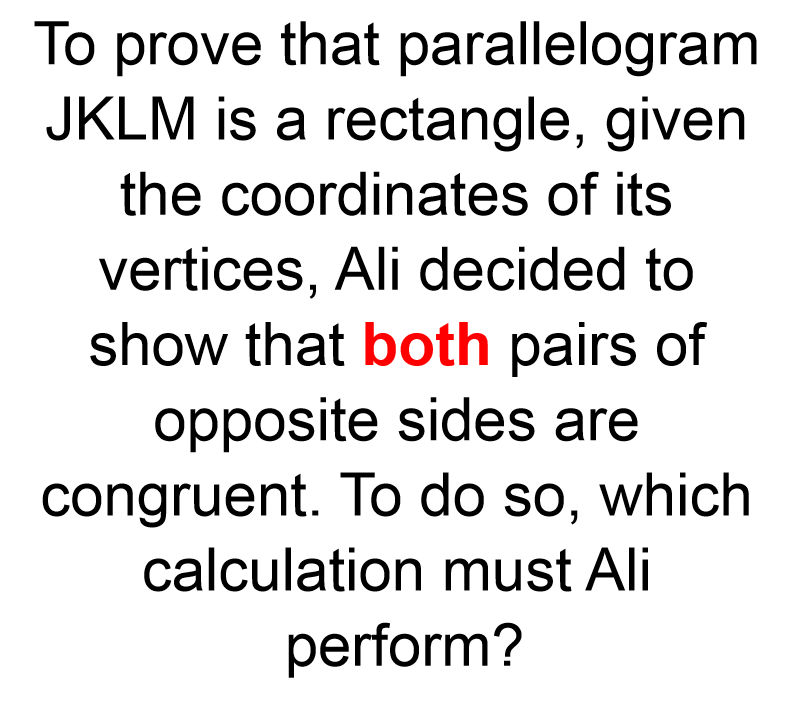
92.
a)

Find the slope of 2 sides.

b)

Find the slope of all 4 sides.

c)

Find the slope of the diagonals.

d)

Find the length of all 4 sides.

93.
a)

Find the slope of all 4 sides.

b)

Find the midpoint of all 4 sides.

c)

Find the length of all 4 sides.

d)

Find the length of 2 sides.

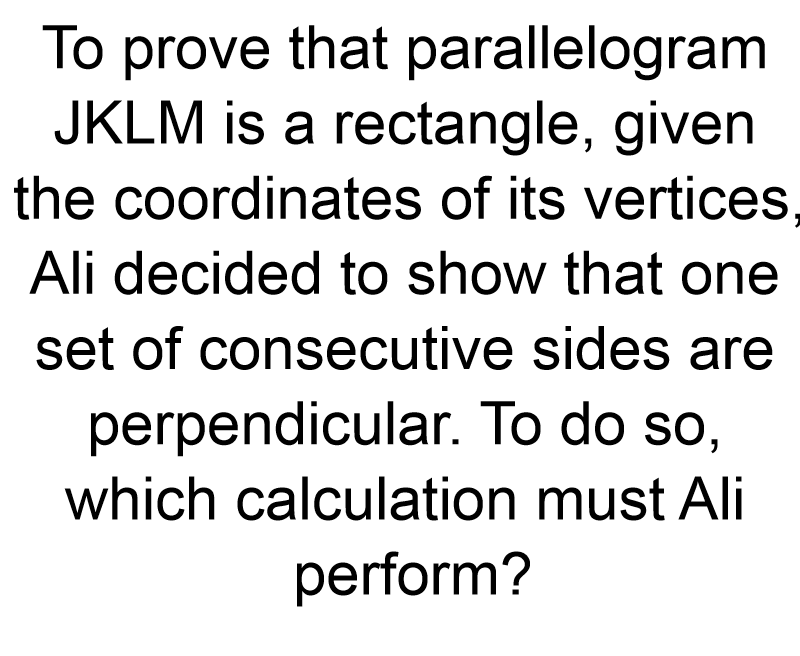
94.
a)

Find the slope of two consecutive sides.

b)

Find the slope of all 4 sides.

c)

Find the slope of the diagonals.

d)

Find the length of two consecutive sides.
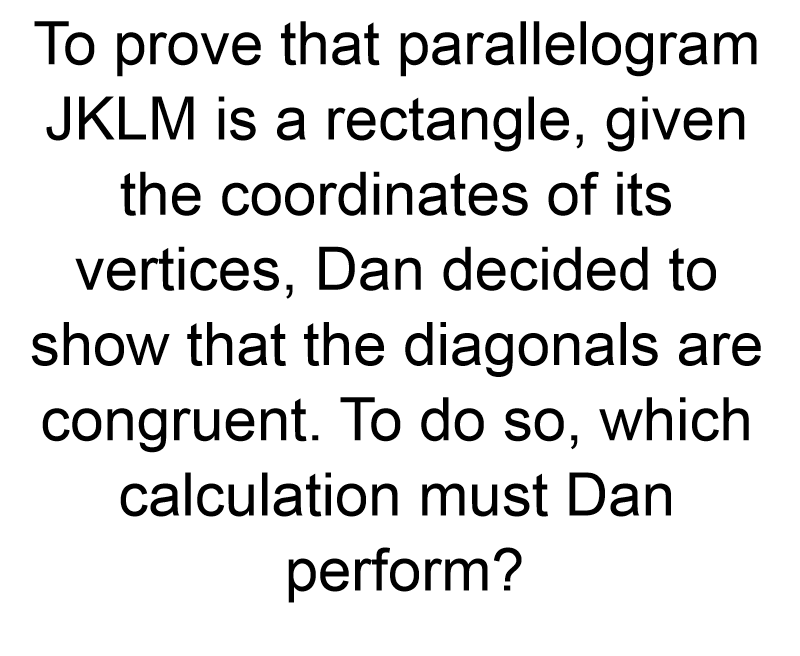
95.
a)

Find the length of all 4 sides.

b)

Find the length of both diagonals.

c)

Find the slope of both diagonals

d)

Find the slope of all 4 sides.

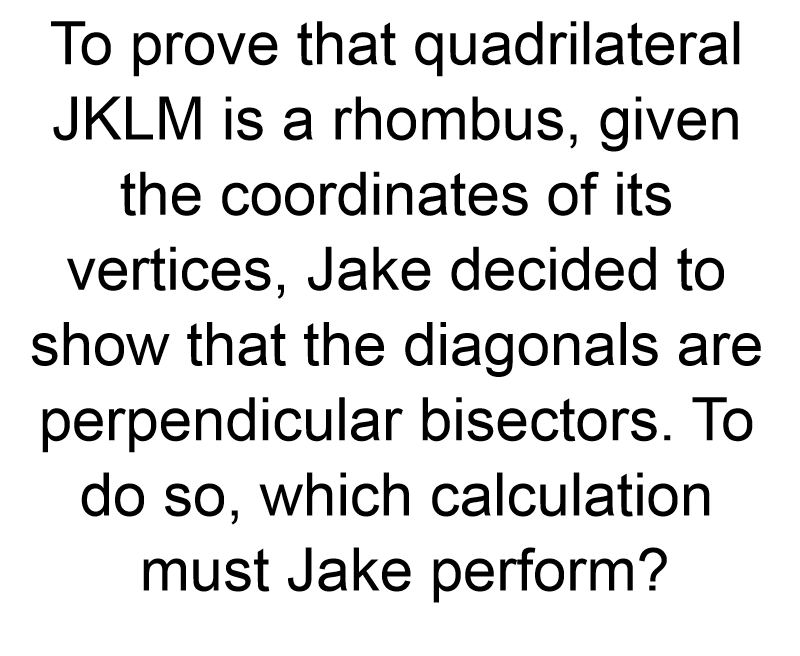
96.
a)

Find the midpoint of the diagonals.

b)

Find the length of the diagonals.

c)

Find the slope of the diagonals.

d)

Diagonals in a rhombus are not perpendicular, so this is not a good method.

97.

a)

SAA

b)

SAS

c)

ASA

d)

SSS

98.
a)
AAA
b)
SAS
c)
SSS
d)
SSA
99.

a)

ASA

b)

SAS

c)

SSA

d)

AAA

100.

a)

ASA

b)

SAS

c)

SAA

d)

AAA