wayground logo

Free Printable Worksheets

Font size

S
M
L
XL
Worksheets

Grade 10 Final Revision - Part 1

Total questions: 105

Worksheet time: 4hrs 14mins

Name
Class
Date
1.

What is the degree of the function:

f(x) = 6x2 + 4 - 3x4 + 5x - 9x3

a)

1

b)

2

c)

3

d)

4

2.

What is the leading coefficient of the function:

f(x) = 6x2 + 4 - 3x4 + 5x - 9x3

a)

6

b)

3

c)

-3

d)

4

3.

What type of function is:

f(x) = 6x2 + 4 - 3x4 + 5x - 9x3

a)

linear

b)

quadratic

c)

cubic

d)

quartic

4.

A function with degree 3 is called

a)

constant

b)

cubic

c)

linear

d)

quadratic

5.

If f(x) = 4x3 + 5x2 - 3, find f(-2).

a)

-415

b)

-15

c)

-55

d)

-615

6.

Simplify:

(4x3 + 2x2 - 5x - 9) + (-3x3 - 5x2 - x + 11)

a)

7x3 + 7x2 - 6x + 2

b)

x3 - 3x2 - 6x + 2

c)

7x3 - 3x2 - 6x + 2

d)

x3 + 7x2 - 4x + 2

7.

Simplify:

(4x3 + 2x2 - 5x - 9) - (-3x3 - 5x2 - x + 11)

a)

7x3 + 7x2 - 4x - 20

b)

7x3 - 3x2 - 6x + 2

c)

x3 - 3x2 - 6x + 2

d)

x3 + 7x2 - 4x - 20

8.

Is this a function:

(-1, 1), (-2, 2), (-3, 2), (-4, 1)?

a)

Yes

b)

No

9.

Is this a function:

(-1, 1), (-2, 2), (-1, -1), (-2, -2)

a)

Yes

b)

No

10.

Is this a function?

a)

Yes

b)

No

11.

Simplify: (x - 5)2

a)

x2 - 25

b)

x2 + 25

c)

x2 - 10x + 25

d)

x2 - 5x - 25

12.

Evaluate: f(4) = -2x2 + 3x - 8

a)

-28

b)

68

c)

36

d)

-60

13.

Is it a function?

a)

Yes

b)

No

14.

Identify the domain:

a)

{3, 4, 5, 6, 7}

b)

{3, 4, 5}

c)

{6, 7}

15.

Identify the range:

a)

{3, 4, 5, 6, 7}

b)

{3, 4, 5}

c)

{6, 7}

16.

Multiply (2x + 3)(2x - 3)

a)

4x2 - 12x + 9

b)

4x2 + 12x - 9

c)

4x2 - 9

d)

4x2 + 9

17.

Which of the following are power functions?

a)
b)
c)
d)

Both option 1 and option 3 are power functions.
18.

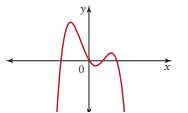
The function shown has:

a)

Degree two with negative leading coefficient.

b)

Degree three with negative leading coefficient.

c)

Degree four with negative leading coefficient.

d)

Degree four with positive leading coefficient.
19.

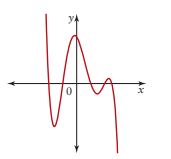
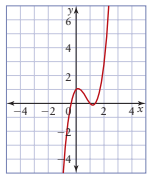
Which of the following could be a possible equation for the function shown?

a)

f(x) =-2x3 + x2 - 5x + 1

b)

f(x) = 2x3 - 4x2 + x + 1

c)

f(x) = 3x2 + 5x + 1

d)

f(x) = -2x3 +3x - 1

20.

State the minimum degree of the function shown:

a)

3

b)

4

c)

5

d)

6

21.

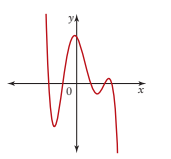
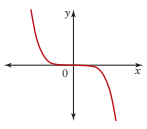
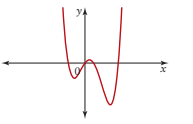
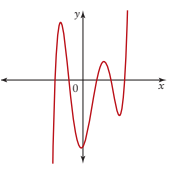
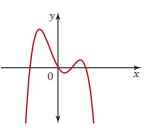
Select all the graphs which show even degree functions.
a)
b)
c)
d)
22.

Which of the following functions contain line symmetry?

a)

g(x) = 3x3 + 2x2

b)

g(x) = 5x4 + 3x3 + 4x2

c)

g(x) = 3x6

d)

g(x) = 18x3

23.

Which of the following functions could represent the graph shown?

a)

f(x) = -2x5

b)

f(x) = -2x4 + 7x3 + 3x2 -5x + 8

c)

f(x) = 2x5 + 3x4 - 3x3 + 5x2 - 3x + 4

d)

None of these functions could represent the graph shown.
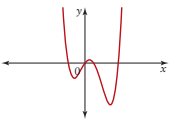
24.

Which description best matches the function shown:

a)

Odd degree with positive leading coefficient.

b)

Even degree with positive leading coefficient.

c)

Degree three, with negative leading coefficient.

d)

Degree four, with negative leading coefficient.

25.

The function f(x) = -5x4 + 3x2 - 3x + 5

a)

Extends from quadrant 2 to quadrant 1.

b)

Extends from quadrant 2 to quadrant 4.

c)

Extends from quadrant 3 to quadrant 1.

d)

Extends from quadrant 3 to quadrant 4.

26.

The function shown contains:

a)

Only one local maximum.

b)

Two local maximums.

c)

Two local minimums.

d)

Three local maximums

27.

What is the relative maximum?

a)

(2,0)

b)

(4.67, -9.48)

28.

What is the relative minimum?

a)

(2,0)

b)

(4.67, -9.48)

29.

As 

x, f(x) x\rightarrow\infty,\ f\left(x\right)\ \rightarrow  

a)

\infty  

b)

-\infty  

30.

As 

x, f(x) x\rightarrow-\infty,\ f\left(x\right)\ \rightarrow  

a)

\infty  

b)

-\infty  

31.

Increasing Interval(s): (Choose all that apply)

a)

(, 2)\left(-\infty,\ 2\right)  

b)

(2, 4.67)\left(2,\ -4.67\right)  

c)

(4.67, )\left(-4.67,\ \infty\right)  

d)

(, 0)\left(-\infty,\ 0\right)  

e)

(0, 9.48)\left(0,\ -9.48\right)  

32.

Decreasing Interval(s): (Choose all that apply)

a)

(, 2)\left(-\infty,\ 2\right)  

b)

(2, 4.67)\left(2,\ -4.67\right)  

c)

(4.67, )\left(-4.67,\ \infty\right)  

d)

(, 0)\left(-\infty,\ 0\right)  

e)

(0, 9.48)\left(0,\ -9.48\right)  

33.

Choose all that apply:

a)

Even Degree

b)

Odd Degree

c)

Positive Leading Coefficient

d)

Negative Leading Coefficient

34.

Choose all that apply:

a)

Even Degree

b)

Odd Degree

c)

Positive Leading Coefficient

d)

Negative Leading Coefficient

35.

Choose all that apply:

a)

Even Degree

b)

Odd Degree

c)

Positive Leading Coefficient

d)

Negative Leading Coefficient

36.

Describe the end behavior of a 15th degree polynomial with a positive leading coefficient.  Choose all that apply.

a)


As x, f(x)As\ x\rightarrow\infty,\ f\left(x\right)\rightarrow\infty  

b)

As x, f(x)As\ x\rightarrow\infty,\ f\left(x\right)\rightarrow-\infty  

c)

As x, f(x)As\ x\rightarrow-\infty,\ f\left(x\right)\rightarrow\infty  

d)

As x, f(x)As\ x\rightarrow-\infty,\ f\left(x\right)\rightarrow-\infty  

37.

What is the relative maximum?

a)

(5, -4)

b)

(3, 0)

38.

What is the relative minimum?

a)

(5, -4)

b)

(3, 0)

39.

As x, f(x)As\ x\rightarrow-\infty,\ f\left(x\right)\rightarrow  

a)

\infty  

b)

-\infty  

40.

As x, f(x)As\ x\rightarrow\infty,\ f\left(x\right)\rightarrow  

a)

\infty  

b)

-\infty  

41.

Increasing Interval(s): (Choose all that apply)

a)

(, 0)\left(-\infty,\ 0\right)  

b)

(, 3)\left(-\infty,\ 3\right)  

c)

(3, 5)\left(3,\ 5\right)  

d)

(5, )\left(5,\ \infty\right)  

e)

(4, )\left(-4,\ \infty\right)  

42.

Decreasing Interval(s): (Choose all that apply)

a)

(, 0)\left(-\infty,\ 0\right)  

b)

(, 3)\left(-\infty,\ 3\right)  

c)

(3, 5)\left(3,\ 5\right)  

d)

(5, )\left(5,\ \infty\right)  

e)

(4, )\left(-4,\ \infty\right)  

43.
All of the x values or inputs are called what?
a)
Domain
b)
Range
c)
Relation
d)
Function
44.
Identify the range of the following relation:
a)
{-6, 14, 2, 28}
b)
{-6,14, 0, 32, 2, 38, 4,44}
c)
{-6, 0, 2, 4}
d)
{14, 32, 38, 44}
45.
what is the range of y=2x+1 when the domain is {-1,0,4}?
a)
R:{-1,1,9}
b)
R:{1,3,9}
c)
R:{-1,0,4}
d)
R:{3,5,9}
46.
f(n)=x2+1
g(n)=2x-5
Find f(n)-g(n)
a)
x2-2x+6
b)
-x2+2x+4
c)
-x2-2x-6
d)
x2-2x-4
47.
f(n)=n2+4n
g(n)=-n-5
Find f(n)+g(n)
a)
n2+3n-5
b)
-n3+2n-7
c)
n3+3n-3n
d)
n2-3n-5
48.
f(x) = x2+9
g(x) = x-9
Find f(x)-g(x). 
a)
x2+x+9
b)
x2-x+9
c)
x2-x
d)
x2-x+18
49.
f(x)=x2+1
g(x)=2x-5
Find f(x)-g(x)
a)
x2-2x+6
b)
-x2+2x+4
c)
-x2-2x-6
d)
x2-2x-4
50.
f(n)=2n+1
g(n)=3n
Find f(n)+g(n)
a)
5n+1
b)
-5n+1
c)
-2n+1
d)
-6n-1
51.
f(x) = 9-3x
g(x) = 5x-7
Find f(x)+g(x). 
a)
14x-10
b)
-8x+2
c)
2x+2
d)
2x-2
52.

f(x) = 6x2 + 3x + 2 and g(x) = x - 7

Find f(x) * g(x)

a)

6x3 - 39x2 - 19x + 14

b)

6x3 - 39x2 - 21x - 14

c)

6x3 - 39x2 - 19x - 14

d)

6x3 - 45x2 - 19x + 14

53.
f(x) = 3 and g(x) = -2x + 5
Find f(x) * g(x)
a)
6x + 15
b)
6x - 15
c)
-6x + 15
d)
6x - 8
54.
f(x) = 4x + 1 and g(x) = 4x - 3
Find f(x) * g(x)
a)
16x2 + 8x - 3
b)
16x2 - 8x + 3
c)
16x2 - 8x - 3
d)
16x2 - 16x - 3
55.
All of the y values or outputs are called what?
a)
Domain
b)
Range
c)
Relation
d)
Function
56.


m(x)=x2+3x7m(x)=x^2+3x-7  

g(x)=3x2+5+2xg(x)=3x^2+5+2x  
Find: g(x) - m(x)

a)

4x2+5x24x^2+5x-2  

b)

2x2+x122x^2+x-12  

c)

2x2x+122x^2-x+12  

d)

2x2+x22x^2+x-2  

57.

If f(x) = 3x-1 and g(x) = x2+2,

what is (f ° g)(x) ?

a)

3x2 +5

b)

x2 +1

c)

3x2 +1

d)

3x2 +6

58.
a)
9 - √5
b)
√14
c)
16
d)
4
59.
a)
9 - 8/3
b)
9 + 8/3
c)
3
d)
1/3
60.
p(x) = 3x + 4
q(x) = 2x2
Find q(p(x))
a)
6x2 + 4
b)
18x+ 48x + 32
c)
18x2 + 32
d)
None of these.
61.
a)
√19
b)
√13
c)
1
d)
3
62.

g(4x)

a)

1728x3

b)

12x3

c)

192x3

d)

36x3

63.

f(x-2)

a)

2x2 - 13x + 18

b)

2x2 - 5x + 18

c)

2x2 - 8x + 3

d)

2x2 - 13x + 2

64.
For synthetic division, what would be the number in the left hand box?
a)
0
b)
1
c)
2
d)
3
65.
a)
2x3 + 3x + (7/x-4)
b)
2x2 + 3x + 8 + (7/x-4)
c)
2x2 + 3x + 8
d)
2x2 - x + 10 + (6/x-4)
66.

What is the proper way to write the answer for the following problem?

a)

2x3-x2-25x+12

b)

2x4-x3-25x2-12x+0

c)

2x3-x2-25x-12

d)

2x4-x3-25x2-12x-0

67.

Cam divided (x4 + 3x2 - 4x - 2) by factor of (x-2) using synthetic division. His work is shown above. Which best describes his mistake?

a)

Cam wrote the remainder incorrectly.

b)

Cam did not use a zero place holder for the x3 term.

c)

Cam added instead of subtracting the rows.

d)

Cam should have used -2 as his division since the factor was x-2.

68.
(2x3 - 5x - 7) ÷ (x - 2)
a)
2x3 - 4x2 + 3x - 13
b)
2x3 + 4x2 +3x - 1
c)
2x2 - 4x + 3 - 13/x-2
d)
2x2 + 4x + 3 - 1/x-2
69.
Which row of Pascal's Triangle would you use to expand (x+y)3?
a)
1
b)
1  1
c)
1  2  1
d)
1  3  3  1
70.

Select the coefficients of the 5th Row in Pascal's Triangle

a)

1;3;3;1

b)

1;4;6;4;1

c)

1;5;10;10;5;1

d)

1;6;15;20;15;6;1

71.

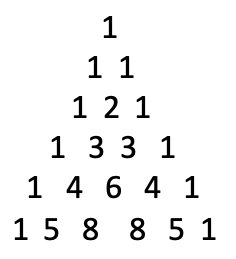
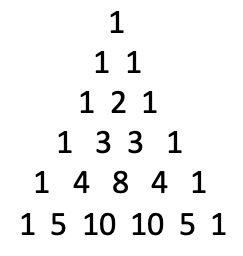
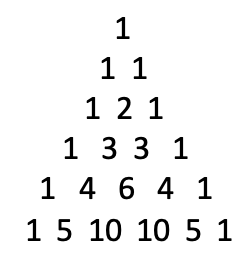
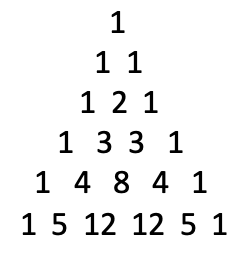
Choose the right Pascal's triangle

a)
b)
c)
d)
72.

What is the Binomial expansion of (x + 1)5 ?

a)

x5 + 5x4 + 10x3 + 10x2 + 5x + 1

b)

x5 + 5x4 + 15x3 + 15x2 + 5x + 1

c)

x5 + 6x4 + 15x3 + 15x2 + 6x + 1

d)

x5 + 1

73.

How many terms are the in the expansion of (1+b)5

a)

5

b)

6

c)

25

d)

50

e)

3

74.
Find the coefficient of the x3 term in (x-3)10
a)
3240x3
b)
3240
c)
262440x3
d)
262440
75.
a)
A
b)
B
c)
C
d)
D
76.
Solve by Factoring:  4x2 + 11x - 3 = 0
a)
x = -3/4 and x = -1
b)
x = 4 and x = 3
c)
x = 1/4 and x = -3
d)
x = -1/4 and x = 3
77.
Factor this difference of cubes:
x3 - 343
a)
(x + 7) (x2 - 7x + 49)
b)
(x2 + 1) (x - 343)
c)
(x - 7) (x2 + 7x + 49)
d)
(x2 - 343) (x + 1)
78.
Factor:   x+ 1
a)
(x + 1)3
b)
(x+1)(x- x + 1)
c)
(x - 1) (x2 + x - 1)
d)
(x + 1)(x2 - 2x + 1)
79.
Factor by grouping:
30x3+15x2-18x-9
a)
(5x2-3)(6x+1)
b)
(5x2-3)(6x+3)
c)
3(5x2+3)(2x-1)
d)
3(5x2-3)(2x+1)
80.
Factor by grouping:
4p³+8p²+3p+6
a)
(2p²+3)(p+2)
b)
(2p²+6)(p+4)
c)
(4p²+3)(p+2)
d)
(4p²+8p)(3p+6)
81.
What is another way to say "where a function crosses the x-axis"?
a)
x-intercept
b)
zero
c)
root
d)
all of these.
82.
Factor:
x- 400
a)
( x - 200) ( x + 200) 
b)
( x + 20) ( x + 20) 
c)
Prime
d)
( x - 20) ( x + 20) 
83.
What are the three factors for
 (x3 +7x2 +7x -15) ÷ (x -1)?
a)
(x-1) (x+5) (x-3) 
b)
(x-1) (x+5) (x + 3) 
c)
(x+1) (x+5) (x-3) 
d)
(x+1) (x-5) (x-3) 
84.
What is the GCF of 18k and 15k3
a)
3k2
b)
3k3
c)
3k
d)
5k
85.
Factor
n2-13n+40
a)
(n-5)(n-8)
b)
(n+5)(n-8)
c)
(n-5)(n+8)
d)
(n+6)(n+1)
86.

Solve the equation by factoring.
x349x=0x^3-49x=0  

a)

x=0,7,7x=0,7,-7  

b)

x=7,7x=7,-7  

c)

x=0,7x=0,7  

d)

x=0,49x=0,49  

87.
What is the remainder R when the polynomial p(x) is divided by (x-5)?
p(x) = x- 5x+ 2x - 10
a)
0
b)
2x-10
c)
-2x-10
d)
2x+10
88.
Is (x-4) a factor of (x3 +x2 -16x-16)?
a)
YES
b)
NO
89.
What is the proper way to write the answer for the following problem? 
a)
2x3-x2-25x-12
b)
2x4-x3-25x2-12x+0
90.
What is the remainder of  (3x3 -5x2 -4x +1) ÷ (x + 3)?
a)
-25
b)
25
c)
113
d)
-113
91.
What is the remainder when      a3 - 4 is divided by a+2? 
a)
-2
b)
-6
c)
-12
d)
0
92.
Decide if (x-3) is a factor of 3x3+10x2-x-12
a)
Yes, it is a factor!
b)
No, it is not a factor!
93.
What is the remainder of  (3x3 -5x2 -4x +1) ÷ (x + 3)?
a)
-25
b)
25
c)
113
d)
-113
94.
Is (x-3) a factor of
(x- 3x+ 2x + 2)?
a)
Yes
b)
No
95.
Is (x-7) a factor of (x2-5x+14)?
a)
Yes
b)
No
96.

When (9x4- 45x3 + 37x2 + x +2) is divided by (x-2), find the remainder.

a)

656

b)

652

c)

-64

d)

-368

97.

If P( -4) = 0, which of the following statements is true about P(x)?

a)

x+4 is a factor of P(x)

b)

P(x) = 0, has four negative roots

c)

4 is a root of P(x) = 0

d)

P(0) = - 4

98.

Given P(x) = 2x4 + x3 –3x2 – x – 15. What is the value of P(2).

a)

25

b)

17

c)

11

d)

9

99.

(x – r) is a factor of P(x) if and only if __________.

a)

P(r) ≠ 0

b)

P(r) = 1

c)

P(r) = 0

d)

P(r) has two negative roots

100.

Is (y + 3) a factor of the polynomial: y3 - 6y + 9

a)

yes

b)

no

c)

maybe

d)

only on Tuesday's

101.

Find the remainder when

P(x)=x4+x32x2+4x5P\left(x\right)=x^4+x^3-2x^2+4x-5  is divided by  (x+3)\left(x+3\right)  .

a)

19

b)

20

c)

21

d)

22

102.

Determine if  (x1)\left(x-1\right)   is a factor of  5x42x3+3x65x^4-2x^3+3x-6  .

a)

Yes

b)

No

103.

Determine if  (x1)\left(x-1\right)   is a factor of  6x32x2+5x86x^3-2x^2+5x-8  .


a)

Yes

b)

No

104.

What can we say if  P(3)=0P\left(-3\right)=0  ?

a)

(x3) \left(x-3\right)\  is a factor of  P(x)P\left(x\right)  

b)

(x+3)\left(x+3\right)  is a factor of  P(x)P\left(x\right)  

c)

(x3)\left(x-3\right)  is NOT a factor of  P(x)P\left(x\right)  

105.

What can we say if  P(2)=3P\left(2\right)=3  ?

a)

(x2)\left(x-2\right)  is a factor of  P(x)P\left(x\right)  

b)

(x2)\left(x-2\right)  is NOT a factor of  P(x)P\left(x\right)  

c)

(x+2)\left(x+2\right)  is NOT a factor of  P(x)P\left(x\right)