wayground logo

Free Printable Worksheets

NEW

Font size

S
M
L
XL
Worksheets

Physical Science final review

Total questions: 37

Worksheet time: 37mins

Name
Class
Date
1.

What is a dependent variable?

a)

the variable that doesn't change

b)

the variable that is changed

c)

the variable that you collect data on

d)

the variable that stays the same

2.

what is an independent variable

a)

the variable that doesn't change

b)

the variable that does change

c)

the variable that is impacted by the change

d)

the variable that stays the same

3.

What does volume measure?

a)

it's not defined for a solid

b)

it's measured in kilograms

c)

the amount of matter

d)

the amount of space matter takes up

4.

What does mass measure?

a)

the milliliters in a beaker

b)

the centimeters on a meter stick

c)

how much matter there is

d)

how much space matter takes up

5.

in a solid if temperature increases what happens to particles?

a)

there is no change

b)

Particles slow down

c)

particles speed up

d)

particles start to move

6.

temperature measures what?

a)

how hot or cold a substance is

b)

the average kinetic energy of particle motion

c)

the time in which it takes particles to start moving

d)

the total energy of all the particles moving

7.

In a liquid, what happens to particles if temperature decreases?

a)

particles will get farther apart

b)

nothing will change

c)

it will turn into a gas

d)

it will turn into a solid

8.

How are kinetic energy and particle movement related?

a)

they are not

b)

if particles speed up, kinetic energy increases

c)

if particles speed up, kinetic energy decreases

d)

if particles slow down, kinetic energy increases

9.

Law of Conservation of Energy states that

a)

energy always increases

b)

energy always decreases

c)

energy stays the same, but never changes form

d)

energy is conserved

10.
Solar energy panels convert what type of energy into electrical energy?
a)
chemical
b)
electromagnetic
c)
nuclear 
d)
thermal 
11.
The unit for force is which of the following?
a)
joule
b)
kilogram
c)
meter
d)
newton
12.
When a pair of balanced forces acts on an object, what is true of the net force that results?
a)
it is greater in size than both forces
b)
is it greater in size than one of the forces
c)
it is equal in size to one of the forces
d)
it is equal to zero
13.

Which two factors determine the strength of the gravitational attraction between

two objects?

a)

mass and distance

b)

distance and speed

c)

mass and weight

d)

speed and weight

14.

Which type of wave has the largest frequency?

a)

Infrared

b)

Radio

c)

X-ray

d)

Ultraviolet

15.

Which type of electromagnetic wave can be blocked by sunscreen lotion?

a)

Radio Waves

b)

Microwaves

c)

Gamma Waves

d)

Ultraviolet Waves

16.

What explains the tendency of the light to bend as it enters the water?

a)

reflection

b)

refraction

c)

diffraction

d)

resonance

17.

The highest point on a wave is:

a)

the crest

b)

the trough

c)

the top

d)

the coast

18.
What kind of wave is pictured below?
a)
compressional wave
b)
transverse wave
c)
sound wave
d)
mechanical wave
19.
Which part of the wave is shown at letter E?
a)
trough
b)
crest
c)
resting point
d)
amplitude
20.
Which travels faster, light or sound?
a)
light
b)
sound
21.
Which type of wave does sound travel in?
a)
Transverse
b)
Longitudinal
22.
Force is a _____ or _______
a)
simple    complex
b)
push     pull
c)
up      down
d)
in      out
23.
Which situation is work not done?
a)
lifting a 20 pound box off the floor
b)
holding a 20 pound box above the floor
c)
sliding a 20 pound box across the floor
d)
sliding a 20 pound box up an inclined plane
24.
What is work?
a)
A push or pull.
b)
When the object moves in the same direction in which the force is exerted.
c)
A change in energy.
d)
The rate at which energy is transferred.
25.
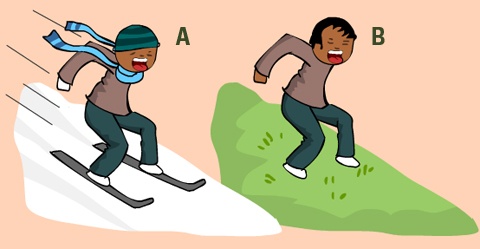
Why is it harder for the boy in Image B to get down the hill?
a)
Motion
b)
Friction
c)
Work
d)
Displacement
26.
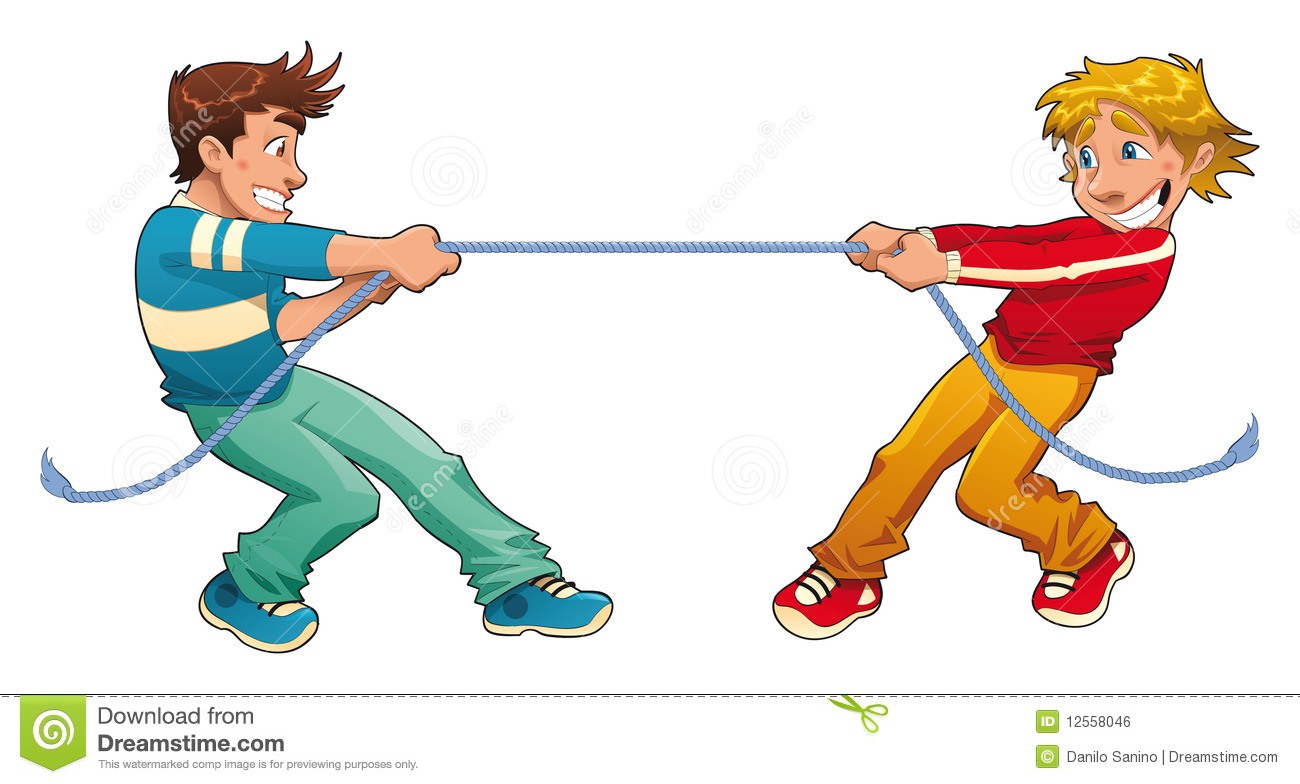
If these boys are pulling with the same amount of force.  What will happen?
a)
The boy in blue will win.
b)
They will not move at all.
c)
The boy in red will win.
d)
Both will fall down.
27.
For every action, there is an equal and opposite reaction.
a)
Newton's
1st
Law of Motion
b)
Newton's
2nd
Law of Motion
c)
Newton's
3rd
Law of Motion
28.
What is the attractive force that exists between all objects that have mass?
a)
Weight
b)
Mass 
c)
Gravity
d)
Viscosity
29.
According to Newton's second law, if you increase the force applied to an object :
a)
it accelerates more
b)
it doesn't move
c)
you get more inertia
d)
it decelerates
30.
Newton's first law of motion states that __________.
a)
when a force is applied on an object, there is an equal force applied by the object in the opposite direction
b)
hen a force acts on an object, its acceleration is in the same direction as the force
c)
an object will remain at rest or keep moving with a constant velocity unless a force acts on it
d)
cceleration is calculated by dividing the force exerted on an object by the mass of the object
31.
Electrical resistance is low in a good conductor.
a)
true
b)
false
32.

Heat always travels from...

a)

Warm to cool

b)

Cool to warm

c)

Warm to warm

d)

Cool to cool

33.

A hot air balloon rising is an example of ...

a)

conduction

b)

convection

c)

radiation

d)

connection

34.

A snowman melting in the sun

a)

convection

b)

conduction

c)

radiation

d)

connection

35.

Heating a kettle on a hot stove (burner)

a)

convection

b)

conduction

c)

radiation

d)

connection

36.

At what point does the biker have the greatest Kinetic Energy?

a)

Point A

b)

Point B

c)

Point C

d)

Point D

37.

At what point does the biker have the greatest Potential Energy?

a)

Point A

b)

Point B

c)

Point C

d)

Point D