wayground logo

Free Printable Worksheets

NEW

Font size

S
M
L
XL
Worksheets

Demand and Supply Revision

Total questions: 40

Worksheet time: 23mins

Name
Class
Date
1.
This part of the market determines DEMAND
a)
buyers
b)
sellers
c)
suppliers
d)
store owners
2.
This part of the market determines SUPPLY
a)
buyers
b)
sellers
c)
consumers
d)
us
3.
For the law of demand, as price rises, what happens to quantity demanded?
a)
it goes up
b)
it goes down
c)
it stays the same
d)
it is not effected
4.
For the law of supply, as price rises, what happens to quantity supplied?
a)
it goes up
b)
it goes down
c)
it stays the same
d)
it is not effected
5.
When quantity supplied and quantity demanded is equal
a)
surplus
b)
shortage
c)
equilibrium
d)
law of demand
6.
If a price is above equilibrium price, it creates a...
a)
shortage
b)
surplus
c)
market price
d)
demand
7.
If a price is below the equilibrium price it creates a...
a)
shortage
b)
surplus 
c)
market price 
d)
supply
8.
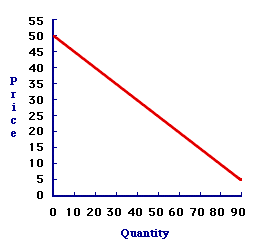
What does this curve represent?
a)
demand
b)
supply
c)
equilibrium
d)
shortage
9.
What does this curve represent?
a)
supply
b)
equilibrium
c)
demand
d)
surplus
10.
a person or company that makes, grows, or supplies goods to sell is called the?
a)
damand
b)
price
c)
producer
d)
shortage
11.
The desire or willingness a consumer has to purchase a good or a service is called?
a)
shortage
b)
supply
c)
price
d)
demand
12.
The amount of goods or services available is called?
a)
supply
b)
demand
c)
producer
d)
consumer
13.
An individual or group who purchases goods.
a)
producer
b)
consumer
c)
goods
d)
services
14.
The point where supply and demand are balanced is?
a)
product
b)
demand
c)
surplus
d)
equilibrium
15.
The law of demand states that if the price of CD’s rise, consumers will
a)
Buy more CDs
b)
Buy fewer CDs
c)
Quantity demanded will not change
16.
The law of supply states that if the price of CD’s rise, suppliers will
a)
Supply more CDs
b)
Supply fewer CDs
c)
Quantity supplied will not change
17.
Which of the following is NOT a determinant of the supply of peanut butter?
a)
The price of peanuts 
b)
The wages of peanut butter factory workers 
c)
The income of peanut butter consumers
d)
Existing peanut butter making technology
18.
What does a “surplus” (extra amount) of goods in a market imply?
a)
Prices are too high
b)
Prices are too low
c)
Supply is too low
d)
Demand is too high
19.
Due to a disappointing economy, Americans are cutting back on the family vacation road trips. What happens to the market for gasoline?
a)
Demand for gasoline will decrease 
b)
Demand for gasoline will increase
c)
Demand for gasoline will stay the same
20.
Costs of producing gasoline has increased due to rising energy costs. What happens to the market for gasoline?
a)
Supply for gasoline will decrease 
b)
Supply for gasoline will increase
c)
Supply for gasoline will stay the same
21.

A drought has made this year's tomato harvest smaller than usual. What will probably happen to the overall supply of tomato sauce?

a)

The supply will probably go up

b)

The supply will probably go down

22.

Long ago, all books were copied by hand. Making new copies was a lot of work and took a long time. But the invention of the printing press made copying books faster and easier. What happened to the overall supply of books after the printing press was invented?

a)

The supply went up.

b)

The supply went down

23.

Weather forecasters predict this summer will be much hotter than usual. What will probably happen to the demand for air conditioners?

a)

The demand will probably go up

b)

The demand will probably go down

24.

Summerfield's population has grown by 10,000 people per year for the last five years. What has probably happened to the overall demand for apartments in Summerfield?

a)

The demand has probably gone up

b)

The demand has probably gone down

25.

Last year, 50 babies were born in the town of

Oakland. This year, 100 babies were born there. What probably happened to the overall demand for diapers in Oakland?

a)

The demand probably went up

b)

The demand probably went down

26.

What will happen to the price of corn if almost no rain falls on corn crops?

a)

The price will increase

b)

The price will decrease

27.

What will happen to the price of teddy bears if puppy dogs become the most popular stuffed toy?

a)

The price will increase

b)

The price will decrease

28.

What will happen to the price of shoes if shoe producers have to pay higher wages to their workers?

a)

The price will increase

b)

The price will decrease

29.
Farmers in California have had wonderful weather. They have produced the largest crop of watermelons in years. What will happen to the price of watermelons?
a)
The price will go up.
b)
The price will go down.
30.
Cold weather in Florida has damaged this year’s orange crop. Farmers have only half of the usual amount of oranges to sell. What will happen to the price of oranges?
a)
The price will go up.
b)
The price will go down.
31.
Millions of people see a famous sports star drinking apple juice on television. The fans think apple juice helps make the athlete strong. What will happen to the price of apple juice?
a)
The price will go up.
b)
The price will go down.
32.

Thousands of people leave a small town due to a factory closing down. Sales at the local grocery store are reduced. What causes this change?

a)

Prices or availability of substitutes

b)

Prices or availability of complementary goods

c)

Change in the weather or season

d)

Change in the number of buyers

33.

New technology advances the rate at which furniture can be assembled. Why does this change the supply?

a)

There is a change in cost of production.

b)

The number of producers changes.

c)

The expectations of consumers changes.

d)

The output rate declines.

34.

Which of the following best refers to the market equilibrium price?

a)

Surpluses depress the number of goods supplied.

b)

Shortages and surpluses will have no effect on the market.

c)

The government will not intervene in the market.

d)

The quantity demanded is the same as the quantity supplied.

35.

Mr Coyote goes to the ticket booth to buy tickets for a Spurs game. Mr. Coyote is told that the game is sold out and no tickets are available. Which best explains why there are no basketball tickets available?

a)

The arena forgot to print enough tickets.

b)

The supply of tickets was greater than the demand.

c)

The arena charged too much money for each ticket.

d)

The demand for tickets was greater than the supply.

36.

Which statement expresses a central idea of how the laws of supply and demand work?

a)

The government sets the prices for goods and services.

b)

Prices are determined by the interaction of producers and consumers.

c)

Consumers alone determine the prices for goods and services.

d)

Technology dictates the prices charged for goods and services.

37.
Which situation is most likely to lead to the lowest prices?
a)
There is only one producer making the good.
b)
Businesses secretly agree to share their profits.
c)
Competition between businesses is prohibited.
d)
Several producers compete to sell goods to the public.
38.

If the price of a substitute to good X increases, then

a)

The demand for good X will increase.

b)

The market price of good X will decrease.

c)

The demand for good X will decrease.

d)

The demand for good X will not change.

39.

Refer to Graph 4-1. The movement from point A to point B on the graph shows

a)

a decrease in demand.

b)

an increase in demand.

c)

an increase in quantity demanded.

d)

a decrease in quantity demanded.

40.

What does the Latin phrase Ceteris paribus literally mean?

a)

"other things being equal."

b)

"after this therefore because of this."

c)

"to respond slowly to a change in price."

d)

"There's no such thing as a free lunch."