
 Worksheets
EMF_U1_Electrostatics
Total questions: 35
Worksheet time: 33mins
How do you write a pair of coordinates?
(X,X)
(Y,X)
(X,Y)
(Y,Y)
In the coordinate (4,9), which number is the y-coordinate?
4
9
neither
both
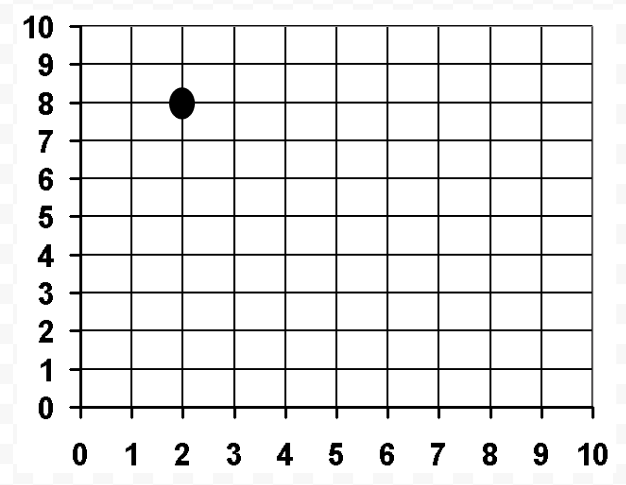
What is the coordinate of this point?
(8, 2)
(2,7)
(2,8)
(8,3)
The coordinate system provides
spatial reference
reference data
Relationship among the data
None of the above
∇×(∇⋅F)
What will this operation result in?
Scalar function
Vector function
Undefined
∇⋅(∇×F)
What will this operation result in?
Scalar function
Vector function
Undefined
The del operator is called as
a) Gradient
b) Curl
c) Divergence
d) Vector differential operator
A vector is said to be solenoidal when its
a) Divergence is zero
b) Divergence is unity
c) Curl is zero
d) Curl is unity
A field has zero divergence and it has curls. The field is said to be
a) Divergent, rotational
b) Solenoidal, rotational
c) Solenoidal, irrotational
d) Divergent, irrotational
When a vector is irrotational, which condition holds good?
a)Stoke’s theorem gives non-zero value
b) Stoke’s theorem gives zero value
c) Divergence theorem is invalid
d) Divergence theorem is valid
The Gauss divergence theorem converts
a) line to surface integral
b) line to volume integral
c) surface to line integral
d) surface to volume integral
The Stoke’s theorem can be used to find which of the following?
a) Area enclosed by a function in the given region
b) Volume enclosed by a function in the given region
c) Linear distance
d) Curl of the function
The Coulomb law is an implication of which law?
a) Ampere law
b) Gauss law
c) Biot Savart law
d) Lenz law
Gauss law cannot be used to find which of the following quantity?
a) Electric field intensity
b) Electric flux density
c) Charge
d) Permittivity
The electric field inside a spherical shell of uniform surface charge density is
Constant, less than zero
Directly proportional to the distance from the centre
zero
None of the above
A charge particle is free to move in an electric field. It will travel
Always along a line of force
Along a line of force, if its initial velocity is zero
Along a line of force, if it has some initial velocity in the direction of an acute angle with the line of force
None of the above
Conduction electrons are almost uniformly distributed within a conducting plate. When placed in an electrostatic field , the electric field 'E' within the plate
Is zero
Depends upon E
Depends upon the atomic number of the conducting element
Depends upon E
what are different types of coordinate systems
cylindrical system
Rectangular system
spherical system
all the above
When two vectors are perpendicular, their
Dot product is zero
Cross product is zero
both are zero
both are not zero depends on vector
which of the following is a vector quantity
Electric potential
Electric charge
Electric field intensity
all of the above
Coulomb is the unit of which quantity?
Field strength
Charge
Permittivity
Force
Coulomb law is employed in
Electrostatics
Magnetostatics
Electromagnetics
Maxwell theory
Two charges 1C and -4C exists in air. What is the direction of force?
Away from 1C
Away from -4C
From 1C to -4C
From -4C to 1C
The electric field intensity is defined as
Force per unit charge
Force on a test charge
Force per unit charge on a test charge
Product of force and charge
Electric potential ____________ as distance increases.
Increases
Decreases
Remains Constant
Is 0
The SI unit for electric potential is the ___________.
Volen
Vespa
Volt
Valspar
The potential difference between the terminals of a connection wire is ……..
Zero
greater than zero
Less than zero
infinity
Electrostatic potential energy is recorded in units of electron-Volts (eV). What is equivalent to 1 eV?
1.602×10⁻¹⁹ 𝐽
100 𝐽
220 𝐽
0.003 𝐽
The direction of electric field lines shows the
direction of the force on a test positive charge.
size of the field.
strength of the field.
all of the above
Define potential difference
The amount of energy per charge
The amount of charge per energy
The amount of charge per second
The amount of voltage per second
Two charged spheres of radii 10 cm and 15 cm are connected by a thin wire. No current will flow, if they have
The same charge on each
The same energy
The same potential
The same field on their surfaces
Two charge +Q and -Q are situated at a certain distance. At the point exactly midway between them
Electric field and potential both are zero
Electric field is zero but potential is not zero
Electric field is not zero but potential is zero
Neither electric field nor potential is zero

