wayground logo

Free Printable Worksheets

NEW

Font size

S
M
L
XL
Worksheets

Properties of Waves

Total questions: 45

Worksheet time: 32mins
Name
Class
Date
1.
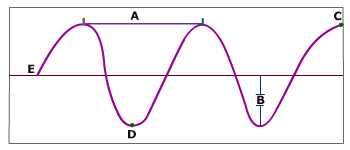
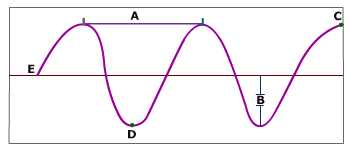
Which letter represents wavelength?
a)
A
b)
B
c)
C
d)
D
2.
Which letter represents the wave crest?
a)
A
b)
B
c)
C
d)
D
3.
Which letter represents the wave trough?
a)
A
b)
B
c)
C
d)
D
4.
Which letter represents amplitude?
a)
A
b)
B
c)
C
d)
D
5.
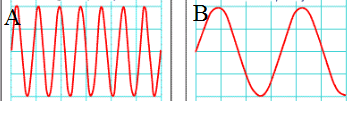
Which wave has a greater frequency?
a)
A
b)
B
6.
If a wave has a greater frequency, what happens to the wavelength?
a)
increases
b)
decreases
c)
stays the same
7.
You shine a light on a mirror and the light waves bounce back. Which phenomenon is happening?
a)
constructive interference
b)
refraction
c)
reflection
d)
diffraction
8.
A sound wave bends around a door and you can hear it in the hallway. Which phenomenon is happening?
a)
constructive interference
b)
refraction
c)
reflection
d)
diffraction
9.
Two water waves combine in phase and build a larger wave. What phenomenon is happening?
a)
constructive interference
b)
refraction
c)
reflection
d)
diffraction
10.
What part of the wave is a compression? 
a)
A
b)
B
11.
What part of the wave is a rarefaction? 
a)
A
b)
B
12.
What do waves carry through objects?
a)
light
b)
sound
c)
water
d)
energy
13.
What type of wave is pictured here?
a)
sound wave
b)
transverse wave
c)
longitudinal wave
d)
seismic wave
14.
What type of wave is pictured here?
a)
light wave
b)
transverse wave
c)
seismic wave
d)
longitudinal wave
15.
Which of the waves below travel fastest through air? 
a)
light waves
b)
water waves
c)
seismic waves
d)
sound waves
16.
Which of the waves below travel faster through solids? 
a)
water waves
b)
seismic waves
c)
sound waves
d)
light waves
17.
Transverse waves carry energy _______ to the direction the medium is moving. 
a)
at a 45 degree angle
b)
perpendicular
c)
parallel
d)
opposite
18.
Which of these factors affects how fast a wave moves? 
a)
the amplitude of the waves vibration
b)
the wavelength of the disturbance in the medium
c)
the kind of material it is moving through
d)
the type of motion that caused the wave to form
19.

A wave that needs a medium to travel is called a(n)

a)

electromagnetic wave

b)

mechanical wave

c)

ocean wave

d)

any way can do this

20.

Longitudinal waves have:

a)

crests and troughs

b)

crests and compressions

c)

compressions and rarefactions

d)

troughs and rarefactions

21.

Transverse waves have:

a)

crests and troughs

b)

troughs and rarefactions

c)

compressions and contractions

d)

rarefactions and crests

22.

What would happen to the wavelength if the frequency was doubled?

a)

the wavelength would be halved

b)

the wavelength would be doubled

c)

the wavelength would stay the same

d)

frequency does not affect wavelength

23.

What does a wave carry from place to place?

a)

energy

b)

matter

c)

people

24.
A mechanical wave cannot travel through...
a)
a vacuum(empty space).
b)
water.
c)
air. 
d)
glass.
25.

The number of times a wave cycle repeats each second is known and the _____ of the wave.

a)

period

b)

frequency

c)

length

d)

crest

26.

Sound waves are which type of waves?

a)

transverse

b)

seismic

c)

longitudinal

d)

frequency

27.
Which waves do NOT need a medium?
a)
Sound
b)
Ocean
c)
Seismic
d)
Light
28.
What is the material waves travel through?
a)
Period
b)
Frequency
c)
Medium
d)
Hertz
29.
Which is the correct equation for calculating the speed of a wave?
a)
T = 1/f
b)
Speed= Wavelength x Period
c)
Speed = Wavelength/Frequency
d)
Speed= Wavelength x Frequency
30.

The unit for measuring frequency is the ---

a)

Joule

b)

Hertz

c)

Gram

d)

Newton

31.

The speed of sound depends on these two things:

a)

The type of medium and the temperature of the medium

b)

Speed of the medium and temperature of the medium

c)

Temperature of the medium and sound of the medium

d)

None of the above

32.
When two waves combine to form a new wave with a smaller amplitude, it is called 
a)
Refraction
b)
Constructive Interference
c)
Resonance
d)
Destructive Interference
33.
A tuning fork starts to vibrate when a certain note is played on the piano, This is an example of _______.
a)
resonance
b)
refraction
c)
diffraction
d)
reflection
34.
What occurs when vibrations traveling through an object match the object's natural frequency?
a)
reflection
b)
diffraction
c)
resonance
d)
refraction
35.
Interference that causes a wave that appears to be standing still is known as what?
a)
Standing wave
b)
Resonance
c)
Destructive Interference
d)
Constructive Interference
36.

Standing waves are created by

a)

Two identical waves reflecting off each other

b)

Two identical waves being diffracted together

c)

Two identical waves move through each other in opposite directions

d)

Two identical waves are diffracted from two identical sources

37.

In the diagram which letters represent the nodes

a)

A B C

b)

A C E

c)

B D

d)

B D E

e)

A C D

38.
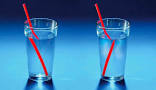
What is this called?
a)
refraction
b)
reflection
c)
reconstroction
d)
retraction
39.

When light passes at an angle to the normal from one medium into another in which its speed is higher

a)

it is bent toward the normal.

b)

it always lies along the normal.

c)

it is unaffected.

d)

it is bent away from the normal.

40.
........... – the angle between the normal and the incident ray.
a)
Angle of incidence
b)
Angle of reflection
c)
Angle of coincidence
d)
Angle of direction
41.
The imaginary line perpendicular to a reflecting surface is called _____.
a)
crooked line
b)
parallel line
c)
angular line
d)
normal line
42.

In the diagram, which letter represents the angle of incidence?

a)

A

b)

B

c)

C

d)

D

43.
Law of reflection state that - The angle of incidence is .................. to the angle of reflection.
a)
equal
b)
double
c)
half
44.

Calculate the wavelength of a wave traveling on a spring when the wave travels at 1.2 m/s and has a frequency of 0.3 sec.

a)

4.8 m

b)

4 m

c)

0.25 m

45.

Water waves on a lake travel toward a dock with a speed of 2.5m/s and a wavelength of 0.8 m. Calculate the frequency of the wave.

a)

2 Hz

b)

0.32 Hz

c)

3.125 Hz