
NEW
Font size
 Worksheets
Mid Term Exam Review
Total questions: 40
Worksheet time: 38mins

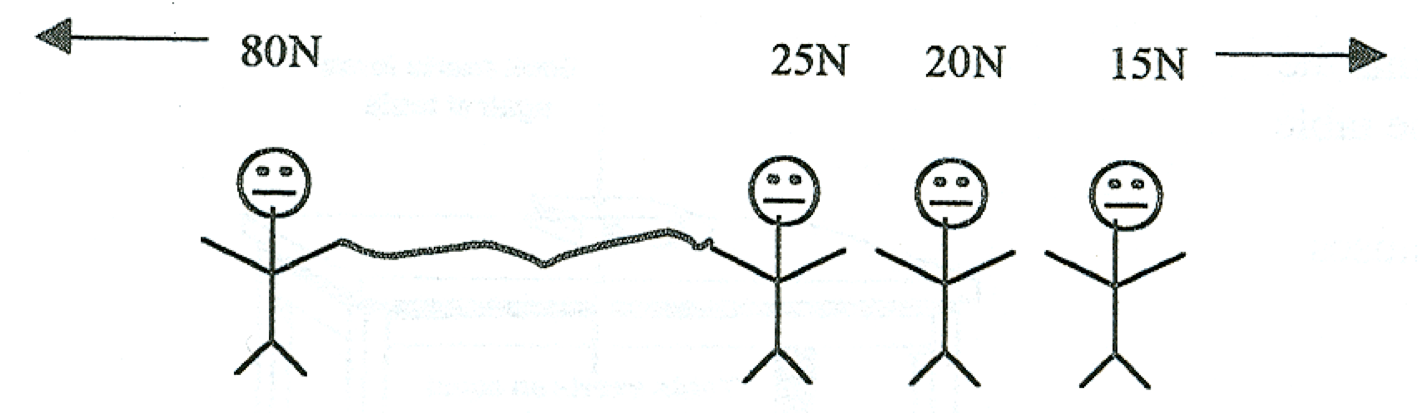
One person pulls on a rope with a force of 400 N to the left. Another person pulls on the rope opposite end with a force of 600 N to the right. What is the unbalanced net force?
200 N to the right
400 N to the right
600 N to the right
1000 N to the right
Newton's first law of motion states:
An object in motion will remain in motion and an object at rest will remain at rest unless acted upon by an outside force.
Acceleration is produced when a force acts on an outside mass.
The greater the mass of the object, the greater the force needed to accelerate
For every action, there is an equal and opposite reaction
Newton's second law of motion states:
An object in motion will remain in motion and an object at rest will remain at rest unless acted upon by an outside force.
Acceleration is produced when gravity acts upon it.
The greater the mass of the object, the greater the force needed to accelerate
For every action, there is an equal and opposite reaction
Newton's third law of motion states:
An object in motion will remain in motion and an object at rest will remain at rest unless acted upon by an outside force.
Acceleration is produced when gravity acts upon it.
The greater the mass of the object, the greater the force needed to accelerate
For every action, there is an equal and opposite reaction

A student runs a distance of 2 meters in 15 seconds. What is his speed?
13 m/s
.13 m/s
133 m/s
13.3 m/s

An object with a mass of 2.0 kg accelerates 2.0 m/s2 when an unknown force is applied to it. What is the amount of the force?
40 N
4.0 N
.40 N
400 N
Weight is _________.
the quantity of matter in an object.
the measure of an object's inertia.
the force exerted by gravity on an object's mass.
equal to the mass of an object.
If you run around the football field (which is 2 miles) 3 times, what is your distance? What is your displacement?
distance 0 miles, displacement 6 miles
distance 3 miles, displacement 2 miles
distance 6 miles, displacement 0 miles
distance 9 miles, displacement 3 miles

An old lady rolls down a hill at 3 meters/second. The hill is 36 meters long. How many seconds does it take the old lady to reach the bottom of the hill?
39 seconds
12 seconds
15 seconds
33 seconds

Velocity is speed with __________________________.
a unicycle helmet
direction
fight

The clown walked 27 feet in 9 seconds. what was his velocity?
18 feet/sec
243 feet/sec
36 feet/sec
3 feet/sec



A kid applies a force of 70 N to a ball over 1.1 meters. How much work did he do on the ball?
77 J
77 W
63.6 J
63.6 W
Which of the following is the best example of work being done.
doing homework
lifting a box
pushing a stationary box
holding a box
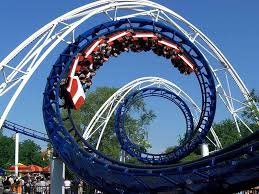
Calculate the potential energy of a roller coaster at the top of a 72 m hill that has a mass of 112 kg.
79,027 J
8064 J
184 J
790,700 J

The variable that is being measured or observed is called the _______________. Hint: this is the variable that is the result or effect
independent variable
dependent variable
control variable

A simple machine that consists a rigid bar that pivots on a fixed point
lever
pulley
wheel and axle
fulcrum

An axe is an example of a
pulley
inclined plane
screw
wedge

The device used to raise a flag up a flag pole is an example of a
wheel and axle
lever
inclined plane
pulley

Which of the following is an example of potential energy?
A compressed spring
A moving car
A spinning wheel
A flowing river
If a force of 50 N is applied to a 5 kg object, what is the acceleration of the object?
15 m/s2
20 m/s2
10 m/s2
5 m/s2
Energy cannot be created or destroyed. It can only be changed from one form to another. This is known as the law of conservation of:
mass
energy
temperature

What energy conversion is taking place in this picture?
solar energy to thermal energy
thermal energy to chemical energy to mechanical energy
chemical energy to thermal and radiant energy


