wayground logo

Free Printable Worksheets

NEW

Font size

S
M
L
XL
Worksheets

Chem Unit 5 Review

Total questions: 40

Worksheet time: 48mins

Name
Class
Date
1.
Molar mass is in units of ________.
a)
grams
b)
grams/mole
c)
mole
d)
moles/gram
2.
What is the molar mass of AuCl3?
a)
96 g
b)
130 g
c)
232.5 g
d)
303.3 g
3.

What is the definition for Avogadro's number?

a)

number of grams per one mole of a substance

b)

whole number ratio that is a multiple of a chemical formula

c)

simplest, whole number ratio of a chemical formula

d)

6.02 x 10²³ particles per one mole of a substance

4.

1 mole of Ca and 1 mole of Na have the same number of atoms.

a)

True

b)

False

5.
What is the molar mass of table salt (NaCl)?
a)
116.886 g/mol
b)
35.453 g/mol
c)
22.990 g/mol
d)
58.443 g/mol
6.
36.0 g of Be contains how many moles?
[1 mole Be = 9g Be]
a)
0.25 mol
b)
4.0 mol
c)
45 mol
d)
320 mol
7.
Covalent bonds are between...
a)
Metal and Non-metal
b)
Non-metal and Non-metal
c)
Metal and Metal
8.
Ionic bonds are between...
a)
Metal and Non-metal
b)
Non-metal and Non-metal
c)
Metal and Metal
9.
Atoms are most stable when their outer shell is complete.
a)
true
b)
false
10.
How are covalent bonds formed?
a)
Sharing of electrons
b)
Transfer of electrons
11.
How are ionic bonds formed?
a)
Transfer of electrons
b)
Sharing of electrons
12.
Is hydrogen considered a metal or a non-metal?
a)
A metal
b)
Nonmetal
c)
Metalloid
13.
Why do elements bond?
a)
To be friends
b)
To create a new element
c)
To become stable
14.

What are valence electrons?

a)

The sum of neutrons and protons.

b)

The # of electrons in the last shell.

c)

A type of bond.

d)

A popular compound.

15.
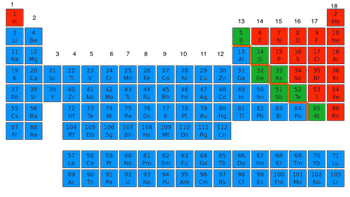
Where are metals located on the periodic table?
a)
Blue
b)
Green
c)
Red
16.
Where are the nonmetals located on the periodic table? 
a)
Blue
b)
Red
c)
Green
17.

When an atom loses an electron, it becomes a

a)

positive ion

b)

negative ion

c)

neutral ion

d)

neutral atom

18.
NaCl
a)
Ionic Bond
b)
Covalent Bond
c)
Both bonds
d)
Neither bond
19.
H2O
a)
Ionic Bond
b)
Covalent Bond
c)
Both bonds
d)
Neither bond
20.
LiF
a)
Ionic Bond
b)
Covalent Bond
c)
Both bonds
d)
Neither bond
21.

Name the compound: (NH4)2S

a)

ammonium sulfide

b)

nitrogen tetrahydrogen sulfide

c)

diammounium sulfate

d)

ammonium sulfate

22.

Name the compound: N2O5.

a)

dinitrogen pentaoxide

b)

binitrogen pentaoxide

c)

nitrogen oxide

d)

pentanitrogen dioxide

23.

Name the compound: MgCl2

a)

magnesium chloride

b)

magnesium dichloride

c)

monomagnesium chloride

d)

manganese chloride

24.

Name the compound: Mg(NO3)2

a)

manganese nitrate

b)

magnesium nitrate

c)

magnesium dinitrate

d)

magnesium dinitrogen hepaoxide

25.

Name the compound: CF4

a)

carbon tetrafluoride

b)

monocarbon tetrafluoride

c)

carbon fluoride

d)

chlorine tetrafluoride

26.

Name the compound: AgNO3

a)

silver mononitrogen trioxide

b)

silver nitrate

c)

silver nitride

d)

monosilver mononitrogen trioxide

27.

Name the compound: Zn3P2

a)

zinc phosphide

b)

trizinc diphosphide

c)

zinc phosphate

d)

zinc phosphite

28.

Write the formula: potassium hydroxide

a)

KOH

b)

POH

c)

KH

d)

KO

29.

Write the formula: carbon monoxide

a)

CO

b)

CO2

c)

OC

d)

C2O4

30.

Write the formula: beryllium oxide

a)

BO

b)

BeO

c)

BeO2

d)

BO2

31.
What is the formula for Hydrosulfuric Acid?
a)
H2(SO3)
b)
H2S
c)
H2(SO2)
d)
H2(SO4)
32.
What is the formula for Nitric Acid?
a)
HNO2
b)
HNO3
c)
HNO4
d)
H2NO3
33.
Name HF
a)
hydrofluoric acid
b)
Hypofluoric acid
c)
hydrogen fluorine acid
d)
fluoric acid
34.
What is a transition metal?
a)
They are elements that charges vary and are represented by roman numerals during nomenclature.
b)
A type of squirrel.
c)
Elements that are not defined as metals or nonmetals.
d)
A metal with no charge.
35.
Where are the transition metals found on the periodic table?
a)
The first 5 elements
b)
The bottom two rows
c)
Group 3-12
d)
Row 3-12
36.

Which one is a transition metal?

a)

Hydrogen (H)

b)

Oxygen (O)

c)

Nickel (Ni)

d)

Phosphorus (P)

37.
Name the compound using appropriate rules:
FeCl3
a)
Chloride Iron
b)
Iron III Chloride
c)
Chloride III Iron
d)
I have no clue
38.
Write formulas for the following compound:
tin (II) fluoride
a)
SnF2
b)
Sn2F
c)
FeF2
d)
Fe2F
39.
Cobalt III
a)
Cu +3
b)
Co +3
c)
Cu -3
d)
Co -3
40.
Manganese II
a)
Mg +2
b)
Mg -2
c)
Mn +2
d)
Mn -2