wayground logo

Free Printable Worksheets

NEW

Font size

S
M
L
XL
Worksheets

Global Warming/Climate Change

Total questions: 41

Worksheet time: 2hrs 3mins

Name
Class
Date
1.

Trees are so important to our environment because they absorb which greenhouse gas?

a)

methane

b)

carbon dioxide

c)

oxygen

2.

Greenhouse gases are important to our planet's survival because...

a)

They create a natural cooling effect that keeps us from burning up.

b)

They fuel the cars we drive.

c)

They create oxygen which we need to breathe.

d)

They keep our earth warm so we can sustain life.

3.

Why are too many greenhouse gases bad for the environment?

a)

They cause trees to die.

b)

They release heat and will be the cause of the next ice age.

c)

They trap heat in our atmosphere causing the planet to warm up.

d)

They are fossil fuels which pollute our environment.

4.

Oil, gasoline and coal are all examples of this type of fuel.

a)

natural gases

b)

fossil fuels

c)

alternative fuels

d)

bio-fuels

5.

Which layer of our atmosphere is being destroyed causing our sun to do more damage to our skin.

a)

ozone

b)

mesosphere

c)

exosphere

d)

troposphere

6.

What is global warming?

a)

a gradual increase in the overall temperature of the earth's atmosphere.

b)

a change in global or regional climate patterns

c)

the cycle of processes by which water circulates between the earth's oceans, atmosphere, and land.

d)

The action of clearing a wide area of trees.

7.
Why does cutting down trees increase global warming?
a)
trees soak up carbon dioxide
b)
trees provide shade which counteracts global warming
c)
trees absorbs the sun's energy without radiating back into the atmosphere
d)
trees drain greenhouse gases like methane from soil
8.
Without the Greenhouse Effect the Earth would be too
a)
warm 
b)
cold
c)
dead
d)
funny
9.
Burning fossil fuels is one of the main causes for global warming.
a)
True
b)
False
10.

As global warming continues, the intensity of what type of storm that hits coastlines is predicted to increase?

a)

Volcanic eruptions

b)

Hurricanes

c)

Tsunamis

d)

Earthquakes

11.
Things you can do to help decrease global warming include:
a)
Eat more ice cream.
b)
Keep your freezer door open.
c)
Keep your air conditioner on high.
d)
Turn off your lights when you’re not using them.
12.
Carmen is going to the market to purchase food for her family. She is very conscious of her choices and is working to reduce her carbon footprint. Which of the following would help her to be successful in her goal?
a)
Purchasing meats packaged at the local supermarket, but trucked in from out of state
b)
Purchasing fresh fruits and vegetables at the local supermarket that were shipped from out of state
c)
Purchasing fresh fruits and vegetables from the local farmer’s market
d)
None of these choices will reduce her carbon footprint
13.
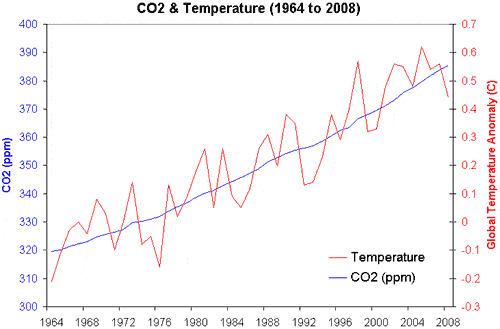
The graph below shows CO2 emissions and temperatures from 1909 to 1949.  What conclusion is best supported by the graph?
a)
There is no relationship between carbon dioxide concentrations and temperatures
b)
As carbon dioxide concentrations increase, temperatures increase
c)
As carbon dioxide concentrations increase, temperatures decrease
d)
As carbon dioxide concentrations decrease, temperatures increase
14.
Which human activity would most likely deplete nonrenewable resources?
a)
use of natural enemies to eliminate insect pests
b)
development of wildlife refuges 
c)
governmental restriction of industrial pollution 
d)
increased use of fossil fuels
15.
Approximately 75 percent of the Earth's surface is covered in water. So why is water considered such a precious resource?
a)
The greenhouse effect is causing most of the world's freshwater to be trapped in the atmosphere
b)
Only a small fraction of the Earth's water is freshwater available for drinking and irrigation
c)
Each year, more freshwater is being trapped in icecaps located at the North and South Poles
d)
Global warming caused by greenhouse gas emissions will likely cause Earth's oceans to evaporate
16.
__________ is an energy resource that WILL NOT run out in the next several hundred years.
a)
Renewable Energy Resource
b)
Natural Gas
c)
Forever Fuels
d)
Coal
17.
__________ is an energy resource that WILL run out in the next several hundred years.
a)
Biomass
b)
Nonrenewable Energy Resource
c)
Wind Energy
d)
Forever Fuels
18.
What percentage of our energy use comes from fossil fuels?
a)
25%
b)
45%
c)
61%
d)
86%
19.
Energy that uses heat that comes from within the Earth is called what?
a)
Geophysical
b)
Geography
c)
Geothermal
d)
Geographic
20.
A main disadvantage to solar energy is it
a)
Produces too much energy.
b)
Causes wind.
c)
Is expensive.
d)
Causes heat.
21.

Based on the data collected, which source of alternative or renewable energy is most efficient?

a)

Coal

b)

Wind

c)

Natural gas

d)

Solar

22.
Which alternative energy source does this information describe?
a)
Hydroelectricity
b)
Solar energy
c)
Biofuels
d)
Wind
23.

Which of the following are renewable resources?

a)

coal, oil, biofuel

b)

plant material, solar, geothermal

c)

coal, oil, petroleum

d)

biomass, soil, fossil fuels

24.
 Energy from the sun is known as......... 
a)
hydroelectric energy
b)
geothermal energy
c)
solar energy
d)
wind energy
25.
A farmer decides that he is going to produce his own energy on the farm by using a type of renewable energy. The renewable energy could come from--
a)
setting up wind turbines
b)
having a coal furnace
c)
using natural gas
d)
burning oil
26.

How can carpooling or walking help conserve nonrenewable resources?

a)

It is less expensive than driving alone.

b)

We would build more bicycles.

c)

We would use less gas and oil which means less fossil fuels burned.

d)

We would lose weight and live longer.

27.
What is a main disadvantage to fossil fuels?
a)
Produce too much energy.
b)
Causes wind.
c)
Emits greenhouse gases.
d)
Causes heat.
28.
Which statement best explains how deforestation affects organisms?
a)
It increases the amount of carbon dioxide in the air, enhancing global warming
b)
It reduces the amount of carbon dioxide in the air, enhancing global warming
c)
It reduces the amount of carbon dioxide in the air, enhancing ozone layer destruction
d)
It increases the amount of carbon dioxide in the air, enhancing ozone layer destruction
29.
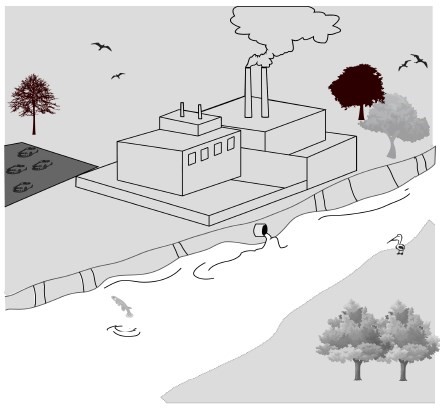
If the factory in this diagram was NOT practicing good environmental conservation, what effect would be produced?
a)
air and water pollution
b)
good fishing for recreation
c)
plentiful animals in the river
d)
purified drinking water
30.

What is it called when manufacturers take trash and turn it into new products?

a)

Composting

b)

Recycling

c)

Biodegrading

31.

Which of the following materials can be recycled?

a)

Glass

b)

Paper

c)

Metals

d)

Plastic

e)

All of the above

32.
Which of the following helped humans live longer after the Industrial Revolution?
a)
Improved medicine
b)
Improved technologies
c)
Improved nutrition
d)
All of the above
33.
Why did bison almost go extinct in the late 1800s?
a)
Disease
b)
Overhunting
c)
Climate change
d)
Ice Age
34.
Why did humans overhunt the Caribbean monk seal to extinction?
a)
For their fur
b)
For their blubber
c)
For their bones
d)
For their flippers
35.
Which of the following helps protect species from extinction?
a)
Laws and policies
b)
Wildlife refuges
c)
Conservation efforts
d)
All of the above
36.
Which is a major environmental concern for our oceans?
a)
Oxygen pollution
b)
Nutrient pollution
c)
Plastic pollution
d)
Air pollution
37.
Which is a nonrenewable natural resource?
a)
Trees
b)
Solar energy
c)
Oil
d)
Oxygen
38.
What is the name of the fuel made from plants?
a)
Solar energy
b)
Biofuel
c)
Oil
d)
Gasoline
39.
Which of the following resources are in high demand due to large human populations?
a)
Oil
b)
Water
c)
Trees
d)
All of the above
40.
Which of the following resources pollutes our environment?
a)
Oil
b)
Water
c)
Trees
d)
All of the above
41.
How much water on this planet is freshwater?
a)
3%
b)
10%
c)
22%
d)
78%