
 Worksheets
Electricity Review (Chapter 6)
Total questions: 25
Worksheet time: 23mins
Like charges repel
Materials that easily lose or accept electrons are considered
Good conductors
Good insulators
Good anti-static agents
Good for storing charge
Which term is not a method for charging an object with static electricity
Alternating Current
Induction
Conduction (Contact)
Friction
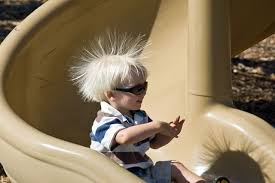
Which is a stronger force?
Gravitational Force
Electrical Force
True or False: Electrical force is always attractive and never repulsive
True
False
Which type of charging method does NOT require the materials to touch?
Conduction (Contact)
Friction
Induction
Van De Graff
What voltage is required to produce a current of 0.65 amps in a wire with a resistance of 200 ohms?
0.0032 V
130 V
307 V
What amount of current is in your fingers if they touch the terminals of a 9.0 V battery when the resistance of your skin is 1,050 ohms?
0.0086 A
117 A
9450 A
How does a battery work to produce current?
The chemical reaction within a battery creates a positive and negative terminal that pushes the current in one direction in the circuit
Electrons stored in the battery flow into the circuit; providing the devices with electricity necessary to work
A battery is a source of electric current because of a _________ between the terminals
Resistance
Light Bulb
Semiconductor
Potential Difference
The rate at which charges flow through a conductor is called...
electrical potential energy
resistance
voltage
current
___________ is the opposition posed by a material to the flow of current
Voltage
Resistance
Charge
Ampere
Calculate the resistance of a bulb that draws 1.3 A of current with a potential difference of 12 V
9.2 Ohms
15.6 Ohms
0.108 Ohms
A 6.0-Volt battery is connected to a 24 ohm resistor. What is the current in the resistor?
0.25 A
4.0 A
18 A
144 A
Which of the following are devices that protect circuits from overload?
Transistor
Fuse
Circuit Breaker
Battery
What type of circuit has a single pathway for current to flow
Open Circuit
Closed Circuit
Series Circuit
Parallel Circuit
Calculate the power of a portable radio that operates on 18 volts and draws 2.2 Amps of Current
39.6 W
8.2 W
1 W
0.12 W
Calculate the current drawn by a 4.0 W flashlight bulb that uses a 12 volt battery
48 Amps
3 Amps
0.33 Amps
A circuit in which two or more paths are connected to a voltage soure
Series Circuit
Parallel Circuit
Closed Circuit
Open Circuit
A device that contains a metal filament that melts when the current is too high
Circuit Breaker
Fuse
Resistor
Battery

If lightbulb B is removed, what will happen?
A and C will both stop working
A will stop working, C will not be affected
A and C will both get brighter
A and C will both get dimmer

