wayground logo

Free Printable Worksheets

Font size

S
M
L
XL
Worksheets

Solving Triangles and Unit Circle Basics Practice Quiz

Total questions: 75

Worksheet time: 19hrs 45mins

Name
Class
Date
1.
The Pythagorean Theorem ONLY works on which triangle? 
a)
obtuse
b)
scalene
c)
isosceles
d)
right
2.
The Pythagorean Theorem is
a2 + b= c4
a)
false
b)
true
3.
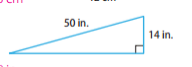
Find the length of the missing side.
a)
20 in.
b)
68 in.
c)
16 in.
d)
80 in.
4.
What is the side of a right triangle across from the right angle called?
a)
square
b)
arm
c)
leg
d)
hypotenuse
5.
Would a triangle with these side lengths be a right triangle?
4, 5, 6
a)
Yes
b)
No
6.

Sides a and b are called legs.

a)

true

b)

false

7.

Side c on a right triangle is ALWAYS the longest.

a)

true

b)

false

8.
Find the length of the missing side. 
a)
48 in.
b)
52 in.
c)
16 in.
d)
24 in.
9.
Find the length of the missing side. 
a)
25 cm
b)
42 cm
c)
52 cm
d)
48 cm
10.

For the above right triangle, find the side length of x. Round your answer to the nearest hundredth.

a)

13.04

b)

8.49

c)

72.00

d)

10.23

11.

Use the above right triangle, with side lengths a, b, and c.

sin(x) = ______.

a)

bc\frac{b}{c}

b)

cb\frac{c}{b}

c)

ac\frac{a}{c}

d)

ca\frac{c}{a}

12.

Find cosθ\cos\theta , where  θ\theta  is the angle shown.  Give an exact value, not a decimal approximation.

a)

 75\frac{7}{5}  

b)

 57\frac{5}{7}  

c)

 257\frac{25}{7}  

d)

 725\frac{7}{25}  

13.

 cos 89°=\cos\ 89\degree=   (a)  
Use a calculator to evaluate the expression.
Round your answer to the nearest hundredth.

14.
Solve for x. SIMPLIFY your radical answer completely.
a)
4√2
b)
2√4
c)
2√2
d)
16√2
15.
Solve for x. SIMPLIFY your radical answer completely.
a)
2√6
b)
6√2
c)
4√6
d)
6√4
16.

The point where two sides of a triangle connect.

a)

corner

b)

vertex

c)

angle

d)

intersection

17.

When the length of all sides of a right triangle are whole numbers.

a)

Yahtzee!!

b)

Pythagorean Triple

c)

Proof

d)

Perfect Triangle

18.

 33\frac{3}{\sqrt{3}}  The result of rationalizing the fraction below is

a)

√3

b)

3

c)

1

d)

none of these

19.
Angles that are exactly 90 degrees are called _____ ______.
a)
tight angles
b)
acute angles
c)
obtuse angles
d)
right angles
20.
The Triangle Sum Theorem states that the sum of all angles in a triangle is ______. 
a)
45°
b)
90°
c)
180°
d)
360°
21.
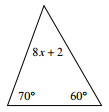
Find the measure of the missing angle.
a)
90o
b)
100
c)
130o
d)
50o
22.
Solve for x.
a)
16
b)
11
c)
50
d)
6
23.
Find the measure of the indicated angle. 
a)
34
b)
46
c)
62
d)
36
24.
To use the Pythagorean Theorem, we need...
a)
A triangle with 2 known angles
b)
A right triangle with 2 known angles
c)
A triangle with 2 known sides
d)
A right triangle with 2 known sides
25.
We can use SOH-CAH-TOA for...
a)
Any triangle ever
b)
Non-right triangles only
c)
Right Triangles only
d)
Never
26.
Set up the problem...
a)
sin X = 41/28
b)
tan X = 41/28
c)
cos X = 28/41
d)
sin X = 28/41
27.

Solve the right triangle. Show work on paper.

a)

m∠B = 39o, AB = 11.58, AC = 7.29

b)

m∠B = 39o, AB = 7.29, AC = 11.58

c)

m∠B = 129o, AB = 11.58, AC = 7.29

d)

m∠B = 129o, AB = 7.29, AC = 11.58

28.

Solve the right triangle.

a)

m∠A = 34o, m∠C = 56o, AC = 5.59

b)

m∠A = 56o, m∠C = 34o, AC = 5.59

c)

m∠A = 34o, m∠C = 56o, AC = 9.01

d)

m∠A = 56o, m∠C = 34o, AC = 9.01

29.
Fill in the blank...
SOH ___ TOA
a)
COH
b)
CAH
c)
COA
d)
CHA
30.
Solve for the missing angle
a)
50
b)
0.053
c)
36.9
d)
95
31.
Find the measure of the indicated angle (?) round to the nearest tenth.
a)
9.4
b)
55.2
c)
20.15
d)
19.4
32.
Find the value of y.
a)
8
b)
4
c)
2√3
d)
8√3
33.

Find the approximate value of y, to the nearest tenth.

a)

4.5

b)

3.2

c)

2.3

d)

5

34.
Find the value of y.
a)
7
b)
7√3
c)
14√3
d)
(14√3)/3
35.
Find the value of y.
a)
11√2
b)
11
c)
22
d)
(11√2)/2
36.
Find the value of x.
a)
18
b)
18√3
c)
36√3
d)
12
37.
Find the value of y.
a)
9
b)
18√2
c)
9√2
d)
(9√2)/2
38.
In this 45-45-90 triangle, I have been given a leg, so to find the other leg I...
a)
Multiply that leg by 2
b)
Use the same length for the second leg
c)
Multiply that leg by √2
d)
Divide that leg by √2
39.
In this 45-45-90 triangle, I have been given the length of a leg.  How do I find the length of the hypotenuse?
a)
It is the same length as the given leg.
b)
Multiply that leg's length by √2.
c)
Multiply that leg's length by 2.
d)
Divide that leg's length by √2.
40.
Which side is the long leg in this 30-60-90 triangle?
a)
4
b)
u
c)
v
41.
Which side is the short leg of this 30-60-90 triangle?
a)
6
b)
m
c)
n
42.
I have been given the short leg in this 30-60-90 triangle.  How do I find the long leg?
a)
Multiply 4 by 2
b)
Multiply 4 by √3
c)
Multiply 4 by √2
d)
Divide 4 by 2
43.
I have been given the short leg in this 30-60-90 triangle.  How do I find the length of the hypotenuse?
a)
Multiply 4 by 2
b)
Multiply 4 by √3
c)
Multiply 4 by √2
d)
Divide 4 by √3
44.
What is the radius of a unit circle?
a)
1
b)
2
c)
1/2
d)
0
45.

When 180° in graphed in standard position, what are the coordinates of its terminal point?

a)

(0, 1)

b)

(1, 0)

c)

(-1, 0)

d)

(0, -1)

46.

Find the circumference. Round to the nearest tenth.

a)

31.4 in

b)

78.5 in sq

c)

15.7 in

d)

3.14 in

47.

What exact distance is travelled by a blue dot when it travels 3 complete laps around a circle that has radius 4 inches?

a)

b)

12π

c)

16π

d)

24π

48.

What exact distance is travelled by a blue dot when it travels 120° around a circle that has diameter 5 feet?

a)

 5π2\frac{5\pi}{2}   

b)

 5π3\frac{5\pi}{3}  

c)

 5π5\pi  

d)

 10π3\frac{10\pi}{3}  

49.
What is 5π/6 radians in degrees?
a)
180
b)
150
c)
360
d)
120
50.
What is 7π/4 radians in degrees?
a)
300
b)
135
c)
315
d)
45
51.
What is 2π/3 radians in degrees? 
a)
150
b)
120
c)
180
d)
 30
52.
What is 240 degrees in radians? 
a)
π/3
b)
4π/3
c)
5π/3
d)
2π/3
53.
What is π/3 radians in degrees? 
a)
30
b)
60
c)
360
d)
90
54.
What is 225  degrees in radians? 
a)
7π/4
b)
5π/4
c)
3π/4
d)
5π/3
55.

Which of the following shows  150°150\degree  in standard positon?

a)
b)
c)
d)
56.

Which of the following shows  210°-210\degree  graphed in standard position?

a)
b)
c)
d)
57.

Which of the following shows  300°300\degree  graphed in standard position?

a)
b)
c)
d)
58.

Which of the following shows  480°480\degree  graphed in standard position?

a)
b)
c)
d)
59.

Which of the following shows  5π4\frac{5\pi}{4}  graphed in standard position?

a)
b)
c)
d)
60.

Which of the following shows  π4-\frac{\pi}{4}  graphed in standard position?

a)
b)
c)
d)
61.

Which of the following shows  11π6\frac{11\pi}{6}  graphed in standard position?

a)
b)
c)
d)
62.

Which of the following degree measures is represented by this diagram?

a)

135°135\degree

b)

85°85\degree

c)

210°210\degree

d)

220°-220\degree

63.

Which of the following degree measures is represented by this diagram?

a)

3π4-\frac{3\pi}{4}

b)

6π5\frac{6\pi}{5}

c)

π3-\frac{\pi}{3}

d)

7π4-\frac{7\pi}{4}

64.

The terminal side of a 330° angle is in what Quadrant?

a)

Quadrant I

b)

Quadrant II

c)

Quadrant III

d)

Quadrant IV

65.

The terminal side of a -45° angle is in what Quadrant?

a)

Quadrant I

b)

Quadrant II

c)

Quadrant III

d)

Quadrant IV

66.
An angle is in standard position if the initial side is along the _______?
a)
positive y-axis
b)
positive x-axis
c)
negative y-axis
d)
negative x-axis
67.
Positive angles are measured in which direction from standard position?
a)
Clockwise
b)
Counterclockwise
68.
Standard position is when .....
a)
the initial side of the angle is on the positive x-axis.
b)
the initial side of the angle is on the negative x-axis.
c)
the initial side of the angle is on the positive y-axis.
d)
the initial side of the angle is on the negative y-axis.
69.
Which quadrant is 120o in?
a)
I
b)
II
c)
III
d)
IV
70.
In what quadrant is -285°?
a)
I
b)
II
c)
III
d)
IV
71.
Find a coterminal angle to 5 degrees.
a)
365
b)
255
c)
-220
d)
-365
72.
Find a coterminal angle to 45 degrees.
a)
360
b)
405
c)
315
d)
295
73.
Find a coterminal angle to -180 degrees.
a)
180
b)
90
c)
270
d)
360
74.
Find a coterminal angle to -90 degrees.
a)
-450
b)
90
c)
180
d)
-180
75.
What are the negative and positive coterminal angles of -225 degrees?
a)
375°, -600°
b)
125°, -356°
c)
135°, -585°
d)
60°, -120°