Worksheets
Semester 1 Review: Energy, Forces, Gravity and Motion
Total questions: 70
Worksheet time: 55mins

A dog walks 12 meters to the east and then 16 meters back to the west. What is the distance the dog travels?
28 m
4 m east
4 m west
4 m

A dog walks 12 meters to the east and then 16 meters back to the west. What is the dog's displacement?
28 m
4 m east
4 m west
4 m

This object is
moving left and slowing down
moving left with constant velocity
moving right and slowing down
moving right with constant velocity

This object is
moving left and slowing down
moving left and speeding up
moving right and slowing down
moving right and speeding up
What is kinetic energy?
Thermal energy
Nuclear energy
Energy in motion
Stored energy
What is potential energy?
Thermal energy
Nuclear energy
Energy in motion
Stored energy
All objects in the universe have a gravitational attraction to each other.
True
False
What is the SI unit used to measure weight?
Grams
Liters
Pounds
Newtons

What force that acts against motion and ultimately slows the roller coaster to a stop?
Applied
Normal
Friction
Magnetic
When the velocity of an object is doubled, its momentum
remains unchanged in accord with the conservation of momentum.
doubles
quadruples
decreases
A 0.250 kg cart moving at 0.400 m/s has how much momentum?
0.1 kg-m/s
1 kg-m/s
10 kg-m/s
100 kg-m/s
What is the unit for mass?
m/sec
kg/sec
kg
kg m/sec
The momentum of an object depends upon the object's ___________&_____________.
size and shape
mass and speed
mass and veloctiy
mass and energy
What is a force?
a push or pull
speed or acceleration
potential or kinetic energy
balanced or unbalanced force
Speed can be found by calculating...
acceleration/ velocity
friction/ gravity
momentum/ time
distance/ time
A car takes 3 hours to travel 180 miles at a constant speed. How fast is the car traveling?
30 mph
50 mph
60 mph
90 mph
TRUE or FALSE: An object in motion will stay in motion unless an unbalanced force acts on it.
true
false
TRUE or FALSE: Every action force comes with an equal reaction force in the opposite direction.
true
false
Four solid balls, each with a different mass, are moving at the same speed. Which ball would require the most force to STOP its motion?
ball with a mass of 5 kg
ball with a mass of 10 kg
ball with a mass of 15 kg
ball with a mass of 20 kg
As distance between two objects increase the pull of gravity
Increases
Decreases
Stays the same
Velocity is both ____ and _____.
speed , direction
direction, mass
volume, density
direction, magnitude
A train traveling 60 mph slows down as it comes to a stop. This is an example of _____________
Acceleration
Distance
Speed
Velocity

Looking at the roller coaster, were does the cart have the most kinetic energy?
A
B
C
D

When a car suddenly stops at a red light, a pizza lying in the passengers seat flies in to the windshield. Why does the pizza fly forward?
The pizza loses its backward force
The pizza's inertia causes it to continue moving.
The friction of braking transfers energy to the pizza.
How much force is needed to accelerate a 5 kg marble at a rate of 2.5 m/s?
12.5
10
2
12
What is the definition of acceleration?
Change in speed or direction
displacement divided by time
the amount of distance covered in a certain amount of time
An object at rest

What is the net force shown in the diagram?
50N right
950N
50N left
150N left
Newton's 2nd law states---
For action there is an equal or opposite reaction
F=M x A
Law of inertia
Assuming there is no friction, what type of energy does the car have at d
only kinetic
only gravitational potential energy
both kinetic energy and potential energy
the car has no energy because there is no friction
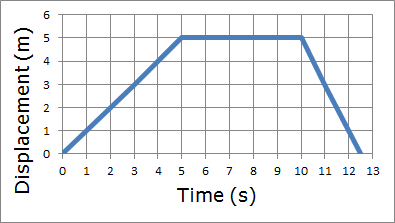
According to the graph how fast does the person travel in the first 5 seconds?
2 m/s
10 m/s
12.5 m/s
1 m/s
A car driving at 50 miles per hour drives for 2 hours. What distance did it cover?
50 miles
25 miles
100 miles
75 miles
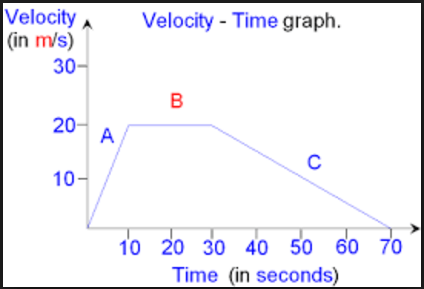
This is a velocity-time graph. If the object is moving in a positive forward direction, what is the object doing in segment B?
Positive acceleration -speeding up
Negative acceleration -slowing down
Constant Velocity
Not moving

What is the tendency of an object to resist a change in motion?
coffee
motion
inertia
gravity

The force that opposes motion between two surfaces in contact with each other.
inertia
friction
momentum
gravity

A magician pulls a frictionless tablecloth out from under dishes and glasses on a table without disturbing them.
Newton's 1st Law
Newton's 2nd Law
Newton's 3rd Law

Pushing a child on a swing is easier than pushing an adult on the same swing, because the adult has more mass and requires more force to accelerate.
Newton's 1st Law
Newton's 2nd Law
Newton's 3rd Law

When you step on a Lego. You push on the Lego and the Lego pushes back on you.
Newton's 1st Law
Newton's 2nd Law
Newton's 3rd Law
When an unbalanced force acts on an object, the force ______________________.
changes the motion of the object
is cancelled by another force
does not change the motion of an object
is equal to the weight of the object

A 2kg cat sits on a branch 4m above the ground. How much potential energy does the cat have?
8J
80J
0.8J
2J

How fast must a 2kg cart move to have 16J of kinetic energy.
16 m/s
32 m/s
8 m/s
4 m/s
Two factors effecting the magnitude of the force of gravity between 2 objects are...
Mass and Distance
Mass and Matter
Distance and Weight
Weight and Mass
The force of gravity acting on an object is the object's ______.
Mass
Matter
Weight
Terminal velocity

You push on a tree with 20 N of force. If the tree doesn't move, the tree is pushing back on you with _____of force.
20N
40N
10N
0N
A person would weigh more on Jupiter than on the Earth because . . .
Jupiter has more mass, and therefore more gravity
Jupiter has less mass, and therefore more gravity
Jupiter has more mass, and therefore less gravity
Jupiter has less mass and therefore less gravity
When will the forces of gravity between two objects be the GREATEST?
when the masses of both objects are small and the objects are far apart
when the masses of both objects are large and the objects are close together
when the masses of both objects are small and the objects are close together
when the masses of both objects are large and the objects are far apart

Which graph represents a students standing at their locker for a period of time.
A
B
C
D

What is this graph showing?
Constant Speed
Acceleration (speeding up)
Deceleration (slowing down)
No motion
Speed is different from velocity because
Velocity has a direction
Speed uses Distance /Time
Velocity doesn't include time
Velocity doesn't include distance
There are 2 forces acting on an object one is 8 N to the left , and the other is 4 N to the right. Find the net force. Is this balanced
12 N Right No
4 N Left No
12 N Right Yes
4 N Left Yes
When a bird flies, its wings push air downward. As a result the air pushes back upward on the bird. Which law of motion most applies to the way the wings of a bird beat?
Every action has an equal and opposite reaction
The rate of acceleration of an object depends on the amount of force applied.
Objects in motion tend to remain in motion until acted upon by an another force.
Force is defined by mass times acceleration
If a car is moving on a highway at 70 kilometers per hour, going south, and then turns to travel 70 kilometers per hour, going east, what happens to its speed and velocity?
Speed - changing, Velocity - constant
Speed - constant, Velocity - changing
Speed - constant, Velocity - constant
Speed - changing, Velocity - changing

The diagram represents the movement of a train from left to right, with velocity v. Which statement is true?
The train is speeding up.
The train is slowing down.
The train is moving at a constant speed.
The train is speeding up in certain intervals while decreasing in others.

The image above shows two opposite forces acting on a rolling cart, what can we say is true about the affect of the forces on the cart?
It cannot be determined without knowing which man is stronger.
It cannot be determined because one man is taller than the other.
The forces are unbalanced, and net force on the cart moves it to the left.
The forces are unbalanced, and net force on the cart moves it to the right.

How does the gravitational force the Earth exerts on the sun compare to the gravitational force the sun exerts on the Earth?
The gravitational force the sun exerts on the Earth is larger
The gravitational force the Earth exerts on the sun is larger
Their gravitational forces are equal
There is not enough information

The diagram shows a planet traveling at a constant speed in a circular path around the sun. Which labeled arrow represents the direction of the gravitational force acts to keep the planet in orbit?
W
Z
X
Y
How does the force of gravity between two objects change when the distance between them is 3 times larger?
3 times more
3 times less
9 times more
9 times less
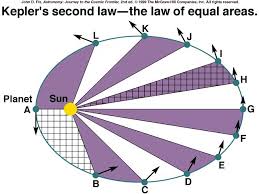

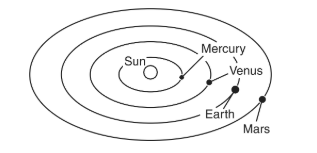
Which planet will take the least amount of time to revolve around the Sun?
Mercury
Venus
Earth
Mars

What is the orbital period of a planet that is 9.5 AU from the sun?
4.5 years
9.5 years
17 years
29 years

What is the orbital period of a planet that is 0.5 AU from the sun?
0.35 yrs
0.63 yrs
1 yr
1.4 yrs

How much does a 70kg person weigh (on the earth)?
70 N
7 N
700 N
80 N
Which graph represents an accelerating car
A
B
C
D
How does the acceleration of the Earth compare to the acceleration of the much more massive sun?
the acceleration is larger for the smaller mass earth
the acceleration is larger for the larger mass sun
the acceleration of the sun is the same as the acceleration of the earth
There is no way to measure accelerations in space
The graph shows the progress of a swimmer as he transitions from lap 2 to lap 3. How does the speed of the swimmer during the first 5 seconds compare to the speed during the last 2.5 seconds?
the speed between 0 and 5 seconds is greater than the speed between 10 and 12.5 seconds
the speed between 0 and 5 seconds is less than the speed between 10 and 12.5 seconds
the speed between 0 and 5 seconds is equal to the speed between 10 and 12.5 seconds
The swimmer is not moving between 0 and 12.5 seconds