
 Worksheets
Motion
Total questions: 65
Worksheet time: 2hrs 56mins
Name
Class
Date
1.
The slope of a distance vs. time graph shows an object's
a)
displacement
b)
velocity
c)
acceleration
d)
location
2.
On a distance vs. time graph, the steeper the slope _____
a)
the slower the speed
b)
the faster the speed
c)
less acceleration
d)
greater acceleration
3.

LT4: The graph shows Ashley riding her bike to Maria's house.
What was occurring from point B to point C?
What was occurring from point B to point C?
a)
She was increasing her speed.
b)
She stopped for 4 minutes
c)
She was decreasing in speed
d)
She is accelerating for 4 minutes
4.

LT4: The graph shows Ashley riding her bike to Maria's house.
What is occurring from point A to point B?
What is occurring from point A to point B?
a)
they are traveling at a constant speed
b)
they are decreasing in speed
c)
they stopped to take a break
5.

What does this graph represent?
a)
Constant speed
b)
Acceleration
c)
Not moving
6.
Changes in our speed, direction or both are called _________.
a)
gravity
b)
changes
c)
acceleration
d)
deceleration
7.

What type of motion is being depicted by these lines?
a)
Constant Speed
b)
Acceleration
c)
Not moving
d)
Deacceleration
8.

What type of motion is represented in this graph?
a)
Constant speed
b)
Acceleration
c)
Not moving
d)
Negative acceleration
9.

What is happening at D?
a)
Stationary
b)
Accelerating
c)
Fast steady speed; moving away from the starting position
d)
Slower steady speed; moving away from the starting position
10.

What is happening at E?
a)
Stationary
b)
Accelerating
c)
Fast steady speed; moving away from the starting position
d)
Steady speed; returning to start position
11.

What is happening at A?
a)
Stationary
b)
Accelerating
c)
Slower steady speed; moving away from the starting position
d)
Steady speed; returning to start position
12.

What is happening at B?
a)
Stationary
b)
Accelerating
c)
Slower steady speed; moving away from the starting position
d)
Steady speed; returning to start position
13.

Which runner had the greatest speed?
a)
A
b)
B
c)
C
14.

A race between 3 students is shown, which had a head start?
a)
A
b)
B
c)
C
15.

Which runner accelerated the entire race?
a)
A
b)
B
c)
C
d)
A and B
16.

What is happening in this graph from point B to C?
a)
The object is going down a hill.
b)
The object is returning to its starting location.
c)
The object is slowing down.
d)
The object is staying still.
17.

What is happening in the graph from point O to A?
a)
The object is moving SLOWLY
b)
The object is moving FAST
c)
The object is NOT moving
d)
The object is accelerating
18.

What is happening in this graph from point A to B?
a)
The object is accelerating.
b)
The object is not moving.
c)
The object is decelerating.
d)
The object is moving at a constant speed.
19.

Every morning, Tom walks along a straight road from his home to the bus stop. Below, is a graph representing Tom’s trip to school.
- Was Tom walking, jogging, or sprinting during segment 1, which is between 0 seconds and 50 seconds?
- Was Tom walking, jogging, or sprinting during segment 1, which is between 0 seconds and 50 seconds?
a)
walking
b)
jogging
c)
sprinting
20.

Every morning, Tom walks along a straight road from his home to the bus stop. Below, is a graph representing Tom’s trip to school.
- What is the distance covered through the second segment, which is between 50 seconds, and 70 seconds?
- What is the distance covered through the second segment, which is between 50 seconds, and 70 seconds?
a)
40 meters
b)
60 meters
c)
80 meters
d)
20 meters
21.

Every morning, Tom walks along a straight road from his home to the bus stop. Below, is a graph representing Tom’s trip to school.
- What is the average speed of Tom’s Journey throughout the second segment, which is between 50 seconds and 70 seconds?
- What is the average speed of Tom’s Journey throughout the second segment, which is between 50 seconds and 70 seconds?
a)
5 m/s
b)
4 m/s
c)
3 m/s
d)
2 m/s
22.

This is a velocity-time graph. What is the object doing in segment C?
a)
Positive acceleration
b)
Negative acceleration
c)
Constant Velocity
d)
Not moving
23.

How fast was the car going at the 20 second mark?
a)
2 m/s
b)
20 m/s
c)
10 m/s
d)
0 m/s2
24.
A car traveling constant speed will...
a)
get faster as time goes by
b)
make a d vs. t graph with a curved line
c)
make a v vs. t graph with a steep slope
d)
make a v vs. t graph with no slope
25.
Scott travels north 5 miles and then goes west 3 miles before coming straight back south 2 miles. What is his distance?
a)
10
b)
7
c)
8
d)
6
26.
1. Amy runs 2 miles south, then turns around and runs 3 miles north. What is her displacement?
a)
5 miles
b)
1 mile north
c)
1 mile south
d)
3 miles north
27.
_____ is how fast an object moves in a specific direction.
a)
velocity
b)
speed
c)
displacement
d)
distance
28.
Bill runs 400 meters to Andy's house, turns around, and runs 400 meters back home. What is Bill's displacement?
a)
0 meters
b)
400 meters
c)
800 meters
d)
1600 meters
29.
Bill runs 400 meters to Andy's house, turns around, and runs 400 meters back home. What is Bill's distance?
a)
0 meters
b)
400 meters
c)
800 meters
d)
1600 meters
30.
Which of the following could never be negative?
a)
a distance
b)
a velocity
c)
a displacement
d)
a vector
31.
_____ are measured in units of m/s in Physics.
a)
Speed and velocity
b)
Distance and displacement
c)
Scalars
d)
Vectors
32.
Vector quantities need both a magnitude and a _____.
a)
distance
b)
displacement
c)
direction
d)
velocity
33.

Avery likes to walk 30 feet in 10 seconds. What is her speed?
a)
3 feet/sec
b)
6 feet/sec
c)
10 feet/sec
d)
2 feet/sec
34.

What is the person doing from 5 seconds to 10 seconds?
a)
Walking
b)
Running
c)
Standing Still
d)
Walking Fast
35.

A drag racer accelerated from 0 m/s to 200 m/s in 5 s. What was the acceleration?
a)
0 m/s
b)
40 m/s2
c)
-40 m/s2
d)
40 m/s
36.

Which graph shows the object standing still?
a)
A
b)
B
c)
C
d)
D
37.

Which graph represents zero acceleration (constant velocity)?
a)
A
b)
B
c)
C
d)
D
38.

Which graph represents the greatest acceleration?
a)
A
b)
B
c)
C
d)
D
39.
Which of the following is the correct equation to calculate distance?
a)
D = S x T
b)
D = S/T
c)
D = T/S
d)
D = T + S
40.

What is this graph showing?
a)
Constant Speed
b)
Acceleration (speeding up)
c)
Deceleration (slowing down)
d)
No motion
41.

How many times does this object STOP moving?
a)
None
b)
Once
c)
Twice
d)
Three times
42.

What is the distance traveled by this object?
a)
40m
b)
80m
c)
100
d)
100m
43.

What is the objects average speed from 0-20 seconds?
a)
0.5m/s
b)
10m/s
c)
2m/s
d)
10m
44.

If a ball is dropped, what force makes the ball move?
a)
friction
b)
magnetism
c)
gravity
d)
centripetal force
45.

If you throw a baseball straight up, what is its velocity at the highest point?
a)
9.8 m/s2
b)
9.8 m/s
c)
0 m/s2
d)
0 m/s
46.

If you drop a banana, how fast is it going after 2 seconds?
a)
-5m/s
b)
-10m/s
c)
-20m/s
d)
-30m/s
47.
What is the value of g on Earth?
a)
about 10 m/s^2
b)
10 N
c)
10 m
d)
10 s/m^2
48.
Velocity is
a)
speed
b)
direction
c)
speed with a direction
d)
distance traveled over time
49.
What is the difference between a theory and a law?
a)
The amount of evidence
b)
Theories can be proven wrong and Laws can't
c)
Theories address why something occurs and laws just tell what occurs
d)
laws can be broken but theories cannot
50.
You walk outside and see a bright object in the sky, you think its a satellite. What you just did is called ....
a)
hypothesis
b)
made an inference
c)
made observations only.
d)
formed a thoery
51.
There are 56 blue Woodland Cowboy football players on the field. The "56" is what type of observation?
a)
qualitative
b)
quantitative
c)
numeralative
d)
irrelevant
52.
The universe is expanding at a fixed rate. This statement would be know as a...
a)
Law
b)
Theory
c)
Hypotheisis
d)
Observation
53.
All the evidence supports the fact that the Earth is over 8 billion years old. This would be know as a...
a)
hypothesis
b)
theory
c)
law
d)
inference
54.
You find the slope of a line segment by:
a)
change in y over change in x
b)
run over rise
c)
change in y times change in x
d)
y value divided by x value
55.
The following is a unit of acceleration.
a)
m/s
b)
mph / sec
c)
centimeters times hours squared
d)
hours per mile per mile
56.

Which runner stopped for a rest?
a)
Albert
b)
Bob
c)
Charlie
57.
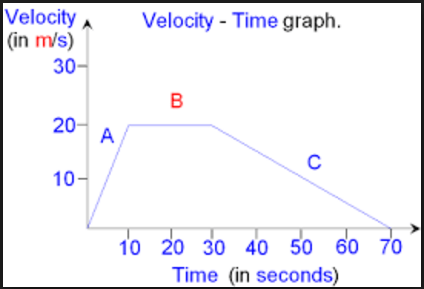
This is a velocity-time graph. What is the object doing in segment A?
a)
Positive acceleration
b)
Negative acceleration
c)
Constant Velocity
d)
Not moving
58.

This is a velocity-time graph. What is the object doing in segment B?
a)
Positive acceleration
b)
Negative acceleration
c)
Constant Velocity
d)
Not moving
59.

Calculate the acceleration for segment A.
a)
2 m/s2
b)
20 m/s2
c)
-2 m/s2
d)
0 m/s2
60.
A car driving at 50 miles per hour drives for 2 hours. What distance did it cover?
a)
50 miles
b)
25 miles
c)
100 miles
d)
75 miles
61.
A truck driving at 60 miles per hour travels 150 miles. How long is it driving for?
a)
9000 hours
b)
0.4 hours
c)
210 hours
d)
2.5 hours
62.
In science, a well-substantiated explanation of some aspect of the natural world that can incorporate facts, laws, inferences, and tested hypotheses.
a)
Fact
b)
Theory
c)
Law
d)
Hypothesis
63.
A testable statement about the natural world that can be used to build more complex inferences and explanations. To be a hypothesis, a statement must contain a possible explanation.
a)
Fact
b)
Theory
c)
Law
d)
Hypothesis
64.
Laws tells us that it happens but doesn’t describe how or why.
a)
True
b)
False
65.
A possible explanation to a problem that has not yet been tested.
a)
data
b)
theory
c)
hypothesis
d)
fact
100 %

