
 Worksheets
8th STAAR Review MOSTLY CHEMISTRY
Total questions: 60
Worksheet time: 1hrs 24mins
Name
Class
Date
1.
The positive particles of an atom are
a)
electrons
b)
positrons
c)
neutrons
d)
protons
2.
the central region of an atom where its neutrons and protons are is its
a)
nucleus
b)
electron cloud
c)
core
d)
center
3.
an atom with atomic number 6 would have how many protons
a)
6
b)
12
c)
3
d)
cannot be determined
4.
Particles in an atom that are neutral and have no charge are
a)
negatrons
b)
electrons
c)
neutrons
d)
protons
5.
Particles in an atom that are neutral and have no charge are
a)
negatrons
b)
electrons
c)
neutrons
d)
protons
6.
True or False? Neutrons have a negative charge
a)
True
b)
False
7.
A particle that moves around the nucleus is a(n)...
a)
Proton
b)
Neutron
c)
Electron
d)
Quark
8.

What does the 1.00794 stand for?
a)
Hydrogen
b)
atomic number
c)
atomic mass
d)
atomic explosion
9.

Which of these is the proton.
a)
A
b)
B
c)
C
d)
None
10.

How many protons does this atom have?
a)
2.5
b)
6
c)
5
d)
10.811
11.
Find a periodic table. Look online or in your agenda. How many neutrons does Aluminum have?
a)
13
b)
27
c)
14
d)
40
12.
On a periodic table, find Na (sodium). How many neutrons does it have?
a)
11
b)
22
c)
23
d)
12
13.
What are the two main parts of the atom?
a)
nucleus and cytoplasm
b)
nucleus and electron cloud
c)
core and electron cloud
d)
protons and neutrons
14.
The atomic number tells you what?
a)
number of electrons
b)
number of protons
c)
number of neutrons
d)
both electrons and protons in an atom.
15.
Element or Compound?
H2O
H2O
a)
Element
b)
Compound
16.
Element or Compound?
H2SO4
H2SO4
a)
Element
b)
Compound
17.
Element or Compound?
Au
Au
a)
Element
b)
Compound
18.
Element or Compound?
Au
Au
a)
Element
b)
Compound
19.
Element or Compound?
CF3CO2H
CF3CO2H
a)
Element
b)
Compound
20.
How many Hydrogen are in 4H2O?
a)
6
b)
8
c)
2
d)
4
21.
How many Oxygen are in H2O?
a)
1
b)
2
c)
0
d)
4
22.
How many Oxygen are in H2O?
a)
1
b)
2
c)
0
d)
4
23.
2H2 + O2 ----> 2H2O What is the product?
a)
------>
b)
2H2O
c)
2H2+ O2
24.
2H2 + O2 ----> 2H2O What is the product?
a)
------>
b)
2H2O
c)
2H2+ O2
25.
2H2 + O2 --------> 2H2O What are the reactants?
a)
----->
b)
2H2O
c)
2H2 +O2
26.
2H2 + O2 --------> 2H2O What are the reactants?
a)
----->
b)
2H2O
c)
2H2 +O2
27.
How many Magnesium are in 10MgCl2?
a)
10
b)
5
c)
20
28.
How many elements are in C6H12O6?
a)
1
b)
2
c)
3
d)
4
29.
How many elements are in C6H12O6?
a)
1
b)
2
c)
3
d)
4
30.
How many atoms are there TOTAL in:
H2SO4
H2SO4
a)
6
b)
5
c)
7
d)
3
31.
How many atoms are there TOTAL in:
H2SO4
H2SO4
a)
6
b)
5
c)
7
d)
3
32.
Number of N in (NH₄)₂CrO₄
a)
1
b)
2
c)
8
d)
16
33.
Number of N in (NH₄)₂CrO₄
a)
1
b)
2
c)
8
d)
16
34.
What is Newtons 1st law of motion?
a)
Force= Mass multiplied by acceleration
b)
An object at rest stays at rest unless acted on an unbalanced force. (inertia)
c)
For every action there is a equal and opposite re-action.
d)
law of gravity
35.

What law of motion does this picture represent?
a)
Newtons 3rd law
b)
Newtons 4th law
c)
Newtons 1st law
d)
Newtons 2nd law
36.

What law of motion does this picture represent?
a)
Newtons 1st law
b)
law of gravity
c)
Newtons 4th law
d)
Newtons 2nd law
37.
What law of motion does this picture represent?
a)
Newtons 1st law
b)
law of gravity
c)
Newtons 4th law
d)
Newtons 2nd law
38.

What law of motion does this picture represent?
a)
Newtons 1st law
b)
Newtons 4th law
c)
Newtons 3rd law
d)
Newtons 2nd law
39.

Describe the speed of the object from 4-6 seconds using the distance vs. time graph.
a)
Increasing speed
b)
Decreasing speed
c)
Not moving
d)
Constant speed
40.

Describe the speed of the object from
0-2 seconds using the distance vs. time graph.
0-2 seconds using the distance vs. time graph.
a)
Constant
b)
Speeding up
c)
Slowing down
d)
Not moving
41.
The first energy level can hold up to how many electrons?
a)
8
b)
4
c)
2
d)
5
42.

What is the atomic mass of "F"
a)
9
b)
18
c)
17
d)
19
43.
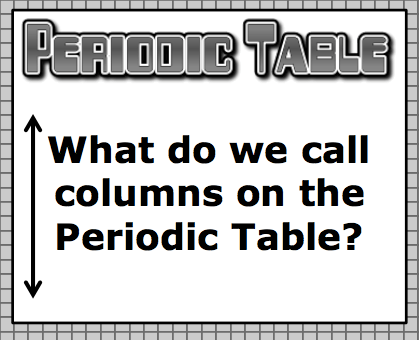
a)
Periods
b)
Groups
44.
a)
Periods
b)
Groups
45.
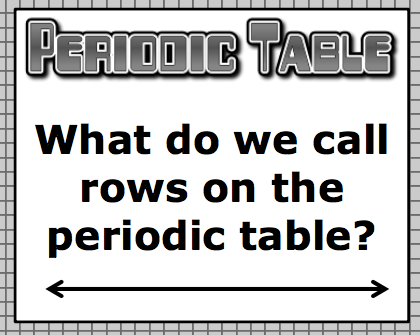
a)
Periods
b)
Groups
46.
a)
Periods
b)
Groups
47.

a)
energy levels
b)
valence electrons
c)
protons
d)
neutrons
48.
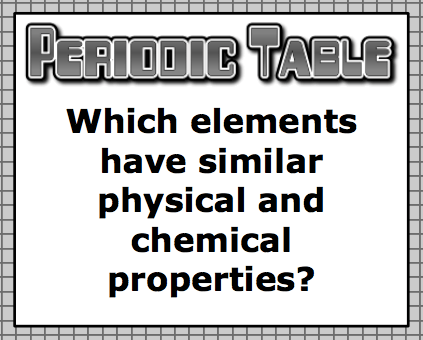
a)
Same group
b)
Same period
49.
Particles in an atom that are neutral and have no charge are
a)
negatrons
b)
electrons
c)
neutrons
d)
protons
50.

What is happening in this graph from point B to C?
a)
The object is going down a hill.
b)
The object is returning to its starting location.
c)
The object is slowing down.
d)
The object is staying still.
51.

What is happening in this graph from point A to B?
a)
The object is accelerating.
b)
The object is not moving.
c)
The object is decelerating.
d)
The object is moving at a constant speed.
52.
A decomposer?
a)
Eats dead plants or animals and breaks down to put nutrients in the soil
b)
Eats plants or other animals for food
c)
Makes its own food
d)
Machine that gathers trash
53.
A decomposer?
a)
Eats dead plants or animals and breaks down to put nutrients in the soil
b)
Eats plants or other animals for food
c)
Makes its own food
d)
Machine that gathers trash
54.
All members of one kind of organism that live in the same area
a)
population
b)
microorganism
c)
communit
d)
organism
55.
Is sunlight a biotic or abiotic factor?
a)
biotic
b)
abiotic
56.

This animal is an .......
a)
Producer
b)
Consumer
c)
Decomposer
57.

What level consumer could you consider the deer?
a)
Primary
b)
Secondary
c)
Tertiary
d)
Quarternary
58.

This tree is a......
a)
Producer
b)
Primary Consumer
c)
Secondary/Tertiary Consumer
d)
Decomposer
59.

Which of the following is a herbivore?
a)
cricket
b)
frog
c)
hawk
d)
shrew
60.

What does a food web represent?
a)
All connections of energy flow throughout all organisms in a habitat.
b)
The specific ways that mutualism is carried out.
c)
A single pathway or energy flow between organisms.
d)
How carnivores get their food.
100 %

