wayground logo

Free Printable Worksheets

NEW

Font size

S
M
L
XL
Worksheets

Mass, Matter, and Energy!!!!!!

Total questions: 57

Worksheet time: 45mins

Name
Class
Date
1.
Anything that takes up space and has mass is...
a)
Matter
b)
Work
c)
Power
d)
Newton's 1st Law
2.

The Law of Conservation of Mass says...

a)

matter is created

b)

matter is destroyed

c)

matter is not created or destroyed, it is changed

d)

matter does not change

3.

True or false: The Law of Conservation of Mass means that the number of atoms of the products (results) is more than the number of atoms in the reactants (ingredients).

a)

True

b)

False

4.

Bob puts 200 grams of ice into a pitcher with 900 grams of water to create 1100 grams of ice water. He gets distracted and comes back later to find that the ice has melted in the water. How many grams of water does Bob now have in the pitcher?

a)

200 g

b)

700 g

c)

1,100 g

5.

Suppose a reaction were to happen in an open container in a lab. During the reaction, the scientist observes the chemicals bubble, and produce a gas. During the analysis the scientist notices that the reactants (ingredients) weighed 20 g when he started, and the product (results) weighed 18 g at the end. Explain what happened.

a)

His chemical reaction defied the law of conservation of mass

b)

Mass was destroyed during the reaction

c)

Matter was created during the reaction

d)

The gas that was produced it escaped into the air.

6.

If reaction starts with 20g of reactants (ingredients) it should produce...

a)

a total of 40g of product

b)

a total of 10g of product

c)

a total of 80 g of product

d)

a total of 20g of product

7.
10g of white powder reacts with 10g of clear liquid. The reaction bubbles and changes color producing a black liquid that has a mass of 13g. What can be concluded?
a)
5g of gas was produced
b)
This experiment violates the conservation of mass
c)
7g of gas was produced
d)
The excess reactant is destroyed & disappears during the reaction
8.
In a chemical equation, you will ________________ have the same number of atoms on the reactant and product side.  
a)
always
b)
never
c)
sometimes
9.
If there are 4 H atoms on the reactant side, how many H atoms will be on the product side? 
a)
2
b)
4
c)
6
d)
You need more information to answer this question
10.
At which point is potential energy greatest?
a)
W
b)
X
c)
Y
d)
Z
11.
__________ is stored energy. 
a)
Potential
b)
Kinetic
c)
None of the above 
d)
All of the above 
12.
The faster an object moves, the ________ kinetic energy it has. 
a)
more
b)
less
c)
none of the above
d)
same
13.
What kind of energy is in a rock at the edge of a cliff?
a)
Potential
b)
Kinetic
c)
Both potential and kinetic energy
d)
none of the above
14.
Which is the best example that something has kinetic energy?
a)
a. a car parked on a steep hill 
b)
b. a tennis ball rolling across the court
c)
c. a picture hanging on the wall 
d)
d. a piece of coal before it's burned 
15.
Energy due to motion is ____________ energy. 
a)
Potential 
b)
Energy
c)
Kinetic
d)
Friction
16.
Energy can be _____________ or changed from one type to another.
a)
destroyed
b)
transferred
c)
created
d)
ignored
17.
What kind of energy is in a stretched rubber band?
a)
Potential
b)
Kinetic
18.
Energy can not be created or destroyed, only converted from one form to another.
a)
true
b)
false
19.
At which point is kinetic energy greatest? 
a)
W
b)
X
c)
Y
d)
Z
20.
a)
Potential Energy
b)
Kinetic Energy
21.
a)
Potential Energy
b)
Kinetic Energy
22.
a)
Potential Energy
b)
Kinetic Energy
23.
a)
Potential Energy
b)
Kinetic Energy
24.
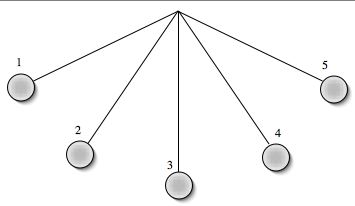
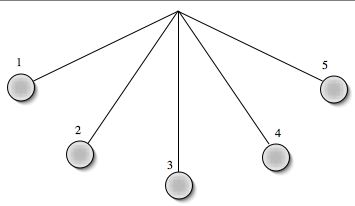
When a pendulum swings, at which point is kinetic energy highest?
a)
1
b)
2
c)
3
d)
4
25.
When a pendulum swings, at which point is potential energy at its greatest?
a)
1
b)
2
c)
3
d)
4
26.
Explain what happens to the potential energy of a rock as it falls off the side of a cliff.
a)
The kinetic energy decreases as the potential energy increases.
b)
The kinetic energy decreases as the potential energy decreases.
c)
The potential energy decreases as the kinetic energy increases.
d)
The potential energy decreases as the kinetic energy decreases. 
27.
When riding a roller coaster, you go up and down many hills. As you get to the top of a roller coaster, what energy change is taking place.
a)
Potential energy is changed into kinetic energy.
b)
Kinetic energy is changed into potential energy.
c)
Chemical energy is changed into heat energy.
d)
Heat energy is changed into chemical energy. 
28.

The distance in between two waves.

a)

wave speed

b)

frequency

c)

wavelength

29.

Frequency is always measured in _________

a)

kilometers

b)

Hertz

c)

centimeters

30.

when a wave hits a barrier and bounces

a)

diffraction

b)

reflection

31.

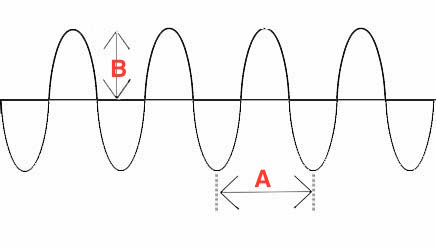
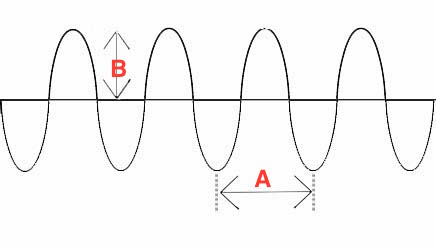
This is a high frequency wave. Which part of the wave is "B"

a)

crest/peak

b)

wavelength

c)

trough

32.

Look at this wave. "A" is which part of a wave?

a)

Crest/Peak

b)

Wave Speed

c)

Resting Point

33.

Does this wave have a high frequency or low frequency?

a)

High

b)

Low

34.
What property of this wave is represented by the letter "A"
a)
amplitude
b)
crest
c)
trough
d)
wavelength
35.
What property of the wave is represented by the letter "B"?
a)
amplitude
b)
crest
c)
trough
d)
wavelength
36.
The lowest point on a wave is the:
a)
Amplitude
b)
Crest
c)
Trough
d)
Wavelength
37.
The number of wavelengths that pass a point each per second is:
a)
frequency
b)
period
c)
longitudinal 
d)
transverse wave 
38.
When the frequency of a wave increases, what happens to the wavelength?
a)
The wavelength is not directly affected by the frequency of a wave.
b)
The wavelength increases.
c)
The wavelength decreases.
d)
More specific information is needed to form a conclusion about the wavelength.
39.
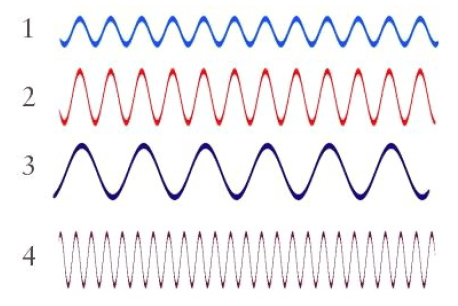
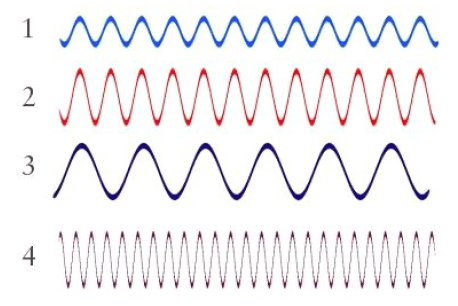
Which wave in the diagram has the greatest frequency?
a)
1
b)
2
c)
3
d)
4
40.
Which wave in the diagram has the greatest wavelength?
a)
1
b)
2
c)
3
d)
4
41.
regular disturbances that carry energy through matter or space
a)
crest
b)
energy
c)
wave
d)
trough
42.
When a wave strikes and object and bounces off. (example echo)
a)
medium
b)
refraction
c)
reflection
d)
interference
43.
When a wave bends as it passes through at an angle from one medium to another.(example: pencil in a glass of water-)
a)
medium
b)
refraction
c)
reflection
d)
interference
44.

This is when sound waves reflect or bounce off an an object.

a)

Echo

b)

Transmission

c)

Refraction

d)

Absorption

45.

This is the term that describes when light passes through matter.

a)

Transmission

b)

Transparent

c)

Translucent

d)

Opaque

46.

This is when light changes direction slightly when it passes from one material to another.

a)

Transmission

b)

Reflection

c)

Refraction

d)

Absorption

47.

This describes when the atoms of matter absorb light, and converts the light into thermal energy.

a)

Transmission

b)

Reflection

c)

Refraction

d)

Absorption

48.

How many atoms of Hydrogen are in H2O

a)

1

b)

2

c)

3

d)

more than 3

49.

The ______ are numbers found on the lower right-hand side of an element symbol.

a)

Coefficient

b)

Exponent

c)

Multiplier

d)

Subscript

50.

4CF2Cl2

a)

C = 4, F = 4, Cl = 2

b)

C = 1, F = 8, Cl = 8

c)

C = 4, F = 8, Cl = 8

d)

C = 1, F = 4, Cl = 8

51.

H2SO4

a)

H = 2, S = 4, O = 4

b)

H = 2, S = 1, O = 4

c)

H = 8, S = 4, O = 4

d)

H = 2, SO = 4

52.
How many Hydrogen are in 4H2O?
a)
6
b)
8
c)
2
d)
4
53.
2H2 + O2 ----> 2H2O What is the product?
a)
------>
b)
2H2O
c)
2H2+ O2
54.
2H2 + O--------> 2H2O What  are the reactants?
a)
----->
b)
2H2O
c)
2H2 +O2
55.
How many elements are in C6H12O6?
a)
1
b)
2
c)
3
d)
4
56.
How many Sodium (Na) are in 6NaCl?
a)
1
b)
12
c)
6
57.
The particles of a gas move ____than the particles of the same substance in the liquid or solid state.
a)
faster
b)
slower
c)
same speed