
 Worksheets
Honors Review - Fission, Fusion, and Decay (SPS4abc)
Total questions: 70
Worksheet time: 2hrs 54mins
Where does fusion take place?
sun
stars
deep inside the earth
nuclear reactors
Where does fission take place?
sun
stars
deep inside the earth
nuclear reactors
Fission creates the energy that causes:
Volcanic Eruptions
Earthquakes
Flooding
Thunderstorms
What process uses fission to generate electricity?
Nuclear power
Nuclear bombs
Physical change
Chemical reaction
What element is the main source of fuel for fission?
Uranium
Hydrogen
Carbon
Krypton
What element is the main source of fuel for fusion?
Uranium
Hydrogen
Carbon
Krypton
Advantages of Nuclear power include:
Creates a lot of energy
Safer than coal (in the U.S.)
Involves harmful radioactive elements
Produces radioactive waste that must be stored
Disadvantages of Nuclear power include:
Creates a lot of energy
Safer than coal (in the U.S.)
Involves harmful radioactive elements
Produces radioactive waste that must be stored
Fission:
Splitting of radioactive elements into lighter elements
Combining of small elements into heavier elements
Creates a LOT of energy
Produces radioactive waste
Fusion:
Splitting of radioactive elements into lighter elements
Combining of small elements into heavier elements
Creates a LOT of energy
Requires temperatures over 50 million degrees Celsius
What process describes two small nuclei combining into a larger nucleus?
fission
fusion
alpha decay
beta decay
What process is described by the splitting of a nucleus into smaller nuclei?
fusion
fission
half-life
gamma radiation

What nuclear process is shown in the picture?
alpha decay
gamma emission
fusion
fission

The nuclear equation shown models which nuclear process?
fusion
fission
beta decay
gamma emission

Which nuclear process if shown in the picture?
alpha decay
beta decay
fusion
fission
One disadvantage of nuclear energy produced through fission is ___.
it is a fossil fuel
it leaves behind radioactive waste
it emits large amounts of pollution into the atmosphere
there are no disadvantages
Which of the following is NOT an example of nuclear fission?
nuclear power plants
the sun
atomic bombs

Which material is responsible for initiating and continuing the chain reaction?
neutron, 01n
Uranium - 235, 23592U
Krypton - 90, 9036Kr
Barium - 144, 14456Ba
Which of the following is NOT a true statement about nuclear fission?
big atoms split apart
it occurs naturally
it produces radioactive waste
it releases less energy than fusion
It creates radioactive waste products.
What do scientists call isotopes with radioactive nuclei that can emit or give off smaller subatomic particles and electromagnetic radiation?
stable isotopes
radioactive isotopes
electromagnetic isotopes
strong nuclear force isotopes
Which subatomic particle seems to have a stabilizing effect on an isotope?
protons
neutrons
electrons
quarks
A large unstable isotope is bombarded by high speed particles (usually neutrons) and breaks apart into smaller particles and nuclei during what type of reaction?
fusion
electromagnetic
double replacement
fission
Which of the following statements is false about stability and decay?
The less stable the isotope, the quicker the sample decays.
Scientists use the half life as an indicator of how stable a particular isotope is.
The half life is equal to the time it takes for one-fourth of a sample’s neutrons to decay.
The more stable the isotope, the slower a sample decays.
An example of an uncontrolled fission reaction is _______________
Nuclear power plants
Radioactive decay
Nuclear bomb
On the surface of the sun
Can be stopped by aluminum foil; has almost no mass and a negative charge.
beta particle
alpha partcle
gamma ray
half-life
Powerful radiation that can cause biological damage.
beta particle
alpha particle
gamma ray
carbon dating
Using the decay of an isotope to find the age of a once-living object [fossil].
carbon dating
alpha particle
gamma ray
half-life
A helium nucleus; low energy.
gamma ray
carbon dating
half-life
alpha particle
Time necessary for 50% of a radioactive sample to decay.
carbon dating
half-life
alpha particle
gamma ray
The type of radioactive particle that can be stopped by a sheet of paper is the ____.
alpha particle
uranium
beta particle
gamma ray
The most penetrating type of radiation is the _______.
beta particle
gamma ray
uranium
alpha particle
_____ is the only fundamental force that attracts and repels.
Gravitational
Strong Nuclear
Electromagnetic
Weak Nuclear
What causes an atom to be unstable
Imbalance of protons and neutron
Not enough electrons in the electron cloud
Too much energy in the nucleus
Too much space between the nucleus and the electron cloud
Only nuclei with _________ atomic numbers can undergo fission.
small
even
odd
large
In fusion, the product is a larger atomic nucleus.
Fission produces energy but fusion does not.
Fusion produces energy but fission does not.
In fission, the product is a larger atomic nucleus.
You have 100 grams of radioactive C-14. The half life of C-14 is 5730 years.
How many grams are left after 2 half lives?
100 grams
25 grams
2 grams
50 grams
Imagine you have 50,000 atoms of uranium-238. If U-238 has a half-life of 4.5 billion years, how many U-238 atoms will be left after 4.5 billion years?
25,000
50,000
12,500
0
If 10 mg of iodine 131 is given to a patient, how much is left after 24 days? The half-life of iodine-131 is 8 days.
1.25mg
1.25g
10g
10mg
After the third half-life, how much of the sample is left?
1/2
1/3
1/16
1/8

What percent of carbon-14 would be left after 5730 years?
100%
75%
50%
25%
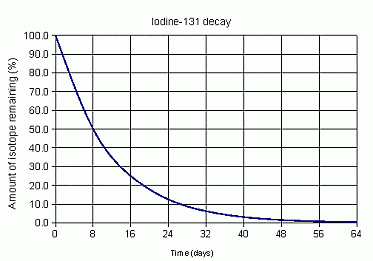
What is the half-life of iodine-131?
32 days
8 days
16 days
24 days
The time it takes for a radioactivity level to drop by a half is is the sample's ___________________.
quarter life
whole life
wonderful life
half life
If the half-life of uranium-232 is 70 years, how many half-lives will it take for 10 g of it to be reduced to 1.25 g?
1 half-life
2 half-lives
3 half-lives
4 half-lives

When an isotope goes through 3 half-lives, _____ _________________ remains
1/32 or 3.125%
1/8 or 12.5%
1/16 or 6.25%

When an isotope goes through 4 half-lives, _____ _________________ remains
1/4 or 25%
1/8 or 12.5%
1/16 or 6.25%

How much of an 80 g sample will remain after 21.2 years?
40 g
20 g
10 g
5 g

How many years will it take for an 80 g sample to decay to 10 g? (Remember, you must add 5.3 years for each half-life.)
10.6 years
15.9 years
21.2 years
26.5 years

If 20 g of copper-64 has a half-life of 13 hours, what mass of copper-64 will remain after 39 hours? ( Drag the answer to the space.) (a)

If 20 g of copper-64 has a half-life of 13 hours, what mass of copper-64 will remain after 26 hours?
20 g
10 g
5 g
2.5 g

What is the half-life of radium-226?
1600 years
3200 years
4800 years
6400 years

What is the half-life of strontium-90?
25 years
50 years
75 years
100 years

How many grams will remain after 100 g of cobalt-60 has gone through 3 half-lives?
50 g
25 g
12.5 g
6.25 g

How many years will it take for 75% of 100 g of cobalt-60 to decay?
5 years
10 years
15 years
20 years
The % of the parent isotope remaining after 2 Half Lives.
50%
25%
12.5%
6.25%
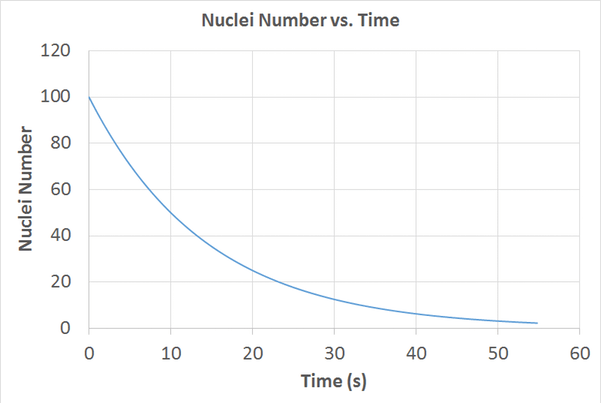
What is the Half life of this isotope?
5 seconds
10 seconds
15 seconds
20 seconds

What is the only difference between two different isotopes of the same element?
Number of neutrons
Number of protons
Number of electrons
Size of atom
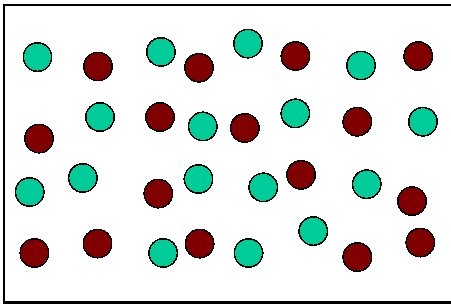
The diagram shows 32 atoms.
16 of the Red are parent isotopes
16 of the Green are daughter isotopes
How many half-lives have occurred?
0
1
2
3
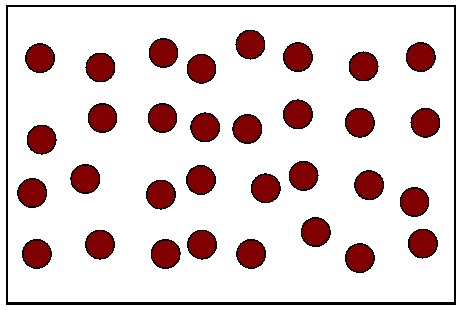
The diagram shows 32 atoms
32 of the Red are the parent isotope
0 of the atoms are daughter isotopes
How many half-lives have occurred?
0
1
2
3
If the half life of a radioactive element is 100yrs, how long would it take for the radioactivity to reduce by one half?
200yrs
100yrs
50yrs
300yrs

