wayground logo

Free Printable Worksheets

NEW

Font size

S
M
L
XL
Worksheets

Force on a Spring

Total questions: 60

Worksheet time: 3hrs 45mins
Name
Class
Date
1.
A spring with k=73 N/m is compressed 70 cm.  An object of mass 4 kg is attached to one end of the compressed spring.  What is the acceleration of the object at the moment the spring is released?  
a)
.078 m/s/s
b)
0.17 m/s/s
c)
13 m/s/s
d)
1.3 X 10^5 m/s/s
2.
A spring has a spring constant of 330 N/m.  How far is the spring compressed if 150 N of force are used?
a)
2.2 m
b)
0.0014 m
c)
5.0 m
d)
0.45 m
3.
A force of 470 N is applied to stretch a spring which has a spring constant, k=1100 N/m.  How much does the spring stretch past its free length?
a)
0.214 m
b)
2.34 m
c)
0.427 m
d)
5.17 X 10^5 m
4.
What force should be applied to compress a spring by 0.013 m if its spring constant is k = 1900 N/m?
a)
1880 N
b)
24.7 N
c)
1900 N
d)
0.127 N
5.
Which of the following is a true statement regarding springs?
a)
The higher the value of the spring constant, the stiffer the spring.  
b)
In Hooke's law, the force exerted by the spring acts in the same direction as displacement.  
c)
Springs are designed to provide unpredictable variations in force.  
d)
The force exerted by a spring has a quadratic relationship with the displacement form equilibrium.  
6.
Which of the following springs is the stiffest?
a)
A spring that requires a froce of 2000 N to compress it by 6.8 m.
b)
A spring that requires a force of 4000 N to stretch it by 9.0 m. 
c)
A spring that requires a force of 8000 N to compress it by 45 m.  
d)
A spring that requires a force of 4800 N to stretch it by 14 m.
7.
A force of F=500 N is applied to extend a spring.  What is the displacement x of the spring if its spring constant is k= 540 N/m?
a)
0.96 m
b)
0.93 M
c)
1.3 m
d)
1.1 m
8.
A net force of 430 N acts to stretch an extension spring.  How far will the spring stretch if its spring constant is 700 N/m?
a)
43.9
b)
0.307 m
c)
1.63 m
d)
0.614 m
9.
A 25,000 N Car is supported by 4 springs.  If each spring is deflected by 0.040 m what is the spring constant? 
a)
160,000 N /m
b)
620,000 N/m
c)
630,000 N/m
d)
120,000 N/m
10.
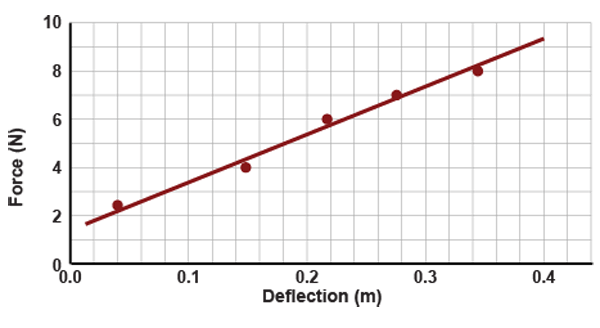
What Quantity can you calculate from the graph and give the magnitude of that quantity.  
a)
distance 4.5 m
b)
Force 15 N
c)
spring constant 20 N/m
d)
spring constant 200 N/m
11.
A spring with a spring constant of k is cut into 4 equal length pieces.  What is the spring constant of each of the pieces?
a)
1/2 K
b)
2 K
c)
1/4K
d)
4K
12.
Hooke's Law describes the behaviour of which kind of material under tension?
a)
plastic
b)
metals only
c)
elastic
d)
non-metals only
13.

If F is force, k is spring constant and e is extension, Hooke's Law tells us that:

a)

F=k/e

b)

e=Fk

c)

k=Fe

d)

F=ke

14.
Hooke's Law fails when a material reaches its:
a)
breakdown
b)
elastic limit
c)
end of tether
d)
fracture stress
15.
A graph of extension against force for an elastic material is:
a)
A downward curve
b)
An upward curve
c)
A straight line from any point on the x and y axis
d)
A straight line from the origin
16.
A stiff material has a:
a)
high spring constant
b)
low spring constant
c)
spring constant of any value
d)
spring constant which is difficult to predict
17.
A spring has a spring constant of 5N/cm.  What is its extension when loaded with 15N?
a)
4cm
b)
5cm
c)
3m
d)
3cm
18.
A spring extends 1.5m under load 10N. What is its spring constant?
a)
0.15N/m
b)
10N/m
c)
6.7N/m
d)
15N/m
19.
If the Earth's gravitational field strength is 10N/kg, how much weight does a 100g mass have in Newtons?
a)
100g
b)
10N
c)
1N
d)
1000N
20.
Which of the following springs is the stiffest?
a)
A spring that requires a froce of 2000 N to compress it by 6.8 m.
b)
A spring that requires a force of 4000 N to stretch it by 9.0 m. 
c)
A spring that requires a force of 8000 N to compress it by 45 m.  
d)
A spring that requires a force of 4800 N to stretch it by 14 m.
21.
If extension = Stretched length - original length. What is the extension of spring D.
a)
1mm
b)
2mm
c)
3mm
d)
0mm
22.

What is the potential energy of a 3kg ball that is on the ground?

a)

0 J

b)

3 J

c)

9.8 J

d)

29.4 J

23.

A 100 N force is applied to move an object a horizontal distance of 5 meters at constant speed in 10 seconds. How much power is done?

a)

50J

b)

50W

c)

500J

d)

500W

24.

How will you describe the energy at Point A?

a)

mostly potential energy

b)

mostly kinetic energy

c)

losing PE, gaining KE

d)

losing KE, gaining PE

25.

How much power is generated by Ashley (50 kg) running up a 6 m flight of stairs in 5 seconds?

a)

60 W

b)

62 W

c)

600 W

d)

1500 W

26.
The picture shows a geothermal power plant. 
Which statement best describes this energy source?
a)
Geothermal power plants are renewable energy sources used to remove magma.
b)
Geothermal power plants are nonrenewable energy sources used to produce natural gas.
c)
Geothermal power plants are renewable energy sources used to produce electricity.
d)
Geothermal power plants are nonrenewable energy sources used to dig for oil.
27.
The picture shows sunlight shining on solar panels. 
Which statement best describes this energy source?
a)
Sunlight is a renewable energy source used to produce hydropower.
b)
Sunlight is a nonrenewable energy source used to produce nuclear power.
c)
Sunlight is a renewable energy source used to produce electricity.
d)
Sunlight is a nonrenewable energy source used to produce natural gas.
28.
Which is a renewable source of energy?
a)
oil
b)
nuclear
c)
wind
d)
natural gas
29.
Which is a renewable source of energy?
a)
coal
b)
uranium
c)
ocean tides
d)
natural gas
30.

Which is a nonrenewable source of energy?

a)

solar

b)

wind

c)

coal

d)

geothermal

31.
Coal, oil, and natural gas are all are renewable energy sources.
a)
True
b)
False
32.

A windmill is a renewable energy source

a)

True

b)

False

33.

A small child slides down the four frictionless slides A–D. Rank in order, from largest to smallest, her speeds at the bottom.

a)

vD > vA > vB > vC

b)

vD > vA = vB > vC

c)

vC > vA > vB > vD

d)

vA = vB = vC = vD

34.

Starting from rest, a marble first rolls down a steeper hill, then down a less steep hill of the same height. Ignoring friction, for which is it going faster at the bottom?

a)

Faster at the bottom of the steeper hill

b)

Faster at the bottom of the less steep hill

c)

Same speed at the bottom of both hills

d)

Can’t say without knowing the mass of the marble

35.

Rank in order, from largest to smallest, the gravitational potential energies of the balls.

a)

1 > 2 = 4 > 3

b)

1 > 2 > 3 > 4

c)

3 > 2 = 4 > 1

d)

3 > 2 > 4 > 1

36.

Each of the boxes shown is pulled for 10 m across a level, frictionless floor by the force given. Which box experiences the greatest change in its kinetic energy?

a)

A

b)

B

c)

C

d)

D

e)

E

37.

If a system is isolated, the total energy of the system

a)

Increases constantly.

b)

Decreases constantly.

c)

Is constant.

d)

Depends on the work done on the system.

e)

Depends on the work done by the system.

38.

Which of the following is defined as an energy transfer?

a)

kinetic energy

b)

work

c)

potential energy

d)

chemical energy

39.

How much power is required to raise a 200-kg crate a vertical distance of 2 m in a time of 4 s?

a)

400 W

b)

1000 W

c)

1600 W

d)

4000 W

40.

How much work is done on a 200-kg crate that is hoisted 2 m in a time of 4 s?

a)

400 J

b)

1000 J

c)

1600 J

d)

4000 J

41.

A basketball that is dropped bounces back up to its original height. Pick the correct energy transformation from the point when it was dropped until it returns to the original height.

a)

KE --> PE --> Elastic

b)

PE --> KE --> Elastic --> KE --> PE

c)

KE --> PE --> Elastic --> PE --> KE

d)

Elastic --> PE --> KE --> Elastic

42.

Which requires more power – a person walking up stairs or a person running up stairs?

a)

walking

b)

running

c)

they require equal power output

d)

no power is required at all

43.

Which requires more work – a person walking up stairs or a person running up stairs?

a)

walking

b)

running

c)

they require equal work

d)

no work is required for either because the movement is vertical

44.

What is the unit for power?

a)

what

b)

watt

c)

joule

d)

Jewel-Osco

45.

A rock has 10 J of potential energy on top of a roof. If it is dropped and lands with only 8 joules of kinetic energy, how much work did air resistance do on the rock?

a)

-18 J

b)

-10 J

c)

-8 J

d)

-2 J

46.

A major league pitcher can throw a baseball with a kinetic energy of 150 J. How much work must the pitcher do to the ball to give it that much KE?

a)

150 J

b)

0

c)

Can’t tell without knowing the mass of the ball

47.

You are traveling along a freeway at 65 mi/h; your car has kinetic energy. You suddenly skid to a stop because of congested traffic. What happened to the kinetic energy your car just had?

a)

It is all in internal energy in the road

b)

It is all in internal energy in the tires

c)

Some of it has transformed to internal energy for the tires and the road, and some of it transferred away by sound energy and thermal energy into the air.

d)

It was destroyed

48.
What kind of energy is represented in the picture?
a)
Thermal
b)
Chemical
c)
Sound
d)
Nuclear
49.
On a roller coaster, where is maximum potential energy?
a)
At the bottom of a big hill
b)
When going around a corner
c)
When going upside down
d)
At the top of a big hill
50.
On a roller coaster, where is maximum kinetic energy?
a)
At the bottom of a big hill
b)
When going around a corner
c)
When going upside down
d)
At the top of a big hill
51.

A 40-kg person is climbing 3 m up a flight of stairs in 6 seconds. How much power did they exert climbing the stairs?

a)

400 W

b)

1200 W

c)

200 W

d)

120 W

52.

A ball rolls to the top of a frictionless hill. What is the energy transformation?

a)

gravitational potential to kinetic

b)

kinetic to thermal

c)

kinetic to gravitational potential

d)

chemical potential to kinetic

53.

A rock falls off a table and lands on a spring, squishing it. What is the energy transformation?

a)

gravitational potential to kinetic to gravitation potential

b)

kinetic to elastic potential to gravitational potential

c)

gravitational potential to kinetic to elastic potential

d)

chemical to thermal

54.

A 3.0 kg ball is on a table 1.5 m above the ground. What is its gravitational potential energy?

a)

4.5 J

b)

44.1 J

c)

3.4 J

d)

29.4 J

55.

What is the kinetic energy of a 12 kg dog running at 3 m/s?

a)

36 J

b)

353 J

c)

54 J

d)

118 J

56.

How much work is needed to push a resting 20 kg crate to a velocity of 5 m/s?

a)

15 J

b)

250 J

c)

300 J

d)

100 J

57.

50 J of work is done lifting a 2.0 kg book in the air. How high was it lifted?

a)

2.6 m

b)

3.6 m

c)

1.0 m

d)

25 m

58.

How much energy is used by a 100 W light bulb over 1 hour? (be sure to convert to seconds first)

a)

100 J

b)

36,000 J

c)

360,000 J

d)

240,000 J

59.

Bobby lifts a book to the second floor in 20 seconds. Carol lifts the same book to the second floor in 10 seconds. Who did more work?

a)

Bobby

b)

Carol

c)

They did the same amount of work

d)

Not enough information

60.

Bobby lifts a book to the second floor in 20 seconds. Carol lifts the same book to the second floor in 10 seconds. Who used more power?

a)

Bobby

b)

Carol

c)

They did the same amount of work

d)

Not enough information