
 Worksheets
Electrochemistry: Fuel Cells and Batteries
Total questions: 31
Worksheet time: 3hrs 35mins
What is an anode?
It is the electrode where oxidation takes place.
It is the electrode where reduction takes place.
It is an aqueous solution containing an electrode.
It is the salt bridge that connects half-cells.
What is a cathode?
It is the electrode where oxidation takes place.
It is the electrode where reduction takes place.
It is an aqueous solution containing an electrode.
It is the salt bridge that connects half-cells.

Given their standard reduction potentials, which of the species is going to be oxidized?
Cu2+/Cu = 0.34V
Zn2+/Zn = -0.76V
Cu
Zn
CuSO4
ZnSO4
What occurs to the mass of copper electrode in the following reaction?
Zn/Zn2+ // Cu2+/Cu
increases
decreases
remains the same
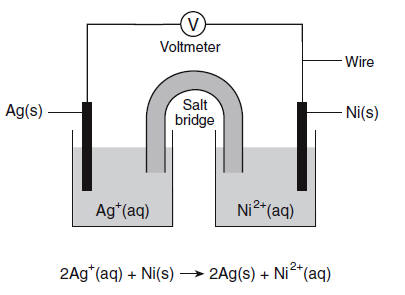
What reaction occurs at the anode?
Ag+/Ag = 0.80V
Ni2+/Ni = -0.25V
Ag+ + e- →Ag
Ag → Ag+ + e-
Ni2+ + 2e- → Ni
Ni → Ni2+ + 2e-
What would be the theoretical cell potential of the previous electrochemical cell?
Ag+/Ag = 0.80V
Ni2+/Ni = -0.25V
1.05V
-1.05V
0.55V
-0.55V
Which statement best describes how a salt bridge maintains electrical neutrality in the half-cells of an electrochemical cell?
It prevents the migration of electrons.
It prevents the reaction from occurring spontaneously.
It permits the migration of ions.
It allows for the reaction from occurring spontaneously.
When an electrochemical cell is operating, it is
approaching equilibrium
using external energy
undergoing oxidation, only
undergoing reduction, only
What is one problem with fuel cells
They are inefficient
They produce harmful chemicals
It is difficult to supply them with fuel
They can't help make petrol
Which one below is not a major reason to develop automotive fuel cell technology?
Efficiency
Low capacitance
Low or zero emissions
Local source production
CH4(g) + 2H2O(l) → CO2(g) + 8H+(aq) + 8e-
The corresponding equation for the half-reaction at the cathode is

In the image is an acidic hydrogen fuel cell. The half reaction occurring at the identified electrode is...
O2 (g) + 4H+ (aq) + 4e- → 2H2O (l)
O2 (g) + 2H2O (l) + 4e- → 4OH- (aq)
H2 (g) → 2H+ (aq) + 2e-
H2 (g) + 2OH- (aq) → 2H2O (l) + 2e-

In the image is an acidic hydrogen fuel cell. The half reaction occurring at the identified electrode is...
O2 (g) + 4H+ (aq) + 4e- → 2H2O (l)
O2 (g) + 2H2O (l) + 4e- → 4OH- (aq)
H2 (g) → 2H+ (aq) + 2e-
H2 (g) + 2OH- (aq) → 2H2O (l) + 2e-
What is the main reason why hydrogen is more difficult to store than diesel?
Hydrogen is a gas at room temperature but diesel is a liquid
Hydrogen can be liquefied by cooling it
Hydrogen can be stored under pressure
What is a strength of using hydrogen-oxygen fuel cells in manned spacecraft, compared to using chemical cells?
They produce electricity
They produce water that the astronauts can drink
They produce a voltage
What does the potential difference of a cell depend on?
The anode and cathode.
The type of electrolyte and fuel
Whether it's alkali or not
The type of electrode and the electrolyte.
In non-rechargeable cells, why do the chemical reactions stop over time?
One of the reactants becomes used up.
The energy has depleted.
The products are oxidised.
The electrodes become reactive.
Complete the equation which occurs at the negative electrode of a hydrogen fuel cell 2H₂ + 4OH⁻ →
H₂O + 4e⁻
4H₂O + e⁻
4H₂O + 4e⁻
3H₂O + 2e⁻
Why can some cells not be recharged?
Because the reaction is not reversible
Because the reaction is reversible
Because the reactant is used up
Because the products are used up
Cu2+(aq) + 2e- → Cu(s); E0 = 0.34 V
Fe3+(aq) + e- → Fe2+(aq); E0 = 0.77 V
The oxidant and reductant reacting in this galvanic cell are, respectively:
Pb4+(aq) + 2e- → Pb2+(aq); E0 = 1.69 V
Pb2+(aq) + e- → Pb(s); E0 = -0.13 V
What metal should be used for the electrode for the Pb4+/Pb2+ half-cell and what would be the potential difference across the cell?
CH4(g) + O2(g) → CO2(g) + 2H2O(l)
If an alkaline electrolyte is used, the equation for the reaction at the positive electrode is:
Zn(s) + Ag2O(s) + H2O(l) → 2Ag(s)+ Zn(OH)2(s)
This cell delivered 1.50 V. The half-equation for the silver half-cell is:
Ag2O(s)+ H2O(l)+ 2e-→ 2Ag(s)+ 2OH-(aq); E0 = 0.34 V
The standard redox potential for the zinc half-cell must be:

How do fuel cells produce energy (look at the image)
The hydrogen gives of oxygen to create energy then recombine to create water.
Oxygen enters then gives of a electron then combines with hydrogen to create water.
Hydrogen gives of an electron then recombined with the electron and oxygen to create water.
All of the above

