wayground logo

Free Printable Worksheets

NEW

Font size

S
M
L
XL
Worksheets

Earthquakes and Volcanoes Review

Total questions: 46

Worksheet time: 23mins

Name
Class
Date
1.

A vibration caused by an earthquake.

a)

seismic wave

b)

seismometer

c)

seismograph

2.
Where does the energy from an earthquake originate? 
a)
from a sudden increase in solar radiation striking Earth 
b)
from the Moon’s gravitational pull during a close orbit
c)
from rocks under stress shifting deep below Earth’s surface 
d)
from the weight of sediments pushing down on bedrock 
3.

Hawaii was formed by a...

a)

transform boundary

b)

divergent boundary

c)

subduction zone

d)

hot spot

4.
Any change in a rock's shape or volume caused by stress is known as...
a)
fault
b)
fold
c)
deformation
d)
strain
5.

Squeezing force that acts from opposite sides

a)

compression

b)

shear

c)

tension

6.

A pulling apart force

a)

compression

b)

shear

c)

tension

7.

This picture shows

a)

no stress

b)

compression

c)

tension

d)

shear

8.

Identify this picture

a)

no stress

b)

compression

c)

tension

d)

shear

9.

Identify this picture

a)

no stress

b)

compression

c)

tension

d)

shear

10.
The hanging wall slides up and over the footwall is what kind of fault?
a)
strike-slip
b)
normal
c)
reverse
11.
When the hanging wall slips downward below the footwall, what kind of fault is it?
a)
strike-slip
b)
normal
c)
reverse
12.
Which of these boundaries/stresses/faults all correctly go together?  Choose all that apply.
a)
normal, divergent, tension
b)
reverse, convergent, shearing
c)
strike-slip, transform, compression
13.
The cat is standing on the...
a)
foot wall
b)
hanging wall
c)
left
d)
weirdest elevator ever
14.
What is the definition of dormant?
a)
sleeping
b)
extinct
c)
active
d)
invisible
15.
A volcano that has gentle sloping sides and is formed from runny lava
a)
Shield volcano
b)
Cinder cone
c)
Composite
d)
None of these
16.
When an explosive eruption  forms a mixture of hot rock, ash, and gas, this material is called a...?
a)
Land slide
b)
Lava
c)
Eruption trail
d)
Pyroclastic flow
17.
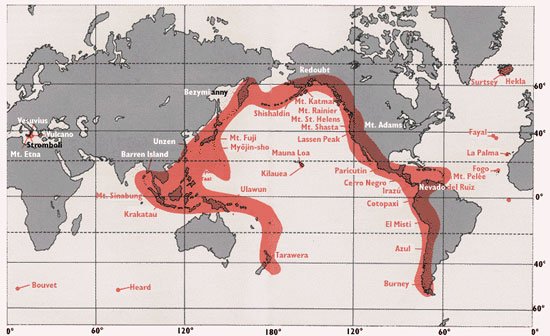
This is the name for the chain of volcanos around the edge of the Pacific Plate.
a)
Circle of Fire
b)
Ring of Lava
c)
Ring of Fire
d)
Circle of Magma
18.

A volcano that has steep sides and is formed from ash, cinders, and bombs.

a)

a shield volcano

b)

a cinder cone volcano

c)

a composite volcano

19.
A volcano that is made from layers of both runny lava and lava chunks is called 
a)
a shield volcano
b)
a cinder cone volcano
c)
a composite volcano
20.
Dormant volcanoes might erupt in the future.
a)
True
b)
False
21.
Where is Mt. St Helens located?
a)
New Jersey
b)
Nebraska
c)
Washington state
d)
I didn't learn this so I give up 
22.
This city was destroyed in 79 A.D. by the eruption of Mt. Vesuvius.
a)
Rome
b)
Munich
c)
Pompeii
d)
Naples
23.
Volcanoes are found...
a)
on land
b)
under water
c)
on islands
d)
all of the above
24.
Volcanoes that have recently erupted are known as:
a)
Extinct Volcano
b)
Dormant Volcano
c)
Active Volcano
d)
What's a volcano?
25.

Volcanoes that are unlikely to erupt in the future are called...

a)

Sleeping

b)

Dormant

c)

Active

d)

Extinct

26.
A subduction zone is...
a)
plates pull apart.
b)
the continental plate slides under the oceanic plate.
c)
where the oceanic plate slides under the continental plate.
d)
plates slap each other a high five.
27.
What is molten rock that has reached the Earth's surface?
a)
Aa
b)
Lava
c)
Magma
d)
Pahoehoe
28.
What is molten rock that has formed deep within the Earth?
a)
Hot Spot
b)
Magma
c)
Lava
d)
Volcano
29.
What factor(s) determine(s) whether an eruption will be explosive?
a)
The amount of gases in the magma
b)
The amount of silica in the magma
c)
The amount of gas and silica in the magma
d)
None of these affect the explosiveness of the volcano
30.

As magma rises towards the surface it collects in a _____ _____ .

a)

magma chamber

b)

side vent

c)

main vent

d)

lava chamber

31.
What is / are sign(s) that a volcano may erupt soon?
a)
Earthquake activity in the area
b)
Changes in the shape of the volcano
c)
Different amounts of gas being produced
d)
All of these are signs
32.
What is a huge hole left behind When a volcano has an enormous eruption and empties the magma chamber and the main vent.  The volcano becomes hollow and collapses leaving this hole behind
a)
Central vent
b)
Caldera
c)
Side vent
d)
Magma
33.

Fast moving lava with a smooth, liquid appearance.

a)

Pahoehoe

b)

AA

c)

ZZ

d)

Magma

34.

Slow moving lava with a rough, chunky appearance.

a)

Pahoehoe

b)

AA

c)

ZZ

d)

Magma

35.
Which type of wave arrives first during an earthquake?
a)
Primary (p-wave) waves
b)
Secondary (s-wave) waves
c)
Rayleigh Waves
d)
Love Waves
36.

Main type of seismic waves that can only travel through the surface of the Earth.

a)

seismic waves

b)

surface waves

c)

body waves

d)

primary waves

37.

This is considered as the fastest kind of seismic waves.

a)

Love waves

b)

Body waves

c)

Primary waves

d)

Secondary waves

38.

Rank the seismic waves in order of appearance when an earthquake first occurs as measured by a seismograph.

a)

S waves, P waves, then surface waves

b)

P waves, S waves, then surface waves

c)

S and P waves at the same time, then surface waves

d)

Surface waves, then S and P waves at the same time

39.

An instrument that detects and measures earthquakes is a

a)

spectrometer

b)

focus seismic map

c)

focus

d)

seismometer

40.
What is the point at which the first movement occurs during an earthquake?
a)
Epicenter
b)
Focus
c)
Fault
d)
Plate
41.
What is a weakness or crack/break in the lithosphere that can shift and create an earthquake?
a)
Earthquake
b)
Epicenter
c)
Fault
d)
Focus
42.
What is the point on the Earth’s surface directly above the focus of an earthquake?
a)
Epicenter
b)
Fault
c)
Hypocenter
d)
Tremor
43.
Which body waves cause particles of rock material to move at right angles to the direction in which the waves are traveling?
a)
Body Waves
b)
P- Waves
c)
S- Waves
d)
Surface Waves
44.

You were provided with data showing the arrival time of the P and S waves recorded from three seismic stations. Which of these can you possibly determine?

a)

the damage at the focus

b)

the distance to the earthquake

c)

the intensity of the earthquake

d)

the location of the epicenter

45.

From the seismogram, the distance to the epicenter can be determined by measuring _____________.

a)

the arrival time of surface wave

b)

the difference in the arrival times of the P and S waves.

c)

the ratio of the amplitude of the largest P and S waves.

d)

. the speed of the surface wave.

46.
What is the minimum number of seismograph stations needed to locate an earthquake epicenter?
a)
1
b)
2
c)
3
d)
1 billion