wayground logo

Free Printable Worksheets

Font size

S
M
L
XL
Worksheets

Year Online Homework 1

Total questions: 32

Worksheet time: 16mins

Name
Class
Date
1.

How is a business 'location' best described?

a)

The place where customers buy products

b)

The place where a business sites its operations

c)

The place where suppliers send components

2.

What can location decisions have a big impact on?

a)

Costs

b)

Revenues

c)

Costs and Revenues

3.

Which of these is NOT an advantage of an efficient transport network?

a)

It enables staff to get to work easily

b)

It allows supplies to be brought in from far afield

c)

Increased time getting finished products moved to market

4.

Which of these is a challenge a business faces when setting up a business overseas?

a)

Greater control of your business activities overseas

b)

Cultural and language barriers

c)

Can provide a more personalised service to customers based locally

5.

Which is an example of infrastructure?

a)

Staff

b)

Markets

c)

Roads

6.

What happens when a government gives a business a location grant?

a)

It is repaid

b)

It is repaid with interest

c)

It does not need to be repaid

7.

Which of the following is an example of relocation?

a)

Redundancies

b)

Moving production overseas

c)

Extra investment in new machines

8.

What is the most likely reason for relocating a factory overseas?

a)

Reduce manufactoring costs

b)

Reduce transport costs

c)

To act ethically

9.

What is a new shop in a city centre NOT likely to benefit from?

a)

Low rents

b)

An established infrastructure

c)

Availability of a specialist support services

10.

Where are restaurants most likely to locate?

a)

In areas that are most convenient for owners

b)

In areas that are most convenient for suppliers

c)

In an area that is most convenient for customers

11.
Before deciding on a retail location, is is important to consider if the town will accept a new retail business.
a)
True
b)
False
12.

Which of the following is likely to be the main factor influencing the location of a small barber shop? Proximity to:

a)

Customers

b)

Labor

c)

Raw materials

d)

Competitors

13.

The rise of the internet has meant that many businesses costs are:

a)

Lower as there is more need for expensive retail premises

b)

Higher as there is more need for expensive retail premises

c)

Higher as there is less need for expensive retail premises

d)

Lower as there is less need for expensive retail premises

14.

A business has the choice to locate at Site A, which is close to the market, or Site B, which is close to materials and labour. The benefit of choosing Site A over Site B is that it is close to:

a)

Customers

b)

Suppliers

c)

Raw materials

d)

Employees

15.

Online businesses locate in less expensive and more remote locations because:

a)

They need to be close to the competition

b)

They do not need to be close to the market

c)

They need to be close to raw materials

d)

Costs do not matter in online business

16.

Which two of the following businesses are most likely to locate close to their competitors? Select two answers:

a)

Garden center

b)

Gas station

c)

Dry cleaners

d)

Restaurant

e)

Clothing store

17.

What would not affect a businesses decision on location?

a)

Proximity to labour

b)

Proximity to customers

c)

Internet access

d)

Proximity to the government

18.
Which one of the following is a benefit of new product development?
a)
It is cheaper to develop a new products
b)
The latest technology can be a feature of the new product
c)
Customers will always prefer newly developed products
19.
Which of these products is an example of a consumer good?
a)
A bottle soap powder
b)
A washing machine repair service
c)
A drink can filling machine
d)
The design of an advertisement for computers
20.
Which of the following is an advantage of a business having a well-known brand name?
a)
It will not have to do any advertising.
b)
It can charge lower prices as a result of brand recognition
c)
It can produce low quality products and sell them
d)
It will have good consumer recognition of its products
21.
Which of the options places the stages of a typical product life cycle in the correct order?
a)
Growth, maturity, decline, introduction
b)
Introduction,maturity, growth, decline
c)
Introduction,decline, growth, maturity
d)
Introduction,growth, maturity, decline
22.
Which of the following definitions best explains the product life cycle?
a)
The length of time for consumers to use up all of a product
b)
The length of time a product stays on a market
c)
Stages of sales that a product passes through
d)
Length of time taken to make a new product
23.
Which choices is not an extension strategy that could be used to lengthen a product life cycle?
a)
The launch of a new product to replace the declining one
b)
A new design of an existing product
c)
The sale of the product in new markets e.g. other countries
d)
The re-launch of the product with a new advertising campaign
24.
Which one of the following products is likely to have the shortest product life cycle?
a)
A new design of washing machine
b)
A mathematics text book
c)
A new hit pop music CD
d)
A luxury branded ice-cream
25.
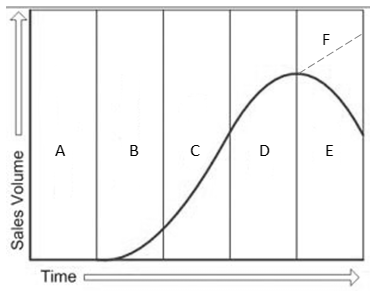
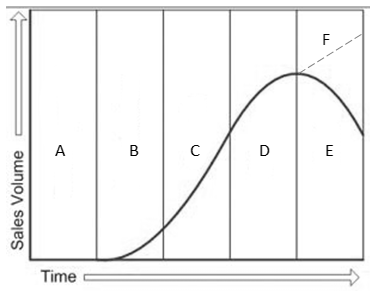
What is happening at point F on the Product Life Cycle?
a)
Introduction
b)
Decline
c)
Maturity
d)
Growth
26.
Which of these are extension strategies of a product?
a)
Cut price
b)
Modify the product
c)
All of these
d)
Special Offers
27.
An established product which is bringing in revenue is a comment about which stage of the Product Life Cycle?
a)
Decline
b)
Maturity
c)
Introduction
d)
Growth
28.
Which of these comments is most suitable for Growth?
a)
Heavy investment but no sales
b)
Sales are likely to be low as the product is new to the market
c)
Revenue is increasing as the product gains popularity
d)
Likely to be characterised as a dog in the Boston Matrix
29.
Firms with a technically superior good may well engage in price skimming. This comment could apply to which stage of the Product Life Cycle?
a)
Introduction
b)
Growth
c)
Decline
d)
Maturity
30.

What is happening at point F of the Product Life Cycle?

a)

Growth

b)

Maturity

c)

Extension Strategy

d)

Introduction

31.
What happens to the cash flow of a business at the growth stage of the product life cycle?
a)
The cash flow should become more positive
b)
Cash flow is likely to be negative because money has to be spent on research and development
c)
Sales will fall and cash flow will drop
d)
There may be a need to spend money re-promoting the product. As a result, cash flow may begin to fall.
32.
Costs are incurred e.g. building new production lines, promotion and distribution costs. Likely the product will still not be profitable. The length of this stage will vary.
a)
Maturity
b)
Growth
c)
Introduction
d)
Decline