
 Worksheets
MOCK TEST - UNIT I,II &III
Total questions: 60
Worksheet time: 41mins
Hardness in water is caused by the presence of:
Sodium chloride
Sodium carbonate
Calcium chloride
Potassium nitrate

Scale formation in boilers causes
no loss of heat
wastage of heat
increase in efficiency
none of the above
Hard water is unfit for use in boilers for “steam raising” because
its boiling point is higher
steam generated at a high pressure
it leads to scale formation inside the boiler
water undergoes decomposition in to oxygen and hydrogen.

What is the function of a boiler?
to heat water to make steam
to heat water to make spaghetti
to transform liquid into a mist
to mix air and fuel
boiler water having high alkalinity could develop ___
acidic corrosion
oxygen pitting
caustic embrittlement
warping
Water treatment process (seawater desalination) is opposite to natural osmosis is
Reverse Osmosis
Ultrafiltration
Nanofiltration
Microfiltration
Min pressure to be applied to prevent the water flow through semipermeable membrane
Hydraulic pressure
Reverse pressure
Osmotic pressure
Membrane pressure
Osmosis - water movement through semi permeable membrane
True
False
What is the first step in the water treatment process?
coagulation
filtration and removal of debris, sand, grit, etc.
flocs
concentation


What is the best way to purify water?
Add salt
Put inside the refrigerator
Filtration or Boiling
Find a very clean stream of water
what is added during coagulation process in water treatment plant
alum and slaked lime
florida
chlorine
calcium carbonate
Large molecules made up of small monomers are called
polymers
peptides
peptones
monomers
Once formed, it can be heated and reformed over and over again
thermoset
thermoplastic
elastomer
kevlar
What is the name of the reaction used to make polymers?
polymerization
cracking
polygonization
precipitation
1,6-hexadiamine and hexanedioic acid are the monomers for
kevlar
nylon 6,6
nylon 6
terylene
The chain growth process is usually much slower than the condensation process.
True
False
Which of the following reaction is not accompanied by elimination of a byproduct molecule?
addition polymerization
condensation polymerization
both of the mentioned
none of the mentioned


Identify the type of plastic that can best be used to make electrical switches.
PVC
Polythene
PET
Bakelite
Select the correct option from the given statements.
Polymers cannot form fibres
Polymers can be both natural and synthetic
Polymer is a natural substance
Polymer is a synthetic substance
What are the 2 types of Polymers?
Thermosetting Plastics
Thermochromic Plastics
Thermoplastics
Thermopolymers
All plastics are man made and do not biodegrade.
True
False
Polythene and PVC are examples of
Bio degradable substance
Thermosetting plastics
Thermoplastics
Rayon
The process of heating and compressing the preform material in to the mould is ___________.
Blow moulding
Transfer moulding
Injection moulding
Compression moulding
In compression moulds, polymerization of plastic takes place in _____________.
machine
mould
material
hopper

Match the parts of the the diagram.
The screw rotates.
The polymer pellets are transferred from the hopper to the cylinder.
The plastic bottle is ejected.
The molten polymer is extruded into the mould.

Match the parts of the diagram.
The two halves of the mould are closed with the molten polymer inside.
The polymer is expanded to fit the shape of the mould.
The molten polymer is extruded into the mould.
The molten polymer is inflated by the compressed air.
Electrons always flow from
cathode to anode
anode to cathode
Oxidation occurs at the
anode
cathode
What is a cathode?
It is the electrode where oxidation takes place.
It is the electrode where reduction takes place.
It is an aqueous solution containing an electrode.
It is the salt bridge that connects half-cells.

Galvanic cells convert
mechanical energy in to electrical energy
potential energy in to electrical energy
electrical energy in to chemical energy
chemical energy in to electrical energy
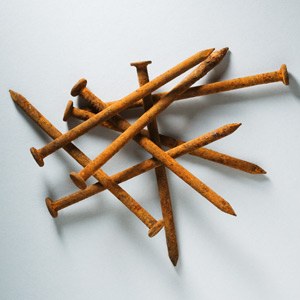
Name the two general classifications of corrosion.
Direct chemical attack and Electrochemical attack.
Fretting corrosion and Galvanic attack.
two types of Noble metals
gold and platinum
iron and copper
stainless steel and aluminum
tin and brass
Define metal corrosion.
Deterioration of metal by chemical or electrochemical attack that can occur internally & externally.
Changes smooth surface.
weakens interior, damages and/or loosens adjacent parts.
All are correct.

This is an example of
Differential Metalation Corrosion
Differential Aeration Corrosion
Which of the following metals is not attacked by the environment?


Rusting can be prevented by
Alloying
Tinning
Galvanizing
All of above
What is the chemical name given to Rust ?
Iron dioxide
Steel oxide
Iron oxide
Carbon dioxide
Which of the following reaction will occur during rusting?
I) Fe --> Fe2+ + 2e-
II) 2H2O + O2 + 4e- ---> 4OH-
III) Fe --> Fe3+ + 3e-
I and II only
II and III only
I , II and III
Underground pipes are protected by
Using antirust solutions
Cathodic protection
Using paints
Alloying with other elemts
Choose the WRONG statement
Dry corrosion occurs in the absence of moisture
Wet corrosion involves the formation of electrochemical cell
Wet corrossion is a slow process
The process of dry corrosion is uniform
An example for sacrificial protection is
Coating with tin (Sn) metal
Coating with paint
Coating iron with a thin layer of zinc or magnesium
Alloying with other elements
Smaller the Ratio of Anodic to Cathodic area
Faster will be the rate of Corrosion
Slower will be the rate of Corrosion

What is corrosion of iron known as?
Rancidity
Fermentation
Rusting
Tarnishing

A wooden chair will be affected by corrosion.
True
False

When a vessel is exposed to moist air, it forms green coating on the surface. The vessel must be made of:
Zinc
Copper
Magnesium
Iron

Which of the following is NOT a method to prevent corrosion?
Electroplating
Crystallization
Alloying
Galvanization
What prevents Rusting
Painting , Oiling , Galvinising
Washing with water

