
 Worksheets
Chapter 6 Chemical analysis (6.1-6.2)
Total questions: 65
Worksheet time: 1hrs 21mins
Charcoal powder is insoluble in water. When water is filtered, the charcoal powder becomes the _______.
solute
residue
filtrate
solvent
In a salt water solution ...
Salt is the solute and water is the solvent
Salt is the solvent and water is the solute
Which of the following statements tells us that a sample of liquid is pure water?
It is colourless.
It leaves no residue when filtered.
It boils at 100oC.
It is odourless.
For paper chromatography to work,
the dyes must have different boiling points.
the dyes must have different solubilities in the solvent.
the starting line on the chromatogram must be drawn using pen.
The starting line must be below the level of the solvent.
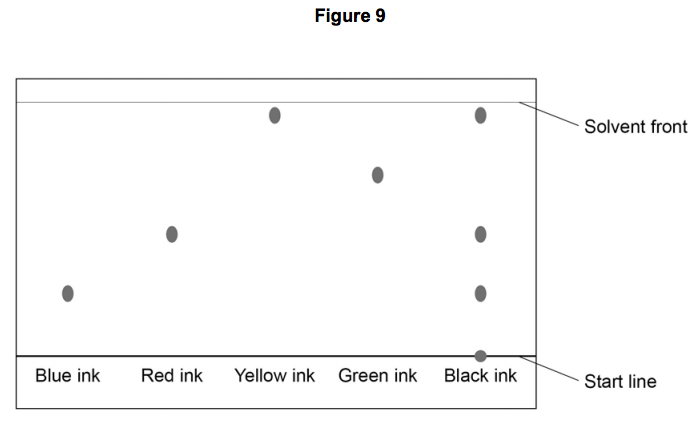
Which ink is most soluble?
Blue
Red
Yellow
Green
Which ink is a mixture?
Blue
Red
Yellow
Black

The setup above shows the separation of a mixture of sand and seawater. After filtering, which substance is found at E?
water
sea water
salt
sand
A mixture contains chalk powder and salt. How do we separate this mixture?
Filter the mixture, then heat the filtrate.
Dissolve the mixture in water, then heat the liquid mixture.
Dissolve mixture in water, filter, then evaporation.
Dissolve mixture in water, evaporate, then filter.
Which method is usually used to separate coloured dyes from each other and identify them?
Chromatography
Simple distillation
Crystallisation
Where are the spots of the samples placed in chromatography?
Randomly on the piece of paper
In a vertical line on the paper
In a horizontal line on the paper
A pigment of an ink has an Rf value of 0.75, and the solvent front has moved 8 cm. Using the following equation, what is the distance moved by the pigment?
Rf value = distance moved by pigment ÷ distance moved by solvent front
0.094 cm
8 cm
6 cm
10.667 cm
What is a mixture?
A mixture consists of two or more elements which are chemically joined together
A mixture consists of one or more substances that are not chemically joined together
A mixture consists of two or more substances that are not chemically joined together
A pigment of an ink moved 4 cm on a piece of chromatography paper, where the solvent front has moved 10 cm. What is the Rf value for the pigment?
0.4
2.5
40
1
A student wants to separate a mixture of ethanol, olive oil and water using the method of distillation. Ethanol has a boiling point of 78˚C, whilst the boiling point of olive oil is 300˚C. Which substance will be collected first?
Water
Ethanol
Olive oil
Esra made a pitcher of lemonade. What can she do to dilute if she thinks it doesn't taste right?
Add water
Boil the lemonade
Add sugar
Put it in the refrigerator

Which separation technique uses the apparatus shown in the picture?
filtration
crystallisation
chromatography
distillation
How can we separate an insoluble solid from a liquid?
chromatography
filtration
crystallisation
condensation
Tijl wants to remove alcohol from his beer. What separation method should he choose?
Distillation
Filtration
Chromatography
He should add more water
What is the physical property on which fractional distillation depends?
different boiling points
different melting points
different solubilities
different densities
During filtration, the solid that is trapped in the filter paper is called ..A.. and the liquid that has passed through the filter paper is called ..B..
A: residue B: filtrate
A: residue B: filterate
A: filtrate B: residue
A: filterate B: residue
A substance is soluble if it can be dissolved.
In paper chromatography, the most soluble solute _____________________ .
does not move from the start point
stays closest to the start point
travels furthest away from the start point
can be found in the middle of the chromatogram
Which of the following mixture/s is/are separated by chromatography?
Pigments from natural colours
Colours in a dye
Colours of flowers extracts
All the above

Which two were the same mixture of dyes?
1 and 5
2 and 6
3 and 4
4 and 6
Which of the dyes contains an insoluble color?
6
5
4
3
When using paper chromatography, two phases are involved. They are the
stationary and mobile phases
solid phase and liquid phase
gaseous phase and mobile phase
constituent phases and analyte phase

Based upon the results of a chromatography done on three different black inks, which ink was composed of only 2 constituents?
A
B
C
D
To calculate the Rf or retention factor, one divides the distance the _______ moved by the distance the ______ travelled.
spot; solvent
solvent; spot
paper; solvent
spot; paper
2.In a paper chromatography, what role does the paper play?
A. It acts as the mobile phase
B. It acts as the solvent
C. It acts as the analyte
D. It acts as the stationary phase
What is the mobile phase in paper chromatography?
Paper
Water
Ink
Solvent or mixture of solvents
Why is it important to fill the water to below the level of the baseline?
Because the baseline is drawn in pencil
If water were added above the baseline the ink/samples would dissolve in the water
The baseline may move
What is the solvent front?
The baseline drawn in pencil
The dots added to the baseline
The level the water reaches, drawn on in pencil
Where the dots travel to

Which sample contains the same dyes as sample B?
A
C
D
E
None of them

Name the Process above.
Fractional Distillation.
Simple Distillation.
Evaporation.
Centrifuging.
A Student has been told to separate a mixture of Water and Ethanol. She has a Bunsen Burner, an RB Flask, a Fractionating Column and a Liebig condenser. Which separation technique can she use?
Fractional Distillation.
Simple Distillation.
Evaporation.
Crystallisation.
Mixtures can be separated by physical means.
Is this Statement True or False?
True.
False.
Compounds can be separated by chemical means.
Is this Statement True or False?
True.
False.
__________ is used to separate an insoluble solid from a liquid.
Crystallisation
Filtration
Chromatography
Distillation
Crystallisation separates a(n) ___________ from a solution.
insoluble solid
soluble solid
gas

Label number 1 in the above experiment.
Solvent front
Solvent
Baseline
In chromatography, water and ethanol are both examples of what?
Mobile phase
Solvent front
Stationary phase
Sample spots
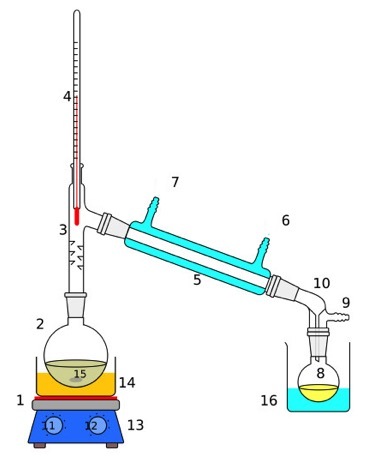
What is the flow of water in 6 and 7?
6: water in; 7: water out
6: water out; 7: water in
Put the two processes used in fractional distillation in the correct order.
Evaporating and then melting
Evaporating and then condensing
Condensing and then evaporating
Melting and then condensing

What is 5?
cooling tube
condenser
distillate
water pump

What is 8?
distillate
filtrate
residue
solute
What is the test for hydrogen?
relight a glowing splint
cloudy limewater
bleaches damp litmus paper
squeaky pop
What is the test for oxygen?
relight a glowing splint
cloudy limewater
bleaches damp litmus paper
squeaky pop
What is the test for carbon dioxide?
relight a glowing splint
cloudy limewater
bleaches damp litmus paper
squeaky pop
What is the test for chlorine?
relight a glowing splint
cloudy limewater
bleaches damp litmus paper
squeaky pop
What is the test for ammonium gas (NH3)?
turns damp red litmus blue
turns limewater milky
bleaches damp litmus paper
'pops' with a lighted splint
In flame testing, what element is indicated by an yellow flame?
Carbon
Sodium
Copper
Lithium
Dilute hydrochloric acid is added to a colourless solution. Bubbles appear immediately and this gas turns limewater cloudy. What ion was present in the solution?
Carbonate
Sulfate
Nitrate
Chloride
What is a precipitate?
An insoluble solid formed in a reaction
when you sweat a lot
When it rains
A soluble solid formed in a reaction
What is the postive test result when a calcium ion (Ca2+) is added to NaOH or aqueous ammonia?
ammonia is produced on warming
White ppt is formed
Light blue ppt is formed
Green ppt is formed

Which gas "explodes" and gives you a squeaky pop?
hydrogen
oxygen
carbon dioxide
Test for sulphate ions is...
Add acid or barium chloride
Add barium chloride or barium nitrate
Add silver nitrate or barium nitrate
Add barium chloride or silver nitrate
What is the test for a carbonate ion (CO32-)?
add an acid - effervescence and CO2 is produced
acidify with nitric acid and add silver nitrate - white ppt is formed
add NaOH and then aluminium foil - ammonia is produced
acidify and add barium nitrate - White ppt is formed
What is the postive test result when ammonia (NH4+) is added to NaOH?
ammonia is produced on warming
White ppt is formed
Light blue ppt is formed
Green ppt is formed

