
 Worksheets
C5 C10 Metal Reactivity and Extraction
Total questions: 60
Worksheet time: 50mins
Name
Class
Date
1.
What is the correct equation when potassium reacts with water?
a)
2K (s) + H2O (l) --> KOH (aq) + H2 (g)
b)
K (s) + 2H2O (l) --> KOH (aq) + 2H2 (g)
c)
2K (s) + 2H2O (l) --> 2KOH (aq) + H2 (g)
d)
K (s) + H2O (l) --> KOH (aq) + H2 (g)
2.
Which of the following is arranged according increasing reactivity?
a)
Mg > Li > Na > K
b)
Mg > Na > Li > K
c)
Na > Li > Mg > K
d)
K > Mg > Na > Li
3.
Which of the following does not react with water?
a)
lithium
b)
magnesium
c)
lead
d)
calcium
4.
What is made when magnesium reacts with hydrochloric acid?
a)
magnesium nitrate and hydrogen gas
b)
magnesium sulfate and hydrogen gas
c)
magnesium oxide and oxygen gas
d)
magnesium chloride and hydrogen gas
5.
The least reactive in oxygen in the list is
a)
iron
b)
zinc
c)
copper
d)
lead
6.
Which one of the following metals reacts most vigorously with cold water?
a)
Sodium
b)
Magnesium
c)
Copper
d)
Zinc
7.
Which one of the following metals could produce zinc metal, if heated with zinc oxide?
a)
Copper
b)
Aluminium
c)
Iron
d)
Silver
8.
Which of these reactions is possible?
a)
Zn (s) + CuO (aq) --> ZnO (aq) + Cu (s)
b)
Cu (s) + FeSO4 (aq) --> CuSO4 (aq) + Fe (s)
c)
Pb (s) + ZnCl2 (aq) --> PbCl2 (a) + Zn (s)
d)
Au (s) + 2HCl (aq) --> AuCl2 (aq) + H2 (g)
9.

Which metal is more reactive than calcium?
a)
magnesium
b)
potassium
c)
silver
d)
aluminum
10.
What will be reaction if less reactive metal is added in a solution with more reactive metal compound?
a)
vigorous reaction
b)
fizzing gas produced
c)
burns moderately
d)
no reaction
11.
Which of the following will not undergo reaction?
a)
zinc metal + zinc oxide
b)
iron metal + copper oxide
c)
zinc metal + iron oxide
d)
magnesium + iron oxide
12.
When metal reacts with liquid water the products are...
a)
metal hydroxide and oxygen gas
b)
metal hydroxide and hydrogen gas
c)
metal oxide and oxygen gas
d)
metal oxide and hydrogen gas
13.
Which of the following metals does not displace H2 gas from dilute HCl or dilute H2SO4?
a)
Mg
b)
Al
c)
Cu
d)
Zn
14.
What happens at the positive electrode?
a)
Positive non-metal ions are attracted
b)
Positive metal ions are attracted
c)
Negative non-metal ions are attracted
d)
Negative metal ions are attracted
15.
What element is used to make up the electrodes?
a)
oxygen
b)
iron
c)
carbon
d)
magnesium
16.
When sodium reacts with hydrochloric acid, what is the name of the salt formed?
a)
Sodium Hydride
b)
Sodium Chloride
c)
Sodium Hydrochloric
d)
Sodium Chlorine
17.
When potassium reacts with sulphuric acid, what is the name of the salt produced?
a)
Potassium Sulphide
b)
Potassium Sulphur
c)
Potassium Sulphuric
d)
Potassium Sulphate
18.
When magnesium reacts with copper sulphate, there are two products. What are they?
a)
Magnesium and Copper
b)
Magnesium Sulphate and Copper
c)
Magnesium Sulphate and Copper Sulphate
d)
Magnesium and Copper Sulphate
19.
When copper and magnesium sulphate are mixed together, there is no reaction. Why?
a)
Magnesium is more reactive than copper
b)
Copper is more reactive than magnesium
c)
Copper never reacts with metal salts
d)
Magnesium Sulphate never reacts with metals
20.
In nature, metals normally react with other compounds to form minerals. What is the metal that is found in the mineral Haematite?
a)
Copper
b)
Aluminium
c)
Iron
d)
Zinc
21.
Metals have many useful properties. For example, they...
a)
...conduct electricity
b)
...are malleable
c)
...are good thermal conductors
d)
All of these
22.
In order to make use of the many useful properties of metals, we need to extract them so that they are in their pure form. A common way of extracting many of the less reactive metals is to heat their minerals with what?
a)
Carbon
b)
Helium
c)
Oxygen
d)
Silicon
23.
What is the name of the positive electrode?
a)
cathode
b)
anode
24.
What is the name of the negative electrode?
a)
cathode
b)
anode
25.
The negatively charged ions migrate toward the ________.
a)
anode
b)
cathode
26.
Explain why the electrolyte has to be a liquid.
a)
So the ions can move
b)
So the electrons can move
c)
So that it doesn't get too hot
d)
So the fish are ok
27.
What is the equation to show what happens to Cl ions at the anode.
a)
Cl- --> Cl + e-
b)
2Cl- --> Cl2 + 2e-
c)
Cl2 + 2e- 2Cl-
d)
Cl2 + 2e- --> 2Cl-
28.
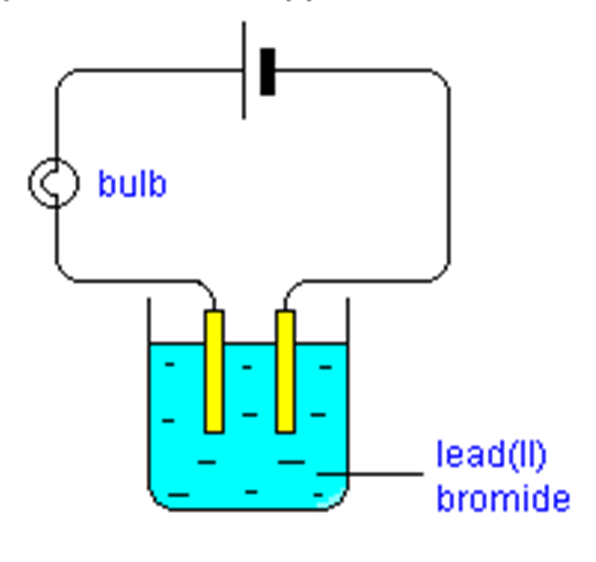
The diagram shows the electrolysis of lead(II) bromide using inert electrodes. Why does the bulb only light up when the lead(II) bromide is melted?
a)
Bromine atoms in lead(II) bromide are converted to ions when it is melted
b)
Electrons flow through the lead(II) bromide when it is melted
c)
The ions in lead(II) bromide are acting as the mobile charge carriers when it is melted
d)
There are no ions in solid lead(II) bromide
29.
The positively charged ions migrate toward the ________.
a)
anode
b)
cathode
30.
Anion loses electrons at the
a)
cathode
b)
anode
31.
Reduction occurs at the
a)
anode
b)
cathode
32.
What is the product formed at the cathode during the electrolysis of molten magnesium fluoride?
a)
magnesium
b)
hydrogen
c)
fluorine
d)
oxygen
33.
What is the product formed at the anode during the electrolysis of concentrated copper(II) chloride?
a)
copper
b)
chlorine
c)
hydrogen
d)
oxygen
34.

a)
A
b)
B
c)
C
d)
D
35.

a)
A
b)
B
c)
C
d)
D
36.

a)
A
b)
B
c)
C
d)
D
37.

a)
A
b)
B
c)
C
d)
D
38.

a)
Aluminium
b)
Iron
c)
Lead
d)
Copper
39.

a)
A
b)
B
c)
C
d)
D
40.

a)
A
b)
B
c)
C
d)
D
41.

a)
A
b)
B
c)
C
d)
D
42.

a)
A
b)
B
c)
C
d)
D
43.

a)
A
b)
B
c)
C
d)
D
44.

a)
calcium oxide
b)
copper (II) oxide
c)
magnesium oxide
d)
sodium oxide
45.
Does Iron displace Aluminium?
a)
Yes
b)
No
46.
What is added to the blast furnace?
a)
Coke, Limestone and Air
b)
Limestone, Haematite and Air
c)
Coke, Limestone, Air and Haematite
d)
Coke, Limestone, Haematite, Air and Dirt
47.
Iron nails + copper oxide =
a)
Iron nails + copper oxide
b)
Iron oxide + copper oxide
c)
Iron oxide + copper
d)
Magic
48.
What is an ore?
a)
a solid metal
b)
a rock cantaining a metal combined with other elements
c)
an element
d)
an object used to row a boat
49.
What is the removal of oxygen from a substance called?
a)
reduction
b)
extraction
c)
electrolysis
d)
oxidation
50.
What is the addition of oxygen to a substance called?
a)
decomposition
b)
reduction
c)
oxidation
d)
extraction
51.
What is oxidation?
a)
loss of oxygen
b)
gain of electrons
c)
gain of hydrogen
d)
loss of electrons
52.
Which element cannot be extracted from its ore by reduction with carbon?
a)
iron
b)
aluminium
c)
copper
d)
lead
53.
How could you extract sodium from molten sodium chloride?
a)
reduction by carbon
b)
electrolysis
c)
decomposition
d)
oxidation
54.
How would you best extract iron from haematite (iron ore)?
a)
reduction by carbon
b)
electrolysis
c)
decomposition
d)
oxidation
55.
Which reaction is used to keep the furnace hot?
a)
CO2 + C -> 2CO
b)
C + O2 -> CO2
c)
Fe2O3 + 3C -> 2Fe + 3CO
d)
C + O2 -> CO2
56.
Which gas is produced as a waste product when iron is extracted from its ore in the blast furnace?
a)
Carbon dioxide
b)
Hydrogen
c)
Nitrogen
d)
Oxygen
57.
Iron is made by burning its ore, hematite. Hematite contains silica. What reacts with this impurity to remove it?
a)
Carbon
b)
Carbon Dioxide
c)
Silicon dioxide
d)
Calcium Oxide
58.
Which statement is correct about extraction of iron from its ore?
a)
Iron is more difficult to extract than copper
b)
Iron is the easiest metal to extract
c)
Iron cannot be extracted from its ore
59.
Which substance is not involved in the extraction of iron from hematite?
a)
Carbon Monoxide
b)
Carbon
c)
Nitrogen
d)
None of the above
60.
What is the product formed at the cathode during the electrolysis of molten magnesium fluoride?
a)
magnesium
b)
hydrogen
c)
fluorine
d)
oxygen
100 %

