wayground logo

Free Printable Worksheets

NEW

Font size

S
M
L
XL
Worksheets

Physical Science 9 Final Exam Review

Total questions: 61

Worksheet time: 55mins

Name
Class
Date
1.
A substance has a mass of 12.9 g and a volume of 8 cm3. What is the mass of a 10.5 cm3 sample of the same substance?
a)
1.61 g
b)
16.91 g
c)
12.6 g
d)
0.15 g
2.
A scientists finds an atom with mass of 16 and 8 protons in it's nucleus. What is the element?
a)
Sulfur (S)
b)
Nitrogen (N)
c)
Oxygen (O)
d)
Chromium (Cr)
3.
How many electrons does a neutral atom of chlorine (Cl) have?
a)
35
b)
36
c)
17
d)
18
4.
Which element has similar properties to Neon?
a)
Argon
b)
Oxygen
c)
Fluorine
d)
Lithium
5.
Elements in group 15 have how many valence electrons?
a)
15
b)
5
c)
8
d)
3
6.
The __________ of an atom is the sum of the protons and neutrons in the nucleus of that atom.
a)
mass number
b)
atomic number 
c)
atomic weuight
d)
isotope weight
7.
Which of these phrases best describes an atom?
a)
a positive nucleus surrounded by a hard negative shell
b)
a positive nucleus surrounded by a cloud of negative charges
c)
a hard sphere with postive and negative charges on the outside
d)
a negative nucleus surrounded by protons and neutrons
8.
What atom matches this electron configuration?
1s22s22p63s23p64s23d10
a)
Zinc
b)
Copper
c)
Nickel
d)
Germanium
9.
The electron configuration of an atom is 1s22s22p6.  The number of electrons in the atom is 
a)
3
b)
6
c)
8
d)
10
10.
Which electron configuration belongs to Chlorine (Cl)?
a)
1s2s2p3s3p5
b)
1s2s2p3s3p6
c)
1s2s2p3s3p7
11.
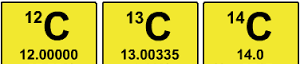
What do these isotopes of carbon all have in common?
a)
neutrons & mass number
b)
atomic number and neutrons
c)
atomic number and electrons
d)
protons, atomic number, and mass number
12.
How many neutrons does the isotope of lithium have?
a)
8
b)
3
c)
4
d)
5
13.

What do the vertical columns on the periodic table tell us?

a)

The number of orbitals

b)

The number of valence electrons (electrons on the outer most shell)

14.
Ionic compound is the bonding of which of the following:
a)
non-metal + non-metal
b)
metal + metal
c)
metal + non-metal
15.
Covalent compound is the bonding of which of the following:
a)
non-metal + non-metal
b)
metal + metal
c)
metal + non-metal
16.
Type of reaction that releases energy/heat
a)
endothermic
b)
exothermic
17.
Type of reaction that absorbs energy/heat
a)
endothermic
b)
exothermic
18.
How many grams of His needed to satisfy the law of conservation of mass if 18 g of O2 reacts to produce 46 g of H2O in the following unbalanced reaction:
H2 + O2 -> H2O
a)
18 g
b)
64 g
c)
28 g
d)
46 g
19.
Which type of reaction is represented by the following equation:
A + B -> AB
a)
Synthesis
b)
Decomposition
c)
`Single Replacement
d)
Double Replacement
20.
Which type of reaction is represented by the following equation:
AB -> A + B
a)
Synthesis
b)
Decomposition
c)
`Single Replacement
d)
Double Replacement
21.
Which type of reaction is represented by the following equation:
A + BC -> AC + B
a)
Synthesis
b)
Decomposition
c)
`Single Replacement
d)
Double Replacement
22.
Which type of reaction is represented by the following equation:
AB + CD -> AD + BC
a)
Synthesis
b)
Decomposition
c)
`Single Replacement
d)
Double Replacement
23.
Ionic compounds can conduct electricity in __________ phase, but not the  ____________ phase.
a)
liquid, solid
b)
solid, liquid
c)
liquid, gas
d)
gas, liquid
24.
What kind of bond forms when atoms exchange electrons?
a)
ionic
b)
covalent
c)
artificial
d)
univalent
25.
What kind of bond forms when atoms share electrons?
a)
ionic
b)
covalent
c)
artificial
d)
univalent
26.

Chemical reactions involve the _______________ of chemical bonds in the reactants which ________________ energy.

a)

breaking, absorbed

b)

breaking, released

c)

formation, absorbed

d)

formation, released

27.

Chemical reactions involve the _______________ of chemical bonds in the products which ________________ energy.

a)

breaking, absorbed

b)

breaking, released

c)

formation, absorbed

d)

formation, released

28.

Which of the following is NOT covalently bonded?

a)

K2S

b)

H2O

c)

I2

d)

CO2

29.

What two types of atoms make a covalent bond?

a)

2 Nonmetals

b)

1 Nonmetal and 1 Metal

c)

2 Metals

d)

2 Noble Gases

30.

Which of these is NOT a polyatomic ion?

a)

OH-

b)

CO32-

c)

PO43-

d)

Cl-

e)

ClO4-

31.

Is this compound ionic or covalent?

a)

ionic

b)

covalent

32.

Is this compound ionic or covalent?

a)

Ionic

b)

Covalent

33.
AgF
a)
silver fluoride
b)
silver fluorine
c)
monosilver monofluoride
d)
silver monofluorine
34.
How do the following two elements bond together?
K1+  S2- 
a)
KS
b)
K8S
c)
K6S3
d)
K2S
35.
How do the following two elements bond together?
Cr3+  O2-         
a)
CrO
b)
Cr3O2
c)
Cr2O3
d)
CrO3
36.
What is the name for PbI4?
a)
Lead (II) Iodide
b)
Lead Iodine
c)
Lead (IV) Iodide
d)
Lead (IV) Iodine
37.
The smallest atoms are found where are on the periodic table
a)
top left
b)
top right
c)
bottom left
d)
bottom right
38.
Most reactive nonmetals are found where are on the periodic table
a)
top left
b)
top right
c)
bottom left
d)
bottom right
39.
Most reactive metals are found where are on the periodic table
a)
top left
b)
top right
c)
bottom left
d)
bottom right
40.
PbS2
a)
lead sulfide
b)
lead sulfur
c)
lead II sulfide
d)
lead IV sulfide
41.
The proper formula for magnesium hydroxide:
a)
MgOH
b)
Mg2OH
c)
Mg(OH)2
d)
Mg2OH2
42.
What is the correct formula for the compound, lithium oxide?
a)
LiO
b)
Li2O
c)
LiO2
d)
Li2O2
43.
Name this compound: 
NH4F
a)
Ammonia fluoride
b)
Ammonium fluorite
c)
Ammonia fluorate
d)
Ammonium fluoride
44.
Name the following ionic compound: MgSO4
a)
magnesium sulfoxide
b)
magnesium sulfide
c)
magnesium sulfate
d)
magnesium oxide
45.
Name this compound: 
Ca2CO3
a)
Calcium carbon oxide
b)
Calcium (II) carbonate
c)
Calcium carbonate
d)
Carbonate (I) calcide
46.
Give the formula for phosphorus trifluoride
a)
P3F
b)
PF
c)
PF3
d)
P3F3
47.
Name SO2
a)
monosulfur dioxide
b)
sulfur dioxide
c)
sulfur oxide
d)

sulfur (II) oxide

48.
What is the proper name for S2O2?
a)
Sulfur oxide
b)
Sulfur dioxide
c)
sulfur (II) oxide
d)
disulfur dioxide
49.
Balance this equation
_N+ _H--> _NH3
a)
1,2,3
b)
1,3,2
c)
1,1,2
d)
2,1,1
50.
Balance this equation
_Zn+_HCl-->_ZnCl+_H2
a)
1,1,2,1
b)
1,1,1,2
c)
1,2,1,1
d)
2,1,1,1
51.
Balance this equation:
MgCl2 --> Mg4+ Cl2
a)
It's already balanced.
b)
4MgCl2 --> Mg4+ 4Cl2
c)
4MgCl2 --> Mg4+ 5Cl2
52.

6 CO2+ 6 H2O + Energy  C6H12O6 + 6 O26\ CO_2+\ 6\ H_2O\ +\ Energy\ \rightarrow\ C_6H_{12}O_6\ +\ 6\ O_2

a)

endothermic reaction

b)

exothermic reaction

53.

O2(g) + 2 H2 (g)  2 H2O (g) + EnergyO_2\left(g\right)\ +\ 2\ H_2\ \left(g\right)\ \rightarrow\ 2\ H_2O\ \left(g\right)\ +\ Energy  

a)

endothermic

b)

exothermic

54.

Is the following reaction endothermic or exothermic

a)

endothermic

b)

exothermic

55.

which factor that affect reaction rate is represented?

a)

Temperature

b)

Catalyst

c)

Surface Area

d)

Concentration

56.

Indicate whether each of the following will: Increase / Decrease / have No effect on the rate of reaction.


                Increasing temperature


a)

Increase

b)

Decrease

c)

No Effect

57.

Indicate whether each of the following will: Increase / Decrease / have No effect on the rate of reaction.


                Decrease Particle Size              

a)

Increase

b)

Decrease

c)

No Effect

58.

Indicate whether each of the following will: Increase / Decrease / have No effect on the rate of reaction.


                Decrease Reactant Concentration             

a)

Increase

b)

Decrease

c)

No Effect

59.
Increase in temperature of the reactants can do one of the following
a)
Slow collision frequency
b)
Allow less effective collision between the particles
c)
Cause particles to lose speed
d)
Increase collision between the particles thus increasing the rate.
60.
A ______________ is a substance that increases the rate of a reaction without being used up during the reaction. 
a)
catalyst
b)
product
c)
reactant
d)
solute
61.
Which of these will NOT speed up the rate of reaction between a strip of magnesium and hydrochloric acid?
a)
tightly coil up the strip of magnesium
b)
cut up the strip of magnesium
c)
increase the concentration of the hydrocholoric acid
d)
increase the temperature of the hydrocholoric acid