
 Worksheets
Weather 2
Total questions: 55
Worksheet time: 1hrs 23mins
What is weather?
what the air is like outside
hot
cold
What is climate?
weather
is the pattern of weather in a place over many years
the temperature
What is humidity?
the patterns of weather
the amount of water vapor in the air
the amount of water
Mountains and other landforms affect the climate.
True
False
What is a barometer?
a tool to help predict the weather
a tool to measure air pressure
a tool used to measure the temperature
Why do winds change during the day and night near a beach?
The warm air over land sinks and stays there
The warm air over water sinks and stays there
The temperature over water and the land change
Cool air sinks over the land and stays there
How does air move?
Warm air rises and cool air sinks
Warm air sinks and cool air rises
What kind of weather would you expect when you have decreased air pressure?
Warm temperatures
Cool temperatures
Clear conditions
Cloudy conditions
What kind of weather would you expect in a low pressure system?
Rain
Clear skies
What kind of weather would you expect in a high pressure system?
Warm temperatures
Cool temperatures
Clear conditions
Cloudy conditions
How do air masses move across the US?
The trade winds move the air masses from west to east
The jet stream moves air masses from west to east
The trade winds move the air masses from the Atlantic Ocean to the Pacific Ocean
The Gulf Stream air moves around the Gulf of Mexico
How does wind move?
From area of high pressure to low pressure
From areas of low pressure to high pressure
Why do we have winds on Earth?
Because of the trade winds
Because of earth’s orbit around the Sun
Because earth receives the sun's rays unevenly
What type of weather conditions are needed for a hurricane to form?
cold ocean currents, high air pressure
warm ocean currents, low air pressure
What is weather?
The amount of moisture in the air
The number of clouds in the sky
The speed of the wind
The state of the atmosphere at any particular time.
What are the characteristics of a high-pressure system?
Wind and rain
Humidity and thunder
Extremely hot temperatures
Clear skies and sun
If the air is only holding one-third as much moisture as it can possibly hold, what is the relative humidity?
25 percent
50 percent
33 percent
67 percent
What will happen if the relative humidity is 100 percent, and the temperature begins falling?
Water vapor will start condensing out of it.
The air will be sticky and uncomfortable
The temperature will rise
The barometric pressure will rise
What causes global convection currents
Forests
greenhouse gases
more land forms
uneven heating of the Earth's surface

What city will experience decreasing temperatures in the next day?
Denver
El Paso
Memphis
Los Angeles

What city is most likely going to see temperatures rise?
San Jose
El Paso
Jacksonville
Chicago
Where do warm ocean currents come from?
warm ocean currents come from the southern hemisphere
warm ocean currents come from the equator
Warm ocean currents come from the poles
Warm ocean currents come from the beach
Where do cold ocean currents come from?
cold ocean currents come from the southern hemisphere
cold ocean currents come from the equator
cold ocean currents come from the poles
cold ocean currents come from the beach

What does this symbol represent?
Cold Front
Warm Front
Stationary Front
Occluded Front

What does this symbol represent?
Cold Front
Warm Front
Stationary Front
Occluded Front
Low Pressures are associated with what type of weather
fair weather
cold weather
warm weather
rainy weather
Warm Fronts bring
rain followed by cool dry air
hurricanes
rain followed by hot humid air
fair weather
cold Fronts bring
rain followed by cool dry air
hurricanes
rain followed by hot humid air
fair weather
What causes GLOBAL winds to move in a curved direction?
breezes
coriolis effect
westerlies
easterlies
The curving path of a moving object (ex: wind) from an otherwise straight path due to Earth's rotation is called what?
Sublimation
Continental Deflection
Transpiration
Coriolis Effect

The Coriolis effect causes ___________.
the Earth to rotate on its axis
earthquakes
global winds to move in a curved path instead of a straight line
the Earth to revolve around the sun


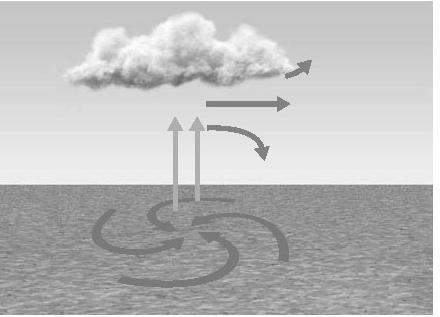
One of the major ways oceans contribute to weather systems is that the oceans -
provide a diverse habitat for many organisms.
store and transport the Sun’s heat energy.
experience changes in amounts of dissolved salt.
reach depths that can be as much as 12,000 meters.
The majority of heat transfer performed on Earth by oceans is from what region to what other region?
From the Equator to the poles.
From coastal regions to inland.
From North America to South America.
From the Pacific to the Atlantic Ocean.
The ocean currents that influence weather are not able to carry heat energy directly from south to north or from north to south. Currents are deflected consistently to the right in the Northern Hemisphere and consistently to the left in the Southern Hemisphere due to -
collisions with the coastlines of continents.
the irregular shape of the ocean floor.
the rotation of Earth on its axis.
the strong winds above the ocean.
Thermal energy from evaporating water drives the weather systems. The regions on Earth that would have the most evaporation are those regions -
near the Equator.
along the coasts of Asia.
near tropical rainforests.
along mountain ranges.
Differences in water temperature create movement in the Ocean because
bodies of water at different temperature have different densities.
warm water is pulled more by the force of gravity then cold water is.
warm and cold water mix until they reach the same temperature.
The ocean just likes to "move-it move-it".

Ocean currents affect climates around the world. Based on the map, which area MOST likely has a warmer climate than expected?
1
2
3
4

