
 Worksheets
DNA and Reproduction
Total questions: 25
Worksheet time: 13mins
Which of the following does not allow for genetic variation in organisms?
Crossing over
DNA replication
Random fertilization
Independent assortment
Meiosis results in.....
two haploid cells with half the number of chromosomes as the parent cell
two diploid cells with half the number of chromosomes as the parent cell
four haploid cells with half the number of chromosomes as the parent cell
four diploid cells with half the number of chromosomes the parent cell
What do you call the cell that forms from fertilization?
fertilized egg
sperm cell
zygote
egg cell
What is the purpose of MITOSIS?
to create sex cells
to kill off body cells
to repair or replace (somatic) body cells
In asexual reproduction, all of the offspring are:
Physically Identical
Genetically Identical
Physically and Genetically Identical
Not Identical
Each daughter cell is diploid (contains the normal number of chromosomes).
Mitosis
Meiosis
Produces 4 daughter cells, each of which is NOT identical to the parent cell.
Mitosis
Meiosis
Produces 2 daughter cells which are genetically identical to the parent cell.
Mitosis
Meiosis
Each daughter cell is haploid (contains half the number of normal chromosomes).
Mitosis
Meiosis
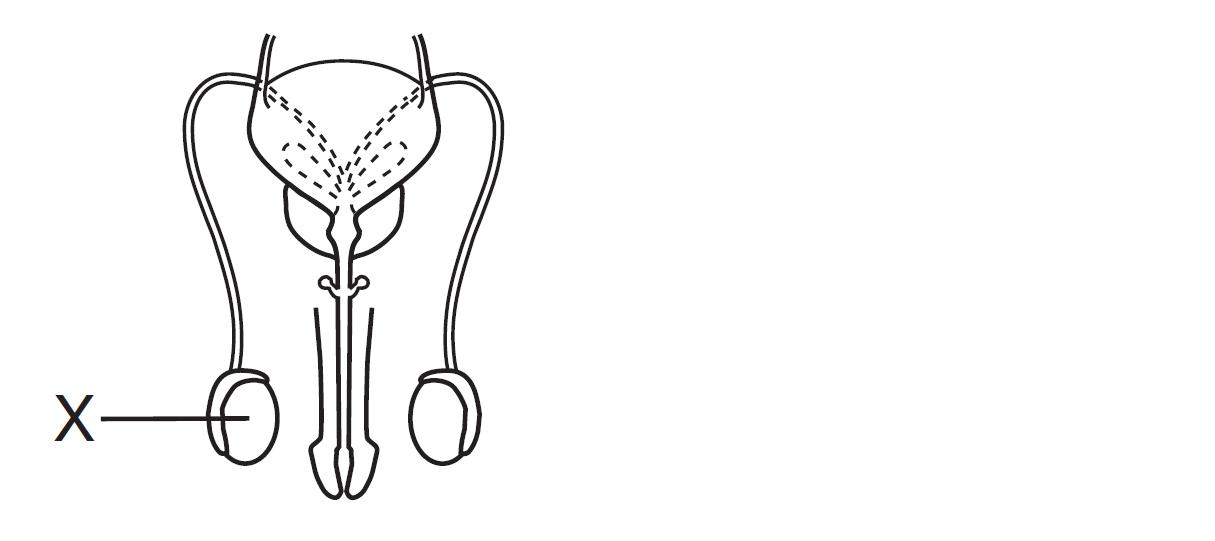
The diagram below represents a system in the human body. The function of structure X is to _____________
produce energy needed for sperm to move
provide food for the sperm to carry to the egg
produce and store urine
produce sperms and male sex hormones
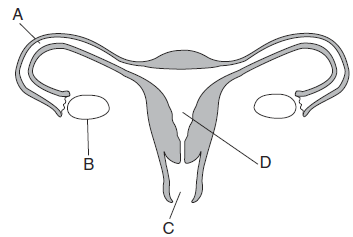
The human female reproductive system is represented below. Where will the embryo attach itself after fertilization?
A
B
C
D
What is the scrotum?
A pouch of skin surrounding the testes to protect and regulate temperature
A fold of skin that protects the penis
An additional gland located at the end of the urethra
Which part of the uterus is connected to the vagina?
The fallopian tubes
The cervix
The ovaries
The fallopian tubes connect
the ovaries to the uterus
the uterus to the vagina
the ovaries to the vagina
In which of the following structures of the female human reproductive system is the blastocyst implanted during normal human development?
Ovary
uterus
vagina
amniotic sac
A fertilized egg undergoes several stages before it is implanted. In which of the following structure of the female reproductive system is the egg fertilized?
Ovary
Uterus
Fallopian tube
Cervix

The diagram shows the male reproductive system and part of the urinary system. Which part produces sperm and hormones?
A
B
C
D
Which female reproductive structure produces the gametes?
Cervix
Fallopian tubes
Ovary
Uterus
Mutation in the cell cycle are best described as which of the following?
A mutation occurs and stops the cell from differentiating into new cells.
A mutation occurs that instruct the cell to begin binary fusion.
A mutation occurs that directs the cell to stop all functions resulting in death of the cell.
A mutation occurs that stops the cell from responding to signals that control cell growth.

Using the diagram, which of the following best describes A and B?
Diagram A represents mitosis with two identical, diploid cells. Diagram B represents meiosis with four genetically different, haploid cells.
Diagram A represents meiosis with two identical, diploid cells. Diagram B represents mitosis with four genetically different, haploid cells.
Diagram A represents mitosis with two genetically different, haploid cells. Diagram B represents meiosis with four identical, diploid cells.
Diagram A represents mitosis with two genetically different, diploid cells. Diagram B represents meiosis with four identical, haploid cells.


Which stage of meiosis I results in the separations of chromosomes?
Prophase I
Metaphase I
Anaphase I
Telophase I
Which stage of meiosis I is there and exchange of genetic material that results in the recombination of chromosomes?
Prophase I
Metaphase I
Anaphase I
Telophase I


