
 Worksheets
SCH4U Electrochemistry
Total questions: 25
Worksheet time: 1hrs 12mins
What is a redox reaction?
A reaction where both reactants get reduced.
A reaction where both reactants get oxidized.
A reaction that involves a transfer of electrons between reactants.
A reaction that involves the combustion of at least one reactant.
What is reduction?
It is the gain of electrons.
It is the loss of electrons.
It is the creation of electrons.
It is the destruction of electrons.
What is oxidation?
It is the gain of electrons.
It is the loss of electrons.
It is the creation of electrons.
It is the destruction of electrons.
What is a reducing agent?
It is the species that gets reduced -- gains electrons.
It is the species that gets oxidized -- loses electrons.
It is the species that creates electrons.
It is the species that destroys electrons.
What is an oxidizing agent?
It is the species that gets reduced -- gains electrons.
It is the species that gets oxidized -- loses electrons.
It is the species that creates electrons.
It is the species that loses electrons.
What is a galvanic (voltaic) cell?
It is a cell that destroys electrons on one side and creates electrons on the other side.
It is a cell that contains only one metal bar and one aqueous ion solution.
It is a type of battery that drives a redox reaction when electricity is applied.
It is a type of battery that generates an electrical current from redox reactions.
What is a standard half-cell?
It is one cell that comprises half of a whole battery.
It is a cell containing only a metal bar with no aqueous ion solution.
It is a cell containing only an aqueous ion solution and no metal bar.
It is a cell that generates half of a volt of electricity.
What is a half-reaction?
It is a reaction at equilibrium where half of the substances are reactants and half of the substances are products.
It is the reaction that occurs when the switch of a galvanic cell is open.
It shows EITHER the reduction component or the oxidation component of a redox reaction.
It shows BOTH the reduction and oxidation components of a redox reaction.
What is an anode?
It is the electrode where oxidation takes place.
It is the electrode where reduction takes place.
It is an aqueous solution containing an electrode.
It is the salt bridge that connects half-cells.
What is a cathode?
It is the electrode where oxidation takes place.
It is the electrode where reduction takes place.
It is an aqueous solution containing an electrode.
It is the salt bridge that connects half-cells.

Given their standard reduction potentials, which of the species is going to be oxidized?
Cu2+/Cu = 0.34V
Zn2+/Zn = -0.76V
Cu
Zn
CuSO4
ZnSO4
What occurs to the mass of copper electrode in the following reaction?
Zn/Zn2+ // Cu2+/Cu
increases
decreases
remains the same
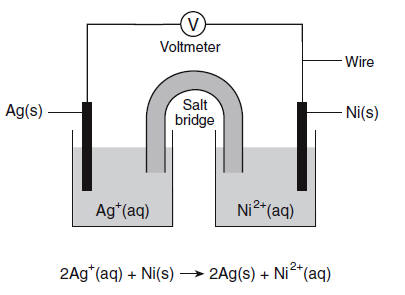
What reaction occurs at the anode?
Ag+/Ag = 0.80V
Ni2+/Ni = -0.25V
Ag+ + e- →Ag
Ag → Ag+ + e-
Ni2+ + 2e- → Ni
Ni → Ni2+ + 2e-

An oxidizing agent will
increase in mass
lose electrons
be reduced
increase in oxidation number

As an element is oxidized, its oxidation number
decreases as electrons are lost
increases as electrons are lost
decreases as electrons are gained
increases as electrons are gained

In the following reaction
Sn+2 + 2Fe+3 --> Sn+4 + 2Fe+2,
the reducing agent is...
Fe+3
Sn+2
Sn+4
Fe+2

When water is electrolyzed, gas collected at cathode, is
sulphur
oxygen
hydrogen
sulphur dioxide
What is oxidation number of Cr in Cr2O72-?
-2
+2
+6
+12

Which statement best describes how a salt bridge maintains electrical neutrality in the half-cells of an electrochemical cell?
It prevents the migration of electrons.
It prevents the reaction from occurring spontaneously.
It permits the migration of ions.
It allows for the reaction from occurring spontaneously.
Electrochemistry is
Study of electron in atom
Study of electricity in molecules
The relationship between chemical reactions and electricity
the study of electrons moving from one a tom to another

The reaction 2NaCl → 2Na + Cl2 is an example of
a reduction reaction, only
both an oxidation and reduction reaction
an oxidation reaction, only
neither an oxidation nor a reduction reaction
Galvanic cells convert
mechanical energy in to electrical energy
potential energy in to electrical energy
electrical energy in to chemical energy
chemical energy in to electrical energy
silver chloride can conduct electrocity in molten state, but not conducting in solid state. This is because silver chloride
is a covalent compound
exist as freely moving charged particles in molten state
exist as atoms in solid state
has freely moving electrons in molten state

