wayground logo

Free Printable Worksheets

Font size

S
M
L
XL
Worksheets

Solar system and light Grade 5

Total questions: 55

Worksheet time: 2hrs 42mins

Name
Class
Date
1.

What is our solar system made up of?

a)

The sun and moon

b)

The sun, moon and Earth

c)

The solar system is the Sun, and the group of planets and bodies that orbit it.

d)

The sun, moon and four planets

2.

What is at the center of the Solar System?

a)

The Sun is at the center of our solar system.

b)

The Earth is at the center of our solar system.

c)

The planet Mars is at the center of the solar system.

d)

The moon is at the center of the solar system.

3.

True or False. Our Sun is a star.

a)

False

b)

True

4.

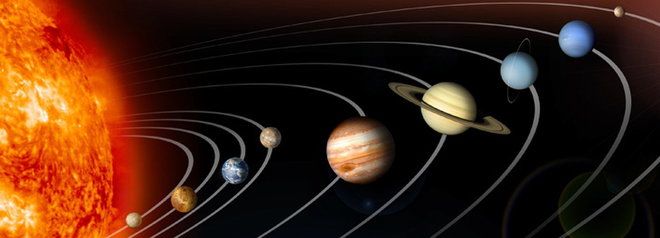
What’s in the inner solar system?

a)

There are eight planets in the inner solar system.

b)

There are four planets in the inner solar system.

c)

There are six planets in the inner solar system.

d)

There are two planets in the inner solar system.

5.
What is a MOON?
a)
Something you see in the night sky
b)
Something in space that is made of cheese
c)
a large object in space that orbits a star
d)
A natural satellite that orbits a planet
6.
What is a GALAXY?
a)
The speed of the internet
b)
A group of billions of stars
c)
A large object in space that orbits a planet
d)
How the heat of the sun is measured
7.
What is the LARGEST planet?
a)
The Sun
b)
Neptune
c)
Venus
d)
Jupiter
8.
Which planet is the 6th planet from the sun?
a)
Saturn
b)
Jupiter
c)
Mars
d)
Neptune
9.
Which answer choice has the planets placed IN ORDER?
a)
Mars, Venus, Mercury, Earth, Saturn, Jupiter, Uranus Neptune
b)
Mercury, Earth, Venus, Saturn, Jupiter, Uranus Neptune
c)
Mercury, Venus, Earth, Saturn, Jupiter, Uranus Neptune
d)
Mercury, Venus, Earth, Mars, Jupiter, Saturn, Uranus, Neptune
10.
What GALAXY do we live in?
a)
Chicago
b)
Milky Way
c)
Barred Spiral
d)
Snickers
11.

What is in our Solar System?

a)

Planets

b)

Moons

c)

Sun

d)

All of the above

12.

The correct term for the way Earth spins on it's axis is ___?

a)

rotate

b)

revolve

c)

year

d)

rings

13.
What is the imaginary line that runs through the center of the Earth?
a)
axis
b)
revolution
c)
axle
d)
satellite 
14.
When the southern hemisphere has winter, what season does the northern hemisphere have?
a)
winter
b)
spring
c)
summer
d)
fall
15.
Which planets have no natural satellites?
a)
Earth & Mars
b)
Jupiter & Saturn
c)
Mercury & Venus
d)
Mercury & Mars
16.
It takes the earth one year to make one what?
a)
revolution
b)
rotation
c)
turn
d)
flip 
17.
Why does the Sun appear to rise and set each day?
a)
The moon rotates on its axis.
b)
The Earth rotates on its axis.
c)
The sun rotates on its axis.
d)
The Earth revolves on its axis.
18.
About how many days does it take for the moon to complete a phase?
a)
45 days
b)
28 days 
c)
1 day
d)
365 days 
19.
The sun goes around the Earth.
a)
True
b)
False
20.
It takes the Earth 365 1/4 days to make one what?
a)
rotation
b)
revolution 
c)
resolution 
d)
circle
21.
How many hours does it take the Earth to make one rotation? 
a)
48
b)
24
c)
28
d)
365
22.
What is another word for rotate?
a)
orbit
b)
skip
c)
spin
d)
run
23.
Which planet is between Mercury and Earth?
a)
Mars
b)
Uranus
c)
Venus
d)
the Moon
24.
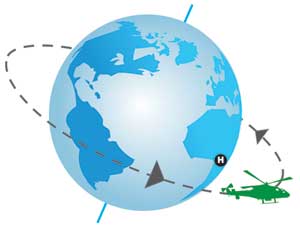
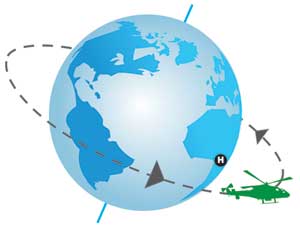
What does the arrow show on this picture of the Earth?
a)
how many times Earth rotates
b)
the direction in which Earth rotates
c)
how fast Earth moves around the sun
d)
how fast airplanes travel around the Earth
25.
Why does the sun appear to change throughout the day?
a)
Earth rotates.
b)
The moon blocks the sun.
c)
The Sun gets closer to Earth.
d)
Spaceships move in front of the sun.
26.
What is light?
a)
Is all around us, and we need it to see.
b)
Is a force that we need.
27.
All light has a SOURCE, or something it comes from. 
a)
True
b)
False
28.
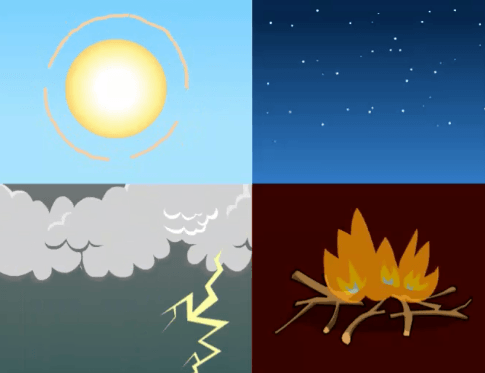
Which of these are examples of NATURAL sources of light?
a)
Sun 
b)
Stars
c)
Lightning
d)
ALL of them
29.
What happens when light hits an object?
a)
Some of the light jumps in different directions
(bounces)
b)
Some of the light gets absorbed by the object.
c)
Some of the light bounces back to your eye
d)
ALL of them.
30.
_______ is when light hits and object and it BOUNCES off.
a)
Reflection
b)
Refraction
31.
Which objects REFLECT more light?
a)
Shiny objects
b)
Dull objects (not shiny)
32.
Things make shadows because they ______ light.
a)
BLOCK
b)
PASS
33.

Smooth shiny objects will cause

a)

Rewind

b)

Reflection

c)

Refraction

d)

Reverse

34.

Light is a type of energy that can be sensed with the

a)

ears

b)

eyes

c)

nose

d)

none of these

35.

What makes it possible to see an object when looking through a periscope?

a)

It contains mirrors that reflect the object.

b)

It magnifies small objects so they can be seen.

c)

It absorbs the light rays passing through it.

d)

It separates the light into different colors.

36.

Which of the following is demonstrated when light bounces off of mirrors or shiny surfaces?

a)

Scattering

b)

Refraction

c)

Absorption

d)

Reflection

37.

What is the Order of the Electromagnetic System?

a)

Red,Yellow,Orange,Green,Blue,Indigo,Violet

b)

Red,Orange,Yellow,Green,Blue,Indigo,Violet

c)

Violet,Indigo,Green,Blue,Red,Orange,Yellow

d)

Violet,Blue,Red,Orange,yellow,green,Indigo

38.

Laws of reflection:

a)

The angle of incidence equals to the angle of reflection.

b)

All mirrors reflect the rays.

c)

The rays travel in straight line.

d)

The incident ray, normal, and reflected ray all lie in the same plane.

39.

The angle of reflection is located...

a)

between the incident ray and the normal

b)

between the incident ray and the reflected ray

c)

between the normal and the reflected ray

d)

between the mirror and the reflected ray

40.
The ray of light that strikes a reflecting surface is called ________.
a)
incident ray
b)
reflected ray
c)
normal ray
d)
none of the above
41.
The imaginary line perpendicular to a reflecting surface is called _____.
a)
crooked line
b)
parallel line
c)
angular line
d)
normal line
42.
The angle produced as a source of light bounces off a reflecting surface is called ______.
a)
angle of crookedness
b)
angle of reflection
c)
angle of incidence
d)
angle of bounce
43.
Why can you see most objects? 
a)
they emit light
b)
light refracts through them
c)
light reflects off them
d)
They absorb light
44.
If the angle of incidence is 45 degree, what is the angle between the incident ray and reflecting surface
a)
45
b)
90
c)
180
d)
none of the above
45.
What does incidence angle equal?
a)
reflection angle
b)
∠C
c)
∠D
d)
all of these
46.
straight lines that represent light waves
a)
rays
b)
image
c)
reflection
d)
visible light
47.
Which of these statements is true?
a)
Light travels in straight lines.
b)
Light is stopped when it meets a solid object.
c)
Light does not travel in straight lines.
d)
Light will only travel for about 2000km before it stops.
48.

Which travels faster?

a)

sound

b)

light

c)

water

49.

2. WHICH OF THE FOLLOWING IS A SOURCE OF LIGHT?

a)

the moon

b)

our eyes

c)

fire

d)

a mirror

50.

8. Which statement best explains why you can see yourself when you look at a mirror?

a)

Light is refracted as it passes through the mirror.

b)

Light is refracted, bouncing off the mirror.

c)

Light is reflected, bouncing off the mirror.

d)

Light is reflected as it passes through the mirror.

51.

The moon generates light.

a)

True

b)

False

52.

How does light affect the pupil?

a)

The pupil gets larger as light decreases.

b)

The pupil gets larger as light increases.

c)

The pupil’s color depends on the amount of light.

d)

The pupil isn’t affected by light.

53.

Where does light come from?

a)

The fish

b)

The clouds

c)

A coral reef

d)

The sun

54.

In this diagram, which is the angle of incidence?

a)

Angle A

b)

Angle B

c)

Angle C

d)

Angle D

55.

Objects that generate their own light are called:

a)

luminous objects.

b)

illuminated objects.

c)

shiny objects.

d)

reflective objects.