wayground logo

Free Printable Worksheets

Font size

S
M
L
XL
Worksheets

College Algebra Final Fall 2021

Total questions: 88

Worksheet time: 6hrs 20mins

Name
Class
Date
1.

Write the inequality in interval notation.

a)

[-4, -1)

b)

(-4, -1)

c)

(-4, -1]

d)

[-4, -1]

2.

Write the following in interval notation

-7 ≤ x < 8

a)

(-7, 8)

b)

[-7, 8)

c)

[-7, 8]

d)

(-7, 8]

3.

Write the following in interval notation

x < 8

a)

[8, ∞)

b)

(8, -∞)

c)

(-∞, 8]

d)

(-∞, 8)

4.

Look at the graph. Write the interval notation for the graph.

a)

(-2,5)

b)

(-∞,-2)⋃(5,∞)

c)

[-2,5]

d)

(-∞,-2]∪[5,∞)

5.

Can you use the symbols [ or ]

with infinity?

a)

Yes

b)

No

6.

What interval notation does the number line graph represent?

a)

[∞, -5)

b)

(∞, -5)

c)

[-5, ∞)

d)

(-5, ∞)

7.

When you graph an inequality, you use a closed dot when you use which symbols?

a)

≤, ≥

b)

<, >

c)

≤, <

d)

≥, >

8.

Would you use a closed or open circle to graph x < 3?

a)

Closed

b)

Open

9.

What inequality is graphed?

a)

2 < x < 4

b)

2 ≤ x ≤ 4

c)

x > 2 or x < 4

d)

x ≥ 2 or x ≤ 4

10.

Write the interval notation for the graph?

a)

[-3, 2)

b)

-3<x<2

c)

(-∞, -3] U (2, ∞)

d)

x > 2 or x < -3

11.

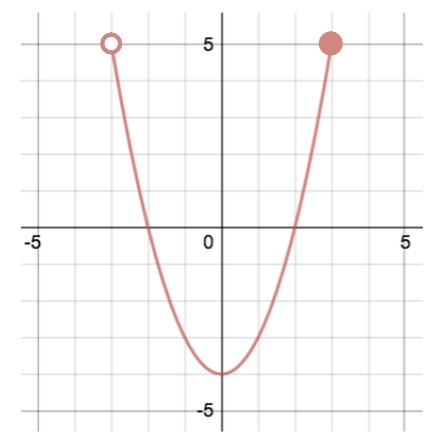
What is the domain of the graph?

Remember: Domain is x

a)

1≤ x ≤ 4

b)

1 < x < 4

c)

1≤ y ≤ 4

d)

1 < y < 4

12.
What is the domain of the graph?
a)
y≥1
b)
x ≥ 1
c)
All real numbers
d)
none of these
13.
What is the domain?
a)
-3 < y ≤ 3
b)
-4 ≤ y ≤ 5
c)
-4 ≤ x ≤ 5
d)
-3 < x ≤ 3
14.
What is the domain?
a)
x = 2
b)
−∞ < x < ∞
c)
y = 2
d)
none of these
15.
What is the range of the graph?
a)
y≥1
b)
x≥1
c)
All real numbers
d)
none of these
16.

What is the domain of the graph?

a)
b)
c)
d)
17.

What is the range of the graph?

a)

-4 < x ≤ 5

b)

-4 ≤ x < 5

c)

-3 < y < 3

d)

-3 ≤ y ≤ 3

18.

What is the domain of the graph?

a)

-6 ≤ x ≤ 6

b)

0 ≤ x ≤ 7

c)

2 ≤ x ≤ 7

d)

No Solution

19.
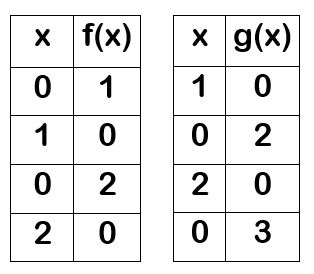
Is this relation a Function?
a)
Yes
b)
No
c)
I Don't Know
20.
What is the Range of this linear function?
a)
-6 ≤ y ≤ 6
b)
0 ≤ y ≤ 6
c)
No Solution
d)
4 ≤ y ≤ 3
21.

If  f(x)=2xf\left(x\right)=2x   and  g(x)=2x21g\left(x\right)=2x^2-1   find  f(g(3))f\left(g\left(3\right)\right)  

a)

34

b)

71

c)

35

d)

142

22.

If  f(x)=2xf\left(x\right)=2x   and  g(x)=2x21g\left(x\right)=2x^2-1   find  g(f(1))g\left(f\left(-1\right)\right)  

a)

2

b)

15

c)

7

d)

-9

23.

If  f(x)=2xf\left(x\right)=2x   and  g(x)=2x21g\left(x\right)=2x^2-1   find  f(g(x))f\left(g\left(x\right)\right)  

a)

 4x214x^2-1  

b)

 4x224x^2-2  

c)

 8x218x^2-1  

d)

 16x2116x^2-1  

24.

If  f(x)=2xf\left(x\right)=2x   and  g(x)=2x21g\left(x\right)=2x^2-1   find  g(f(x))g\left(f\left(x\right)\right)  

a)

 4x214x^2-1  

b)

 4x224x^2-2  

c)

 8x218x^2-1  

d)

 16x2116x^2-1  

25.

If  f(x)=1xf\left(x\right)=\frac{1}{x}   and  g(x)=3x+2g\left(x\right)=3x+2   find  (fg)(2)\left(f\circ g\right)\left(2\right)  

a)

 14\frac{1}{4}  

b)

 18\frac{1}{8}  

c)

 72\frac{7}{2}  

d)

8

26.

If  f(x)=1xf\left(x\right)=\frac{1}{x}   and  g(x)=3x+2g\left(x\right)=3x+2   find  (gg)(4)\left(g\circ g\right)\left(-4\right)  

a)

44

b)

-40

c)

-30

d)

-28

27.

If  f(x)=1xf\left(x\right)=\frac{1}{x}   and  g(x)=3x+2g\left(x\right)=3x+2   find  (gf)(x)\left(g\circ f\right)\left(x\right)  

a)

 13x+2\frac{1}{3x}+2 

b)

 3x+23x+2  

c)

 3x+2\frac{3}{x}+2  

d)

 13x+2\frac{1}{3x+2}  

28.

If  f(x)=1xf\left(x\right)=\frac{1}{x}   and  g(x)=3x+2g\left(x\right)=3x+2   find  f(g(x))f\left(g\left(x\right)\right)  

a)

 13x+2\frac{1}{3x}+2 

b)

 3x+23x+2  

c)

 3x+2\frac{3}{x}+2  

d)

 13x+2\frac{1}{3x+2}  

29.

If  f(x)=x2f\left(x\right)=x^2   and  g(x)=xg\left(x\right)=\sqrt{x}   find  f(f(x))f\left(f\left(x\right)\right)  

a)

 x4x^4  

b)

 2x22x^2  

c)

 2x42x^4  

d)

 x3x^3  

30.

If  f(x)=x2f\left(x\right)=x^2   and  g(x)=1x2g\left(x\right)=\frac{1}{x^2}   find  (fg)(1)\left(f\circ g\right)\left(-1\right)  

a)

 14\frac{1}{4}  

b)

 11 

c)

 1-1  

d)

 14-\frac{1}{4}  

31.

f(1) =

a)

-1

b)

1

c)

2

d)

-2

32.

f(g(3)) =

(a)  

33.

f(h(-4)) =

(a)  

34.

h(f(-2)) =

(a)  

35.

f(f(0)) =

(a)  

36.
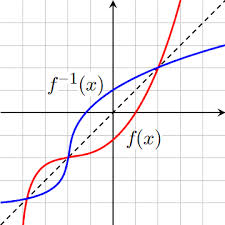
The inverse of the function f(x) is written as ...
a)
f -1(x)
b)
f 2(x)
c)
f '(x)
d)
f +(x)
37.
The inverse has been reflected over which line?
a)
y = x
b)
x = 0
c)
y = 0
d)
x = -y
38.

Which of the following is NOT TRUE about inverse functions?

a)

Inverse functions are reflections of each other over the line y = x.

b)

You find the inverse by switching x and y in the equation.

c)

The domain of a function always becomes the domain of its inverse.

d)

The domain of a function always becomes the range of its inverse.
39.
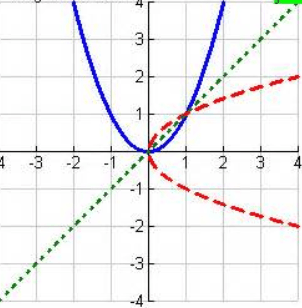
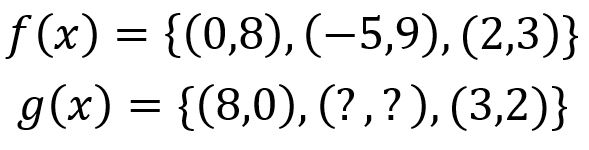
What are the missing values if g(x)=f-1(x)?
a)
(9,-5)
b)
(-9,-5)
c)
(5,9)
d)
(-9,5)
40.

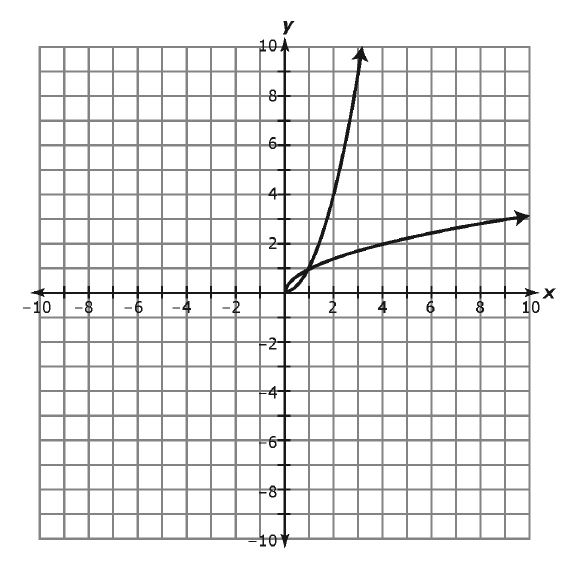
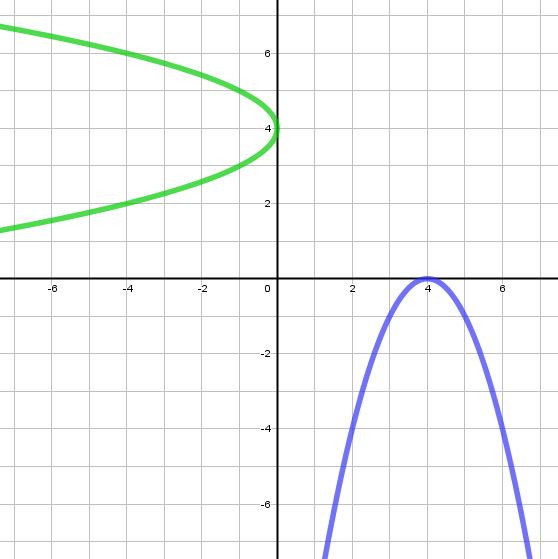
What is the best description?

a)

They are both functions, but not inverse functions.

b)

They are reflected over y=x, but they are not both functions.

c)

They are not reflected over y=x, and they are not both functions.
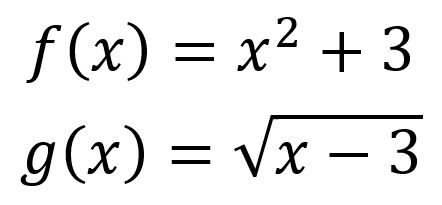
d)

They are inverse functions.

41.

What's the best description?

a)

They are both functions, but not inverse functions.

b)

They are reflected over y=x, but they are not both functions.

c)

They are not reflected over y=x, and they are not both functions.

d)

They are inverse functions.

42.

What's the best description?

a)

They are both functions, but not inverse functions.

b)

They are reflected over y=x, but they are not both functions.

c)

They are not reflected over y=x, and they are not both functions.

d)

They are inverse functions.

43.

What is the best description?

a)

They are both functions, but not inverse functions.

b)

They are inverse functions.

c)

They are reflected over y=x, but they are not both functions.

d)

They are not reflected over y=x, and they are not both functions.

44.

How must the domain of f(x) be restricted such that g(x)=f-1(x) ?

a)

x ≤ 0

b)

x ≥ 0

c)

x ≤ 3

d)

x ≥ 3

45.
Find the inverse of f(x) = -4x - 12
a)
f-1(x) = 4x - 3
b)
f-1(x) = -1/4x - 3
c)
f-1(x) = 1/4x + 3
d)
f-1(x) = -4x - 3
46.

Are the following inverses of each other? Use composition of functions. fog(x) and gof(x)

a)

True

b)

False

47.
Was the inverse function found correctly?
a)
no,
b)
yes
48.
Find the inverse of
f(x) = 1/4x - 7
a)
f-1(x) = 4x + 7
b)
f-1(x) = -4x + 28
c)
f-1(x) = -4x - 7
d)
f-1(x) = 4x + 28
49.
What does it mean to find the inverse of a function?
a)
the x's and y's are switched
b)
the x's and y's are divided by 2
c)
the x's and y's are made negative
d)
the x's and y's are the same
50.

If f(x)=x+5, what is f-1(x)?

a)

(x + 5)2

b)

x - 5

c)

(x + 5)-1

d)

undefined

51.

If f(x)=3x, what is f-1(x)?

a)

x/3

b)

3x2

c)

3x + 3x

d)

3x-1

52.

f(x) = 3x + 10

g(x) = ⅓x - 3

Find g(f(x))

a)

f(g(x)) = 1

b)

f(g(x)) = x

c)

f(g(x)) = 0

d)

None of these.

53.
a)

Inverse Functions

b)

Not Inverse Functions

54.
a)

Inverse Functions

b)

Not Inverse Functions

55.

The scatter plot shows the number coffee shops in different cities and the number of violent crimes. Which of the following is NOT true?

a)

A) As the number of coffee shops increase, violent crimes appears to increase.

b)

B) The line of best fit (regression line) shows a positive correlation

c)

C) The data has a positive correlation coefficient

d)

D) An increase in coffee shops causes an increase in violent crimes

56.
a)
Positive, strong
b)
Positive, weak
c)
Zero
d)
Negative, strong
57.
a)
Positive, strong
b)
Positive, weak
c)
Negative, strong
d)
Negative, weak
58.
Rank these scatter plots according to the intensity of the correlation represented, from weakest to strongest.
a)
1, 2, 3, 4
b)
2, 4, 3, 1
c)
4, 3, 2, 1
d)
1, 3, 4, 2
59.
a)
This residual graph represents a linear fit.
b)
This graph represents a nonlinear fit.
c)
This residual graph represents no fit.
60.
The linear regression equation is y = 61.93x - 1.79.  Use the equation to predict how far this person will travel after 10 hours of driving.
a)
10 miles
b)
617.5 miles
c)
0.19 miles
d)
500 miles
61.
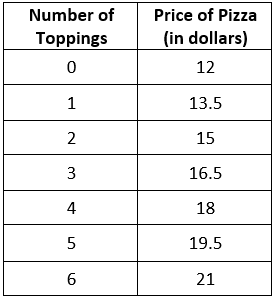
A restaurant sells pizza for the prices in the data table.  Calculate the linear regression equation of the data.
a)
y = 1.5x + 12
b)
y = 12x + 1.5
c)
y = 0.67x - 8
d)
y = -8x + 0.67
62.
A restaurant sells pizza for the prices in the data table.  Calculate the linear regression equation of the data.
a)
y = 1.5x + 12
b)
y = 12x + 1.5
c)
y = 0.67x - 8
d)
y = -8x + 0.67
63.

The annual profits for a company are given in the following table, where x represents the number of years since 1992, and y represents the profit in thousands of dollars. Write the linear regression equation that represents this set of data, rounding all coefficients to the nearest hundredth. Using this equation, estimate the year in which the profits would reach 378 thousand dollars.

a)

2029

b)

2014

c)

2003

d)

8753

64.

The number of newly reported crime cases in a county in New York State is shown in the accompanying table, where x represents the number of years since 1994, and y represents number of new cases. Write the linear regression equation that represents this set of data, rounding all coefficients to the nearest hundredth. Using this equation, find the projected number of new cases for 2003, rounded to the nearest whole number.

a)

974

b)

25,101

c)

940

d)

952

65.
For synthetic division, what would be the number in the left hand box?
a)
0
b)
1
c)
2
d)
3
66.
Let
f(x) = 4x^2 -33x -27.  
Is k = 9 a zero of the function?
a)
yes
b)
no
67.
(2x3 + 5x2 + 9)
÷
(x + 3)
a)
2x2 - x + 3
b)
2x3 - x2 + 3x
c)
2x2 + 11x + 33 + 108/x+3
d)
2x2 - 5x + 12
68.
(3x3 + 5x - 1)
 ÷
(x + 1)
a)
3x3 - 3x2 + 8x - 9
b)
3x2 - 3x + 8 - 9/x+1
c)
3x2 + 3x + 8 + 7/x+1
d)
3x3 + 3x2 + 8x + 7
69.
(2x3 - 5x - 7)
÷
(x - 2)
a)
2x3 - 4x2 + 3x - 13
b)
2x3 + 4x2 +3x - 1
c)
2x2 - 4x + 3 - 13/x-2
d)
2x2 + 4x + 3 - 1/x-2
70.
x3-3x2-10x+24
 ÷
 x+3
a)
x2-7x+5
b)
x-8
c)
x2-6x+8
d)
x+9
71.
-2x2+4x+48
 ÷
x+4
a)
-2x+12
b)
2x+12
c)
-4x+9
d)
4x+9
72.
x2-6x+8
÷
x-2
a)
x-6
b)
x-9 R=2
c)
x-4
d)
x-8 R=3
73.
(2x3 - 5x - 7)
 ÷
 (x - 2)
a)
2x3 - 4x2 + 3x - 13
b)
2x3 + 4x2 +3x - 1
c)
2x2 - 4x + 3 - 13/x-2
d)
2x2 + 4x + 3 - 1/x-2
74.

What is the remainder when a3 - 4 is divided by a+2?

a)

-2

b)

-6

c)

-12

d)

4

75.
(2x3 + 7x2 - 6x - 8) ÷ (x+ 4)
a)
2x2 - x - 2
b)
2x3 - x2 - 2x
c)
2x2 + 15x + 54 + 208/x+4
d)
2x3 + 15x2 + 54x + 208
76.

What does i2 equal?

a)

-1

b)

√-1

c)

1

d)

-√1

77.
(2i)(3i)
a)
5i
b)
-5
c)
6i
d)
-6
78.
(5-2i) + (-7+8i)
a)
-2+6i
b)
12+6i
c)
-35-16i2
d)
-35 -16i
79.
Simplify: 
(10+ 15i) - (48 - 30i)
a)
58 - 45i
b)
58 - 15i
c)
-38 - 15i
d)
-38 + 45i
80.
Find the product
(1+3i)(2-i)
a)
5+5i
b)
5-5i
c)
2-3i
d)
5+7i
81.
Find the sum.
(5-2i) + (-7+8i)
a)
-2+6i
b)
12+6i
c)
-35-16i2
d)
-35 -16i
82.

Refer to the above image, what is the conjugate of the denominator?

a)

-1 + 5i

b)

1 - 5i

c)

1 + 5i

d)

-1 - 5i

83.

Solve the above complex number in the form of a+bi

a)

4/5 + (7/5)i

b)

-4/5 - (7/5)i

c)

-4/5 - 7/5i

d)

4/5 - (7/5)i

84.

What is the simplified form of the above?

a)

7/10 + 11/10 i

b)

13/10 +1/10 i

c)

5/4 - 3/2i

d)

7/10 - 11/10 i

85.
Slopes of parallel lines are...
a)
opposite reciprocals.
b)
opposites.
c)
the same.
d)
always 7.
86.
Slopes of perpendicular lines are...
a)
opposite reciprocals.
b)
opposites.
c)
identical.
d)
always 7.
87.
Slopes of perpendicular lines are...
a)
opposite reciprocals.
b)
opposites.
c)
identical.
d)
always 7.
88.
What slope is parallel to:  
m = 3/4
a)
4/3
b)
3/4
c)
-3/4
d)
-4/3