
NEW
Font size
S
M
L
XL
 Worksheets
Ionic Bonding
Total questions: 17
Worksheet time: 17mins
Name
Class
Date
1.
Why do ionic bonds form?
a)
So the number of protons equals the number of electrons.
b)
To stabilize the atom with a full outer shell.
c)
So an atom can become unstable.
d)
So atoms will stick together to form molecules.
2.
What type of elements will form an ionic bond?
a)
Metals + Metals
b)
Nonmetals + Nonmetals
c)
Metals + Nonmetals
d)
None of the above
3.
To form a charge of +2 an atom must _ electrons. To form -3 it must _ electrons.
a)
Gain 2; Lose 3
b)
Gain 3; Lose 2
c)
Lose 2; Gain 3
d)
Lose 3; Gain 2
4.
Ionic bonds happen because of the ____ of valence electrons.
a)
sharing
b)
transfer
c)
keeping
d)
covering
5.
How many electrons are needed in the outer energy levels of an atom to be stable?
a)
2
b)
4
c)
6
d)
8
6.
An ionic bond is the attraction between:
a)
oppositely charged ions
b)
similarly charged ions
c)
neutral ions
d)
neutral atoms
7.
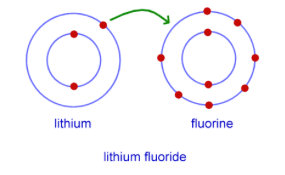
What type of bond is this?
a)
ionic
b)
covalent
8.
Magnesium bromide is an ionic compound with the chemical formula MgBr₂. What does the "2" tell you?
a)
There are 2 bromide ions for every magnesium ion
b)
Bromide has a 2- charge
c)
Bromide has a 2+ charge
d)
There are 2 magnesium ions to every bromide ion
9.
If my charge becomes 2+ what does that say about me?
a)
I am stealing 2 electrons
b)
I am losing 2 electrons
c)
I am in period 2
d)
I have an atomic # of 2
10.
If I gain electrons I become
a)
Positive because I've added to my atom
b)
negative because I've added electrons
c)
same because i'm balanced
d)
equal because now I have electrons
11.
A charged particle that has gained or lost electrons is called a _____.
a)
molecule
b)
ion
c)
isotope
d)
element
12.
Which subatomic particles are found in the nucleus of an atom?
a)
Protons and Electrons
b)
Protons and Neutrons
c)
Neutrons and Electrons
d)
Protons, Neutrons and Electrons
13.
What electrical charge does a proton have?
a)
+1
b)
0
c)
-1
d)
+2
14.

Complete the missing label on the diagram.
a)
Neutron
b)
Centre
c)
Nucleus
d)
Sub atomic particle
15.
Which particle is negatively charged?
a)
proton
b)
atom
c)
neutron
d)
electron
16.
Subatomic particles with a negative charge
a)
Electrons
b)
Neutrons
c)
Protons
d)
Quarks
17.
Subatomic particle with a charge of 0
a)
neutron
b)
proton
c)
electron
d)
quark
Reset

