wayground logo

Free Printable Worksheets

NEW

Font size

S
M
L
XL
Worksheets

Evidence of Evolution Quizzizz

Total questions: 17

Worksheet time: 35mins

Name
Class
Date
1.
How does embryology support the Theory of Evolution?
a)
It shows that they have a common ancestor because of their similarities.
b)
         I'm not sure.
c)
Animals change over time. 
2.
The most recent ancestral form or species from which two different species evolved is known as ________________________.
a)
a common ancestor.
b)
an embryonic stage.
c)
development.
d)
evolution.
3.
The similarities of the bones in the diagram provide evidence that---
a)
The organisms shown lived in the same natural envionrment
b)
The organisms shown may have developed from a common ancestor
c)
The organisms shown have the same genetic diseases
d)
All vertebrate species have identical forelimbs
4.
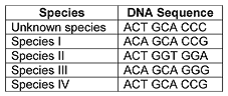
According to this data, the unknown bacterial species is most closely related to: 
a)
Species I
b)
Species II
c)
Species III
d)
Species IV
5.
The diagram shows fossils in different rock layers. Which of these statements about the age of these fossils is most likely correct?
a)
Fossil A and C are the same age
b)
Fossil B is older than fossil C
c)
Fossils A is older than fossil B
d)
Fossil D is older than fossil C
6.
Whales are aquatic mammals that contain a pelvis bone.  Even though it does not aid in its movement, the function must have been used by a common ancestor of the whale.  Thus, the pelvis is referred to as a(n)
a)
vestigial structure
b)
analogous structure
c)
homologous structure
7.
The forelimbs of vertebrates, like the ones pictured here, are similar in terms of number of bones and the orientation of bones. Which best describes how comparing homologous structures provides evidence of evolution?
a)
The genes for the body plan and forelimb layout were present in a common ancestral species vertebrates share, thus passed onto all vertebrates.
b)
Similar anatomical structures show how animals adapt to changing environments
c)
Homologous structures show that different species evolve at different rates
d)
Homologous structures don’t actually provide evidence for evolution
8.
Evolution is called a theory because
a)
we are not sure if it is true
b)
there's not enough evidence yet
c)
scientific theories are supported by a large amount of evidence
d)
none of these is true
9.

_____________________are similar structures which species have, but which perform different functions. They provide evidence of a common ancestor.

a)

DNA

b)

Vestigial structures

c)

Fossils

d)

Homologous structures

10.

Recently, scientists have been able to use ___________to find common proteins and amino acids to determine how closely related species are.

a)

DNA

b)

Vestigial structures

c)

Fossils

d)

Homologous structures

11.

_________________ show clear changes in an organism over time, the environment organisms lived in, the time period the organism lived in, and where the organism lived.

a)

DNA

b)

Vestigial structures

c)

Fossils

d)

Homologous structures

12.

Which IS NOT used as evidence for evolution?

a)

Fossils

b)

Natural Selection

c)

Early Development/Embryos

d)

Body Structure/Anatomy

e)

DNA/Proteins

13.

The fossil record help scientists

a)

better understand the kinds of organisms that lived in the past

b)

better understand how the environment has changed over time

c)

better understand how organisms have evolved over time

d)

all of the above

14.

What is is the study of how and why plants and animals live where they do?

a)

Evolution

b)

Adaptive Radiation

c)

Biogeography

d)

Biogeology

15.
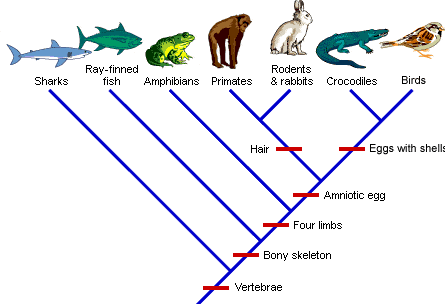
According to this cladogram, sharks are MOST closely related to which organism? 
a)
Amphibians
b)
Ray finned fish
c)
Crocodiles
d)
Birds
16.

Based on the image, which species is MOST related to penguin E?

a)

Penguin A

b)

Penguin C

c)

Penguin F

d)

Penguin B

17.

____________ are similar in function, different in structure, and were not inherited from a common ancestor.

a)

Homologous structures

b)

Analogous structures

c)

Vestigial structures